How Many Hours of ABA Per Week Does a Child Need?

Parents who ask how many hours of ABA per week their child needs are usually already worn out by the schedule and worried that they are not doing enough. There is no single number that fits every child. In research, the total number of hours is linked to results, but the right load is set by a specialist for one particular child, taking into account age, stamina and what the family can sustain, and it is checked by whether new skills keep appearing.
Applied behavior analysis, or ABA therapy (written АВА in Cyrillic), is built around a child's skills, so it makes sense to start the conversation about load with goals and let the hours follow.
What does research say about hours of therapy?
In 2017, Linstead and colleagues published an analysis in Translational Psychiatry of data from 1,468 children aged 18 months to 12 years. All of them received individualized ABA programs, at least 20 hours a month and for at least a month. Both the intensity of treatment and its duration were linked to how many learning objectives a child mastered, across all eight domains that were assessed. The link was strongest for academic skills and language.
That conclusion has limits worth keeping in mind. The study is observational, so it shows an association but cannot prove that the extra hours themselves produced the result. For that reason a figure from a study should not be carried over to your own situation as a norm.
What determines how many hours of ABA a week a child needs
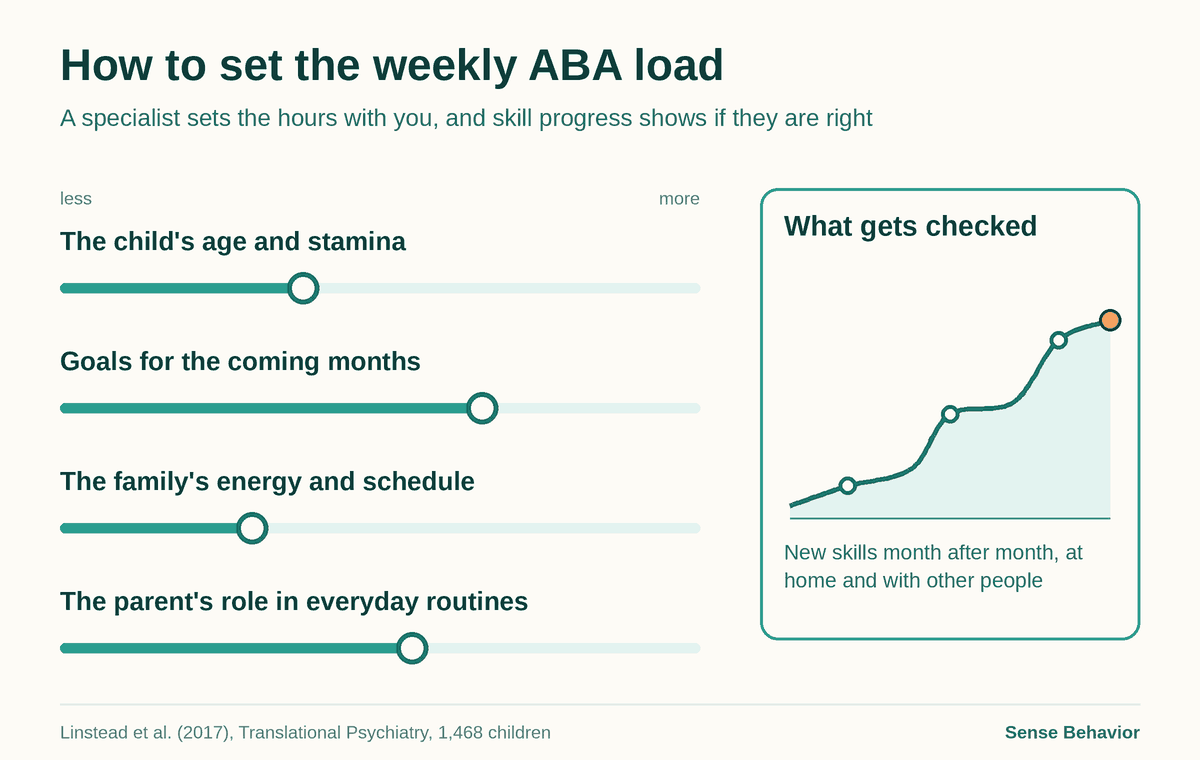
The answer comes from several circumstances, and a specialist usually discusses them with the family before naming any hours.
- The child's age and stamina. For a toddler, two short sessions with games and breaks can feel like a working day does to an adult, while a school-age child handles longer sessions comfortably.
- Goals. The wider the gap between what a child can do now and what they need for daycare, school or life at home, the more work each week carries.
- Family energy. A schedule that holds for three months gives more than a heroic one that falls apart by the end of the second.
- The parent's contribution. Part of the learning happens outside the hours with a specialist, in ordinary routines at home: at breakfast, on a walk, while getting dressed.
The starting point is a skills assessment. It shows which goals are realistic for the next few months, and we explained how that testing works in the article on VB-MAPP. If you have not had one yet, begin there. The parent's role in routines is clear in our review of the parent coaching study, where the specialist teaches the adult and not only the child. The number of hours directly affects the price, and how it adds up is covered in the piece on what ABA therapy costs.
How to tell whether the ABA hours are enough
The number of hours on its own tells you very little, and it is more reliable to look at a few signs. Is your child picking up new skills in at least a few goals? Do the skills work at home and with other people, not only in familiar surroundings? Can the family keep the schedule without feeling that the house has turned into a clinic?
If a child regularly falls apart after sessions and no new skills are visible, the load and the methods are reviewed together with the specialist. The load exists so that skills appear, and when they do not, it is the load itself that gets reviewed.
Sometimes a family simply cannot sustain a heavy schedule. In that case the specialist rebuilds the goals around the real timetable.
How to know how many hours of ABA therapy a child needs
Write down how many hours a week you manage, including what you do yourself in ordinary routines, and three skills that appeared over the last month. With that sheet it is easy to go to a specialist and ask two questions: which goals are set for the next month, and how will we know the load is enough. If you do not have a specialist yet, you can start with a free Sense Behavior consultation, where we will look at your schedule and suggest a load your family can carry.
Sources
- Linstead E., Dixon D.R., Hong E., Burns C.O., French R., Novack M.N., Granpeesheh D. (2017). An evaluation of the effects of intensity and duration on outcomes across treatment domains for children with autism spectrum disorder. Translational Psychiatry
- Linstead et al. (2017), запись в PubMed / PubMed record