Speech therapy is not helping my child: what to do next

If speech therapy is not helping my child, what then? Start by finding out what the sessions are missing: hearing, a suitable goal, enough practice, or the basic skills that speech rests on. When sessions go on for months and no new words appear, you are not doing anything wrong, and the therapist most likely is not either. Usually it is enough to sharpen the goal and add what is missing.
If you are reading this after another session where "nothing worked", it is clear how draining that is. Below is a checking order and one step for today.
Why speech therapy sessions sometimes bring no results
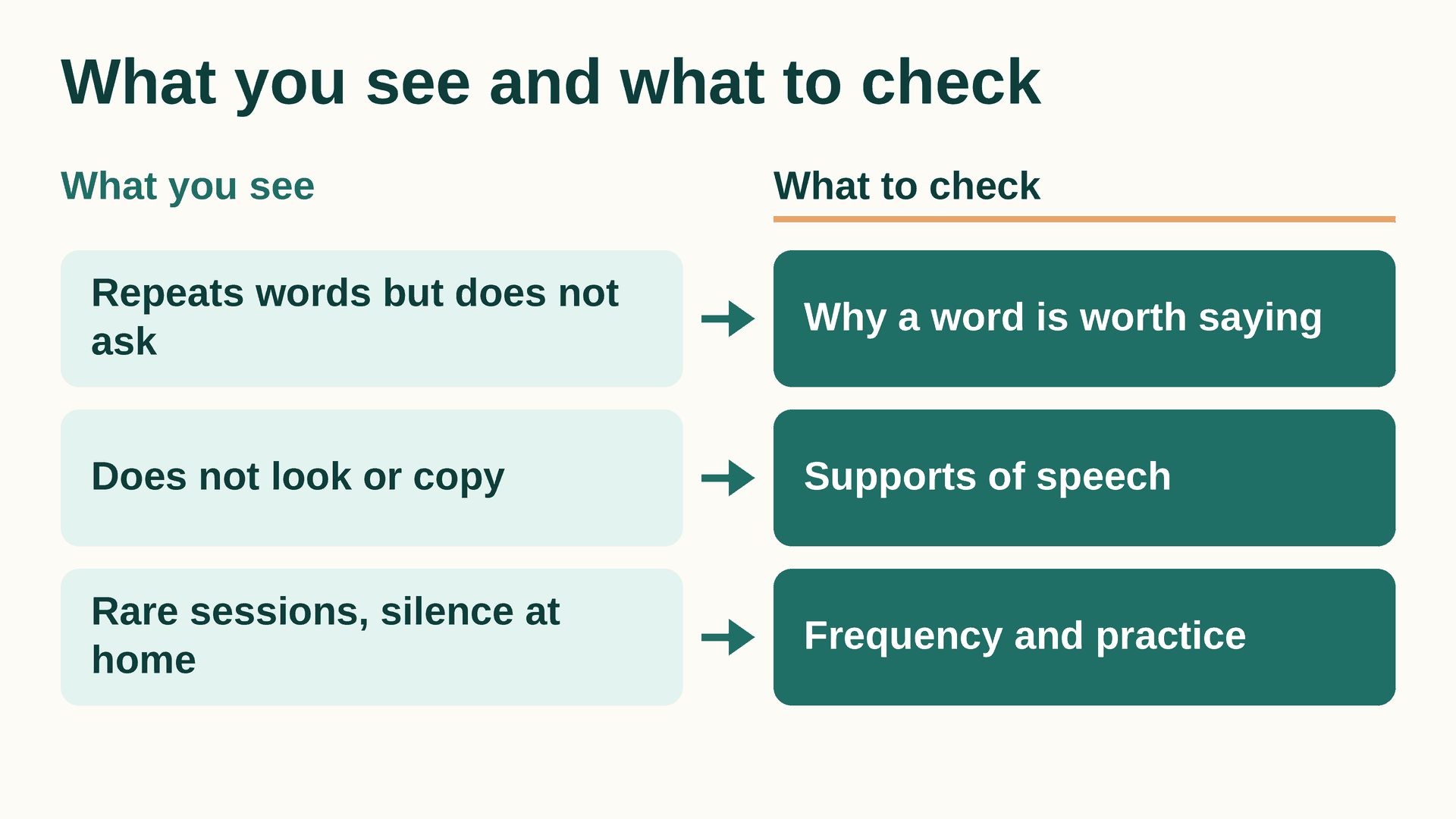
There are several reasons, and they often combine. Speech therapy has its own focus: sounds, vocabulary, grammar. It relies on the child looking at the adult, copying them and understanding why a word is worth saying. If those supports are not in place yet, sound exercises hit a wall.
The second reason is the amount of practice. One hour a week in an office gives a child very few repetitions compared with an ordinary day at home. The third lies outside the sessions: hearing and other medical causes may never have been checked, because families arrive with a question about speech.
What to check when sessions are not working: five questions
- Hearing. Has it been tested by an audiologist, not only judged by how your child reacts to your voice at home? That matters, a lot.
- The goal of the sessions. What is being trained right now: sounds, words, or the ability to ask and share wishes.
- Frequency and home practice. How often the sessions happen and whether there are tasks you can fit into an ordinary day.
- The supports of speech. Does your child look at you, copy movements and sounds, show what they want.
- Data. Does the therapist keep clear notes: what worked at the start and what works now.
These questions can be put to the therapist directly. An attentive specialist will gladly answer and suggest what to change in the plan.
What research says when a child speaks very little
A useful example is the study by Kasari and colleagues (2014). It included 61 children aged 5 to 8 who spoke very little or not at all. The children were randomly assigned to two groups, and both received a blended program that combined developmental and behavioral techniques. One group, however, also had a device from the start that says a word aloud when the child presses a picture. After six months, these children showed a clearer rise in spontaneous utterances and new words.
The authors conclude that even school-age children who barely speak can make quick gains in spontaneous speech with a well-chosen blended program. The sample is small and describes one particular group of children, so the result cannot be taken as a promise. It does show that a change of approach sometimes works where word exercises alone brought no shift for a long time.
Picture cards and gestures do not hold speech back, and you can read more in the article on alternative communication and PECS.
When speech therapy is not helping my child, what can I do today?
Take five minutes and film how your child tells you what they want in an ordinary moment, for example at a meal or beside a favorite toy. Note how they do it: with a look, a gesture, a sound or a word. Bring that video and the questions from the list to the next session.
You can also start a small home practice of requesting, as in the article on a nonspeaking child: a toy in sight but out of reach, and any signal counts as a request.
When to add a skills assessment and behavioral therapy to speech therapy
If a few weeks with a sharper goal and home practice bring no shift, what is needed is a fuller picture of skills, not another month of the same exercises. The VB-MAPP assessment shows which supports of speech are already there, which are missing and where to begin, with details in the article on VB-MAPP. A speech therapist and a behavioral specialist work on different things and complement each other well.
At Sense Behavior, the VB-MAPP skills assessment takes place remotely and does not require an official diagnosis. The work follows ABA (applied behavior analysis) and is led by a certified BCBA specialist. It does not replace a doctor or a speech therapist, and hearing and medical causes still deserve a check.