Speech Delay in a Child With Three Languages in Serbia: What Is Known

Speech delay in a child with three languages in Serbia most often raises one question. Are the languages to blame. Research gives no grounds for thinking so. In a systematic review of 50 studies published by Uljarević and colleagues in 2016, multilingualism did not harm language development in children with developmental disorders. Still, if a child hardly speaks, an assessment is needed regardless of how many languages are used at home. Below we look at what the data show, how to count words across all languages and where to go in Belgrade and Novi Sad.
Does multilingualism harm a child’s speech: what research shows
The short answer is that the data do not confirm that a second and third language cause speech delay by themselves. The quality of studies varies, though, and we show what we rely on.
- The systematic review Uljarević et al., 2016 covered 50 studies. Few works found multilingual children with developmental disorders doing worse. Comparisons with monolingual children with the same disorders found no adverse effects on language development. The authors caution that the number of studies is small and few are of high quality.
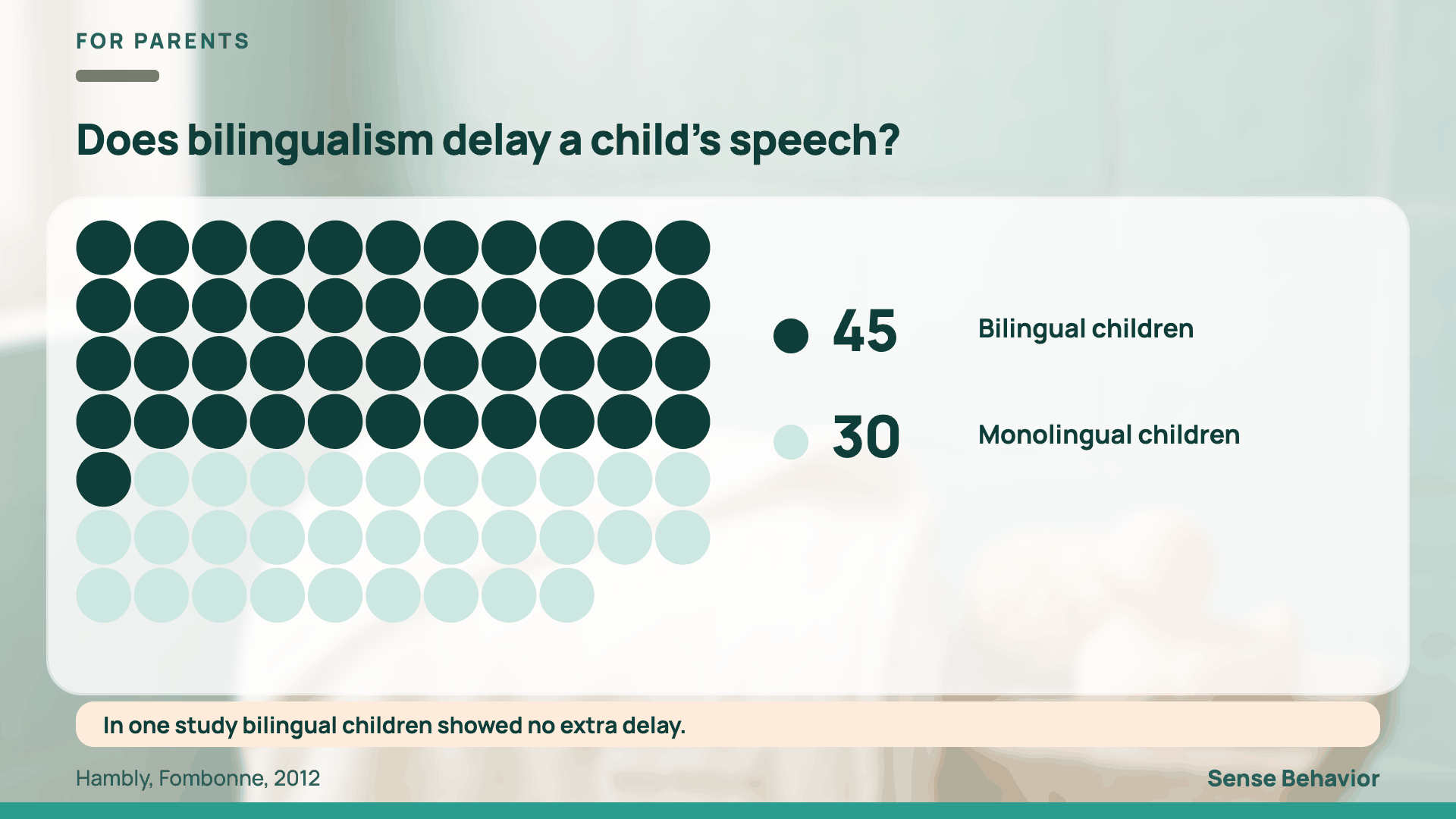
- In Hambly and Fombonne, 2012, children on the autism spectrum aged 56 months on average were compared. There were 45 bilingual and 30 monolingual children. No differences in language level were found between the groups, and the bilingual children had no additional delay.
- In Hoff et al., 2012, language development of bilingual and monolingual children from 1 year 10 months to 2 years 6 months was compared. In each single language the bilingual children lagged behind the monolingual ones, while on total vocabulary across both languages the results were comparable.
These three studies give a clear picture. In a child growing up with several languages, vocabulary is spread across them, so the words in each language taken separately can be fewer. That does not mean a speech delay.
Why a child’s speech may seem to lag behind
Parents abroad often compare the child with peers who speak just one language. In such a comparison a child with three languages can look behind in each of them.
- In the work of Hoff and colleagues, the amount of speech in a language depended on how much of that language the child hears. The less contact with a language, the fewer words in it.
- Total vocabulary across all languages was comparable with monolingual children in that study.
- So count words in all languages together, not only in Serbian or only in one language.
This approach will be useful at a specialist’s appointment. Make a simple list of words the child says or understands, and mark the language next to each word.
Three languages instead of two: what is known and what research does not show
Most of the studies we rely on looked at bilingual children. There is less data on three languages specifically, so conclusions for a trilingual family have to be carried over carefully.
- The 2016 review speaks about multilingualism in a broad sense, not only two languages.
- The work of Hoff and colleagues shows a general principle: the amount of speech in a language is linked to how much of that language the child hears.
- A practical point follows. With three languages each gets a smaller share of total time, and words in each of them taken separately may be fewer.
This is a reason to count total vocabulary, not a reason to cut languages. If you want to reduce the number of languages for the child’s sake, discuss it with a specialist instead of deciding alone.
Speech delay in a child with three languages in Serbia: when the cause is not the language
If speech is scarce in all languages and the child responds poorly when addressed, the cause is worth looking for in development itself rather than in the number of languages. A specialist makes the final decision, and we only name signs for which a visit should not be postponed.
- The child says almost no words in any language.
- The child does not respond to their name or look at people. We wrote about this in the article on what to do if a child does not respond to their name.
- Speech appeared and then disappeared. More in the article on what to do when a child stops talking.
- There are no gestures, pointing or eye contact.
- You feel something is wrong even if others advise waiting.
If the child is about three and silent, start with the article on what to do when a child is not talking at 3. For the youngest, see the article on signs of autism in a 1-year-old. This is not a diagnosis but a reference point for a conversation with a doctor.
At the same time, research does not show that multilingualism masks or causes autism spectrum disorders. The 2016 review and the Hambly and Fombonne study both speak to this. So “let us wait until the child masters one language” is no reason to postpone an assessment.
How a speech assessment works when a family has several languages
The assessment of a multilingual child must take all of the child’s languages into account. If a specialist looks only at Serbian or only at one language, the result may look worse than the reality. Ask the specialist to consider total vocabulary.
- Bring a list of words with the language marked. Include words the child understands.
- Say which languages the child hears and for how long during the day.
- Say from what age and in what setting each language appeared.
- Ask whether the specialist has experience with multilingual children and whether an interpreter is needed.
- Ask for a written report to show other specialists.
If there is no suitable specialist in your own language nearby, help can be built remotely. Read more in the article on remote ABA therapy.
What to do about languages at home if a child has a speech delay
Do not give up your native language just because of a delay. The 2016 review reports that there are few grounds to consider a multilingual environment harmful for people with developmental disorders, for speech and for social development alike. The decision about languages at home is best made together with a specialist.
- Keep the language in which it is easiest for you to talk to the child. A parent’s live speech is more useful than memorised phrases.
- Do not change the language of communication abruptly. If you plan to change it, discuss it with a specialist.
- For Serbian, think ahead about sources of contact: kindergarten, play with other children, sessions.
- Record progress in each language. It will help a specialist see overall progress.
In the Hambly and Fombonne study the subgroups differed in the age at which the second language began. Children who heard two languages from infancy scored higher on the Vineland interpersonal subdomain than those who began the second language later. There was no difference in language level between these subgroups. A rule for your family cannot be drawn from this, but it is one more reason not to fear multilingualism.
A plan for a month: what parents can do if speech is a worry
A plan helps move from worry to action. It does not replace a specialist consultation.
- Week 1. List the words with the language marked and write down which languages the child hears and for how long.
- Week 2. Book the chosen paediatrician and describe the languages in the family. Ask for a referral to a specialist.
- Week 3. Book a speech assessment and agree that all languages are taken into account. Take the word list.
- Week 4. Discuss the report, the session plan and the role of each language at home. Ask for a written plan.
What to tell kindergarten and school staff about the child’s languages
A kindergarten teacher or school teacher in Serbia sees the child in Serbian, where the child may say less than at home. So information from the family helps assess the child’s speech correctly.
- Name the languages the child hears at home.
- Say what the child understands and says in the native language.
- Ask to be told if the child stops responding or speaks noticeably less.
- Ask how the institution organises learning Serbian.
Languages in Serbia: what a family living here should know
In Serbia the Serbian language and the Cyrillic script are in official use. This is written in Article 10 of the Constitution. It matters to a family when the child starts kindergarten and school.
- Under the Law on the Foundations of the Education System, educational work is conducted in Serbian and the Cyrillic script. Languages of national minorities are provided for, and work in a foreign language is allowed by law.
- Foreign citizens are enrolled in institutions on the same terms as citizens of Serbia, apart from certain institutions.
- If a child does not know the language of instruction, the institution organises learning Serbian as a foreign language.
- The Serbian as a foreign language programme is free on condition of reciprocity or is paid by the parents.
We covered kindergarten and school in more detail in the article on kindergarten and school in Serbia in autism. If the child is already in kindergarten, tell the staff which languages the child hears.
Where to go in Belgrade and Novi Sad with a speech delay
The route begins with the chosen paediatrician. The doctor will refer you to specialists and, if needed, to developmental counselling at the health centre.
- The chosen paediatrician. How insurance and choosing a doctor work, we described in the article on a child’s health insurance in Serbia.
- A speech therapist. On choosing a speech therapist in your own language in Belgrade, read the article on a speech therapist in Belgrade.
- Assessment. Where to go if you suspect developmental differences is described in the article on autism in a child in Belgrade.
- Parent associations. They can suggest specialists and tell you about family rights, more in the article on parent communities for autism in Serbia.
In Novi Sad the order is the same. Start with the paediatrician for your place of registration and ask the local health centre how to reach a speech therapist and developmental counselling.
Questions for a speech therapist: what to ask at the first consultation
- Do you assess speech in all of the child’s languages or in only one?
- How do you count total vocabulary?
- Are further examinations needed, for example of hearing or of development overall?
- Which exercises can we do at home in our native language?
- How often are sessions needed and when will you review the plan?
- Do you have experience with multilingual children?
- Is an interpreter needed at the consultation?
Common mistakes of parents of multilingual children
- Waiting until the child masters one language and postponing assessment.
- Abruptly giving up the native language out of fear of delay.
- Comparing the child with peers in one language by one language.
- Not counting words in all languages.
- Believing chat advice that “all bilinguals stay silent until five”.
- Not telling the specialist which languages the child hears.
Sense Behavior in-person sessions in Belgrade and Novi Sad
At the time of writing (October–November 2026) our specialists run sessions in Belgrade and Novi Sad. About five families in Serbia are currently in in-person and hybrid support. That number refers only to the in-person and hybrid format and changes over time.
- Format. In-person sessions take place at the family’s home. There is also remote support and a hybrid format that combines in-person meetings with video work.
- Age. We mostly work with children from one year to 10 years old.
- Who leads. Sessions are led by Yulia Kozlova and other specialists of the centre.
- Language. Sessions are held in the family’s native language, and Serbian can be added if needed.
- Price. It is discussed at the consultation, and this article gives no figures.
- Booking. You can leave a request on our website. The activity is registered in Serbia, and the registration details are at the bottom of the site.
We do not promise results, and every programme starts with an assessment of the child’s skills, including in each language of the family.
Frequently asked questions about speech delay in a child with several languages
Is it true that multilingualism delays speech? The 2016 review and the Hoff study do not confirm this. In each language taken separately there may be fewer words, while total vocabulary is comparable.
Should we keep only one language? The studies reviewed give few grounds for that. Decide together with a specialist.
When should we see a specialist? Do not postpone the visit if there is almost no speech, the child does not respond or speech has disappeared.
Does multilingualism affect an autism assessment? Research does not show that it causes or hides autism. Ask for all languages to be assessed.
In which language should sessions with a speech therapist be? Preferably in the child’s native language, adding Serbian if needed. Ask the specialist.
How can we check that a specialist takes all languages into account? Ask how total vocabulary is counted and whether there is experience with multilingual children.
Neighboring topics for Serbia are covered separately, and these articles may help next.
- Our in-person home sessions and online support are described in ABA therapy in Belgrade and Novi Sad.
- A general overview of help in the country is in ABA therapy in Serbia.
If you need help assessing your child’s skills in your native language, write to us through the website.
Sources
- Uljarević M. et al. (2016). Practitioner Review: Multilingualism and neurodevelopmental disorders. J Child Psychol Psychiatry. doi:10.1111/jcpp.12596
- Hambly C., Fombonne E. (2012). The impact of bilingual environments on language development in children with ASD. J Autism Dev Disord. doi:10.1007/s10803-011-1365-z
- Hoff E. et al. (2012). Dual language exposure and early bilingual development. J Child Lang. doi:10.1017/S0305000910000759
- Ustav Republike Srbije, član 10 (jezik i pismo)
- Zakon o osnovama sistema obrazovanja i vaspitanja (Sl. glasnik RS 88/2017 ... 19/2025), čl. 5 i 23