Nonspeaking child: where to start

When you have a nonspeaking child, where to start is rarely obvious, and that is normal. Begin with communication that needs no words: help your child notice you, copy you, and tell you what they want in any way they can. Words usually grow out of that foundation, and you can start building it at home today without waiting for a specialist appointment.
Below are four building blocks to start with and what research says about gestures and picture cards. If the absence of speech worries you, that is understandable, and a great many families lie awake waiting for first words.
Why isn't my child speaking yet, and should I see a specialist first?
Silence can have several causes, from hearing differences and overall developmental pace to speech disorders and the autism spectrum. There is no way to tell them apart from a description. That is the job of a pediatrician and the relevant specialists, and an assessment usually begins with a hearing check. You can communicate with your child in the meantime, since no diagnosis is needed and the habit of noticing each other helps whatever the cause.
Nonspeaking child: where to start at home in the first week?
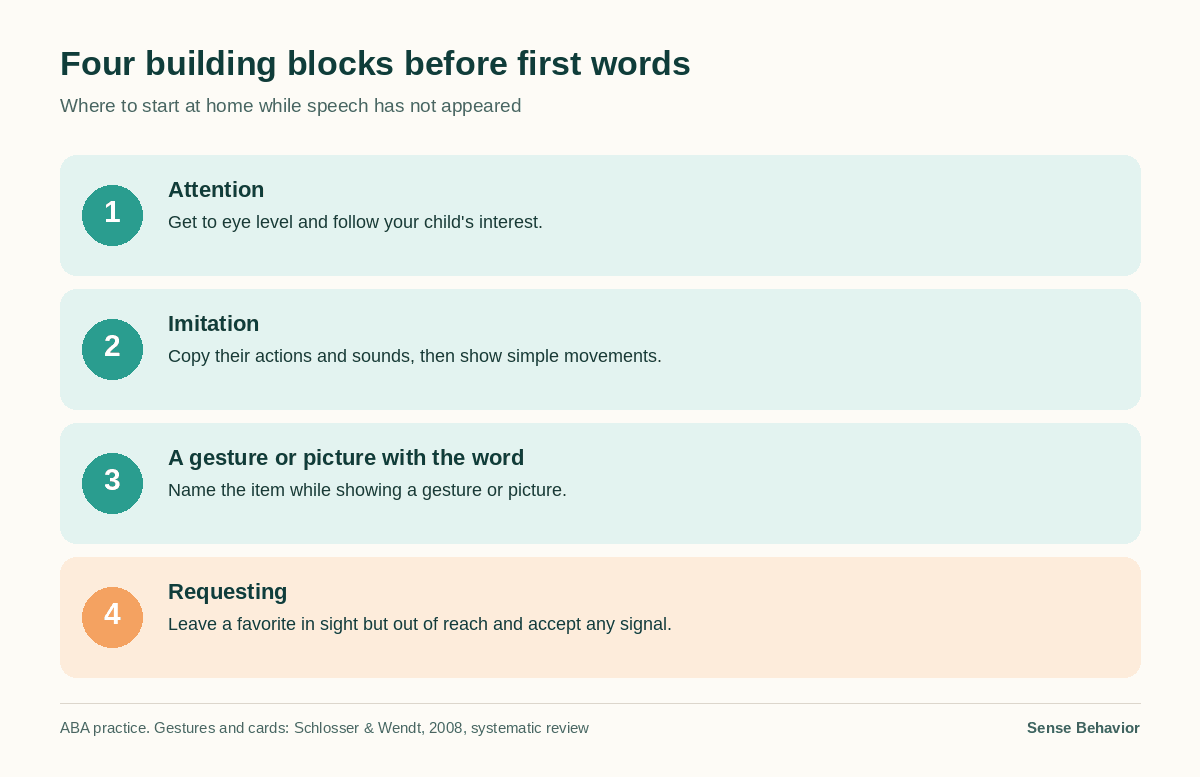
It helps to keep the four building blocks in mind as a sequence, although in practice they overlap. It sounds simple and it is, though in the first days it feels like nothing is happening.
- Attention. Get down to your child's eye level and follow their interest. If they roll a toy car, roll one beside them. That makes you an interesting partner.
- Imitation. Copy their actions and sounds, then show a simple action such as a clap or a wave and wait to see whether they repeat it.
- A gesture or picture with the word. Name the object and show a gesture or a picture at the same time. The word stays in place, and your child gains a second route to understand you and respond.
- Requesting. Leave a favorite toy or snack in sight but out of reach. Accept any signal: a look, a reaching hand, pointing, a card, a sound. Responding to the signal matters more than its form.
Will gestures and picture cards get in the way of words?
Many parents worry about this, and the question has been studied. A systematic review by Schlosser and Wendt (2008) brought together 11 studies of augmentative and alternative communication, meaning gestures, picture cards and electronic devices, in children on the autism spectrum. The authors concluded that such support does not hinder speech and may increase it. They also note that gains differ from child to child and, when they occur, are typically small. The included studies had different designs, some with a single participant, so the conclusions are cautious.
It follows that cards and gestures can be used without fear, but you should not expect them to start speech quickly. They give your child a way to share wishes now, while speech develops at its own pace.
How to teach a nonspeaking child to ask
Pick one favorite item and set aside five minutes. Place it where your child can see it but cannot reach it. Wait 5–10 seconds without prompting. Treat any signal, whether a look, a gesture, a sound or a move toward you, as a request: name the item in one word and give a very small amount. Repeat five times. Notice which way your child asks most often, and build from that.
When is a specialist needed?
If after a few weeks of this practice no signals appear, or you are unsure which approach suits your child, you need a program, because general advice only goes so far. If speech has not appeared by three and you are unsure whether to wait or act, the article on a child who is not talking at 3 covers that, and if speech was present and then disappeared, start with the one on a child who stopped talking. For step-by-step teaching of requests, see how to teach a child to ask.
At Sense Behavior, the VB-MAPP skills assessment takes place remotely and does not require an official diagnosis. The work follows ABA (applied behavior analysis) and is led by a certified BCBA specialist, and you receive a picture of current skills and a clear next step. It does not replace a doctor, and the cause of the silence still deserves a look from a pediatrician and the relevant specialists.