How to Choose an ABA Specialist: What to Ask First

How to choose an ABA specialist when you have never done it and are not sure what to ask? Start with five questions: who leads the program and how their qualification is confirmed, how the work begins, how often an experienced analyst watches the sessions, how you will see progress, and what role you are asked to play. Their answers in one short conversation tell you more than a polished website or big promises. We go through each question below, and the end has one step for today.
Feeling lost at this stage is completely understandable. There are many words around, ABA therapy sounds much the same everywhere, and you want to help your child as soon as possible. The good news is that quality work has recognizable signs, and you are entitled to ask about them.
How to choose an ABA specialist: five questions for a first conversation
All five questions sit in one table below. The question is on the left, the answer you hope to hear is in the middle, and what deserves a second thought is on the right. One row is highlighted, and we return to it shortly, because it is the one backed by research data.
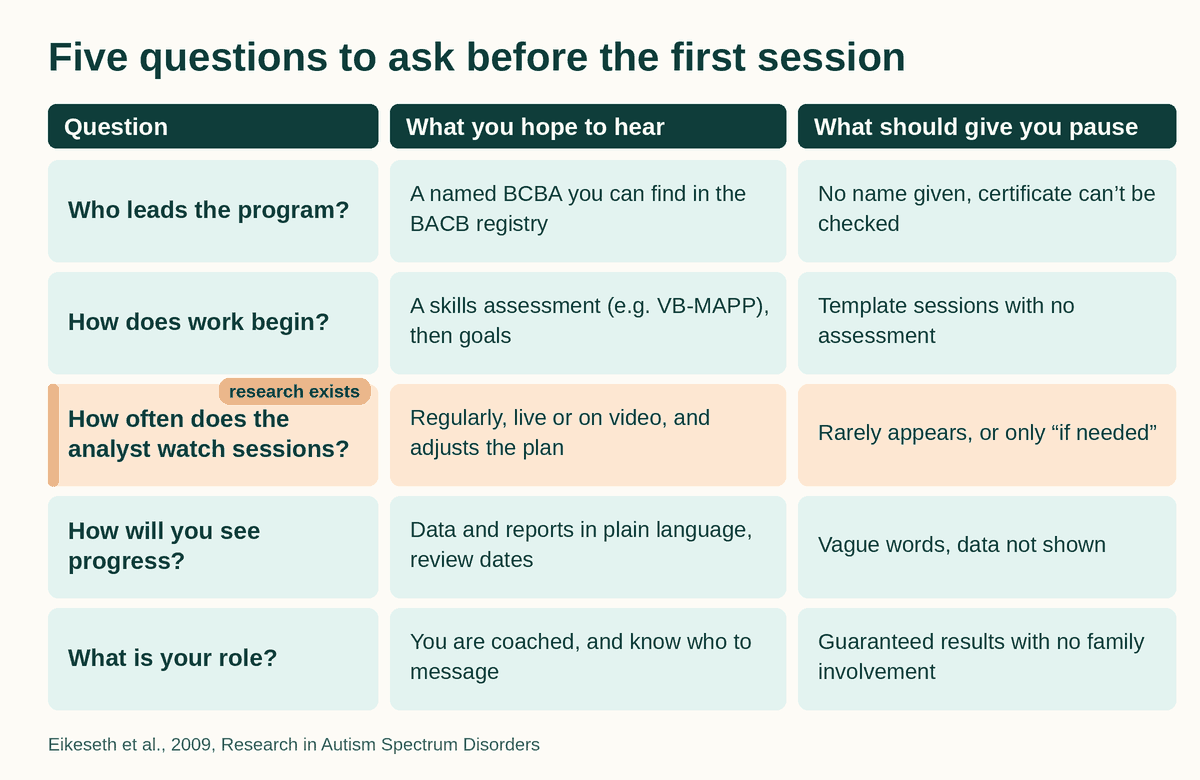
Who leads the program and how to check
The program should be led by a certified behavior analyst, most often a BCBA (Board Certified Behavior Analyst). The certificate is issued by an organization called the BACB, and the title and the organization have different abbreviations, so they are easy to mix up. This is an international certification, and anyone can look up its status in the open registry of the Behavior Analyst Certification Board (BACB). Ask for the name of the specialist who will be responsible for your child and look it up there.
Also ask who will work with your child. Often the sessions are run by an assistant or therapist while the BCBA directs the program. That is a common setup. You only need to be clear about who is responsible for what.
How the work begins
A reliable start looks like this: first an assessment of your child’s current skills, then goals, and only then sessions. The assessment is usually done with dedicated protocols such as VB-MAPP or ABLLS-R. If you are offered a start right away, with a ready-made template that is the same for every child, ask what the goals will be based on. We explained how assessment works in our article on VB-MAPP testing.
How often an experienced analyst sees the work
This is one of the most practical questions. Supervision means the analyst regularly watches sessions, live or on video, and changes the program based on what they saw. A small study by Eikeseth and colleagues (2009) included 20 preschool children who received early intensive behavioral intervention. The more hours of supervision per month a child had, the clearer the gains on intelligence tests.
These data have limits. The sample is small, the link is correlational, and it does not prove that supervision itself is the cause. Still, the finding fits common sense: a program needs someone who adjusts it regularly. Ask directly how often the analyst watches your child’s sessions and how you will learn what they concluded.
How you will know there is progress
A conscientious specialist keeps data. They record how often a child performs a skill and can show it to you in plain language. Ask how often you will get a report and what triggers a revision of the plan when nothing is changing. This question exists for transparency, and a good specialist will gladly answer it.
Your role as a parent and what the price includes
In ABA, the parent takes part in the process. The specialist teaches you to reinforce skills in everyday life, and results depend on it noticeably. Find out how much time a week is expected from you, how session reviews work, and where to write between sessions.
Check what the price covers too: assessment, supervision, answers between sessions. We wrote about why prices differ several times over in how much ABA therapy costs. If sessions will run over video, also read our look at how effective online ABA is.
What deserves a second thought before you start
- Guaranteed results and promises of a cure. Children respond to therapy differently, and a specialist who knows that does not say so.
- Sessions that begin with no skills assessment and no written plan.
- The analyst responsible for the program is not named, and reports and data are not shared.
- Pressure with deadlines like “decide today or the spot is gone”.
How to check an ABA specialist before you choose
Copy the five questions above into your phone notes and arrange a short intro call with one or two specialists. If a BCBA certificate is claimed, look the name up in the registry. And one more thing. Do not decide on the day of the first call, compare the answers calmly in the evening.
This text gives general guidance and does not replace a consultation. The result of therapy depends on the child, and nobody can guarantee it.