Child Not Responding to Name: What to Check and What to Do

A child not responding to name is not automatically a sign of autism. Doctors usually check hearing first, then look at how the child notices people and answers social contact, and only after that discuss other causes. One missed call means very little. A visit makes sense when the lack of response is steady, on different days and in a quiet room.
Most parents know the moment: you call, your toddler keeps rolling a toy car, and your stomach drops. It is tempting to search for the scariest explanation right away. Here is a steadier order of things, covering what may be behind it, how to look at home, and who to see.
Child not responding to name: is it hearing, attention or something else?
There are several possible reasons, and the most common one is the quickest to check. In a 2019 ASHA Leader review, speech-language pathologists working in early intervention note that a missing response to name can point to trouble understanding speech, and it can also be an early sign of autism. That is why they name a hearing check with an audiologist as the first step. Even when hearing is fine, a toddler may answer one time and not the next, because carrying a skill from one situation to another is hard at this age.
Other explanations exist. A child may be so absorbed in play that attention does not switch. Speech may be developing more slowly. Strong sensitivity to sound can also make a toddler seem to tune out the voices around them. Nobody can name the cause from a description or a video, and that call belongs to a specialist after an examination.
At what age should a baby respond to their name?
In CDC materials, not responding to name by 9 months is listed among signs worth attention. Treat it as a landmark. In a prospective study by Miller and colleagues (2017), researchers tested response to name six times between 6 and 24 months in 156 infants, some of whom had older siblings with autism. Those later diagnosed with autism more often failed to turn at 9 months, and about half of them failed repeatedly between 12 and 24 months.
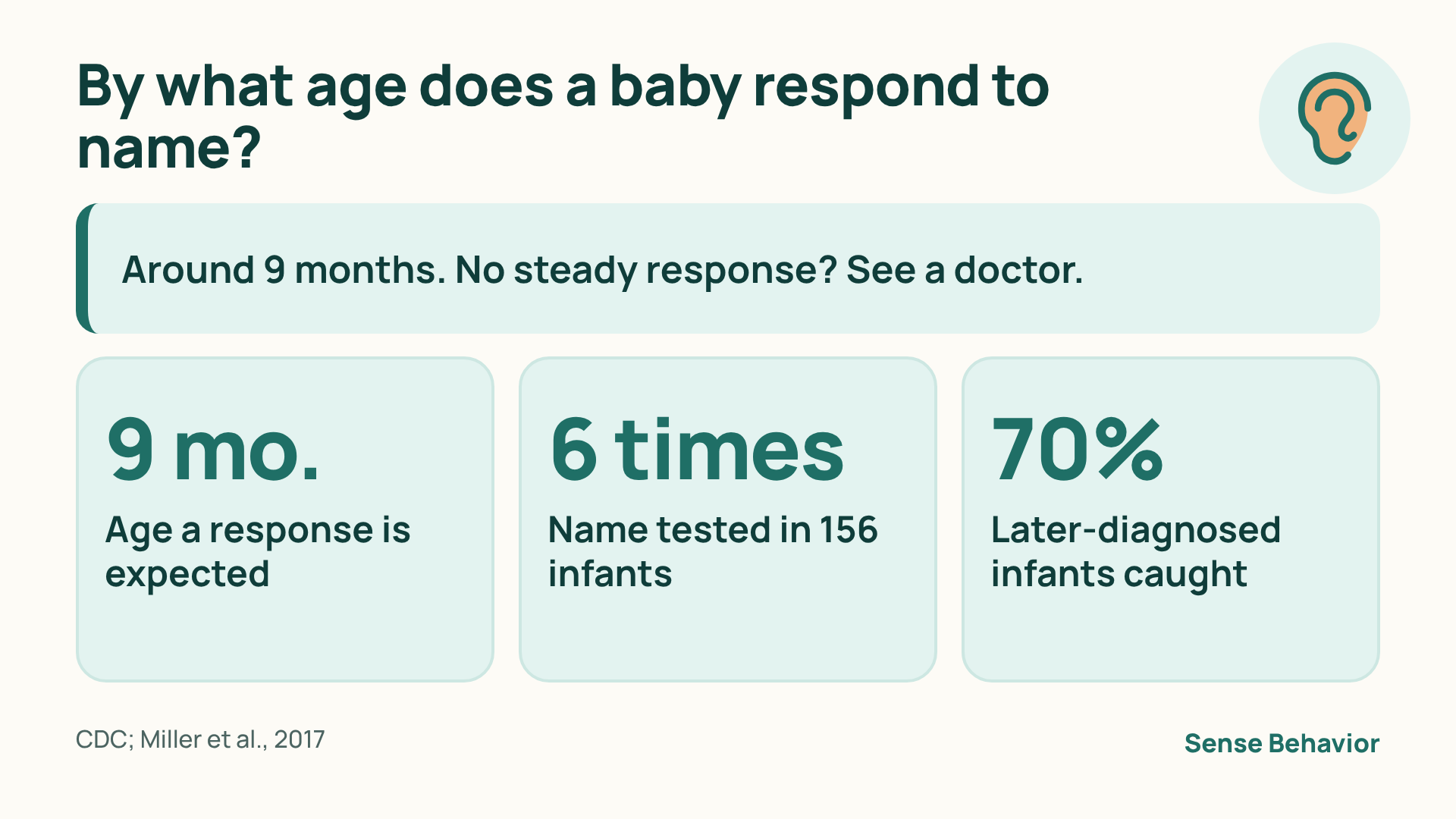
There is a limit to keep in mind. The sensitivity and specificity of this check in the study were both around 70% (counting at least one failure between 12 and 24 months). Put simply, it caught about seven in ten children who were later diagnosed and also flagged roughly one in three of the rest. That is why doctors never rely on one sign and also look at eye contact, gestures, play and speech.
How can I check at home whether my child responds to their name?
Pick a quiet room with the TV off. Stand a couple of steps away, slightly to the side, and call your child by name once in an ordinary voice. Wait a few seconds and note whether they turned, paused, looked at you or smiled. Repeat on different days and at different times, since response shifts with mood and tiredness. Three tries over a week are enough, yes, it sounds boring, but it works.
Once, clap your hands or press a toy that makes a sound instead of saying the name. If your child reacts to neither the name nor the sound, that is a useful clue for the doctor, because then hearing comes first. Write down the date, where you called from, what your child was doing and what happened. Three or four notes explain more at the appointment than the phrase “sometimes he answers.”
Who should I see if my toddler does not react to their name?
Start with a pediatrician or family doctor and ask for a referral for a hearing check with an audiologist or an ENT doctor. If hearing is normal and the response still does not appear, show the doctor your notes and ask about a developmental assessment, including speech and communication. We walked through the order of steps and how to prepare for the visit in the article on where to go if you suspect autism.
If your child is under 4 and you live in Ukraine, also look into the early intervention service, which does not require a diagnosis. The article on early intervention for autism explains how it works. For the signs doctors notice around the first birthday, and what is not yet a reason to worry, see this article.
What can I do at home while waiting for the appointment?
Make the name a pleasant signal. Get down to eye level, say your child’s name and right away do something joyful: toss a ball, smile, hand over a favorite toy. Wait three seconds and do not demand an answer. Avoid using the name for scolding, or it starts to sound like a warning. These games treat nothing and do not replace an examination, they just warm up communication and help you see what works.
If you would like to talk through your family’s situation, Sense Behavior specialists work online with parents in different countries. You can write to us through the link at the bottom of the page.