Myths about autism treatment: what a major scientific review of alternative methods shows
Myths about autism treatment spread especially fast precisely because a child's diagnosis creates an enormous, entirely understandable desire in parents to find a way to help. The problem is that this desire gets used to sell methods that sound promising but don't hold up to close scrutiny. The good news is that a landmark review came out at the end of 2025, pulling together the results of hundreds of studies and finally giving a clear answer to which alternative methods are actually backed by evidence.
What the research shows
An international team led by researchers from Paris Nanterre University, Paris Cité University and the University of Southampton analyzed 248 meta-analyses covering 19 different alternative autism treatments, including probiotics, acupuncture, music therapy, animal-assisted therapy, and vitamin D supplementation (Gosling et al., 2025). The authors' overall conclusion is unambiguous: no high-quality evidence was found supporting the efficacy of any of these methods for core or associated features of autism.
The issue isn't that all 248 meta-analyses are bad on their own, it's that the underlying evidence base they draw on is often too weak to support confident conclusions. The authors assessed the methodological quality of the research using the standard AMSTAR-2 scale and found that only 17% of comparisons within these meta-analyses were backed by high-quality studies. Another 63% were low quality, and 20% were critically low quality.
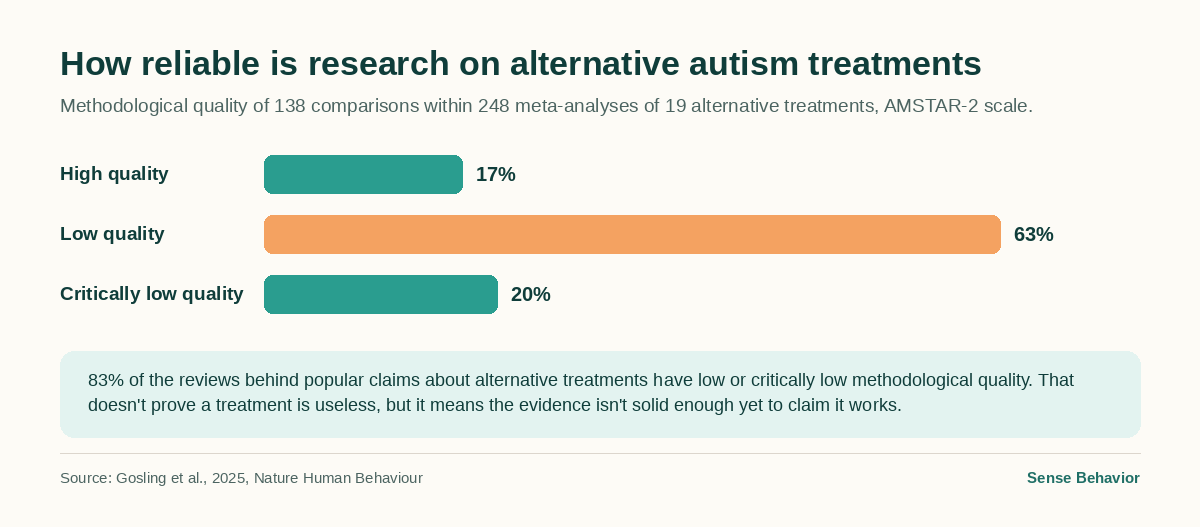
This doesn't mean every one of the 19 methods is necessarily useless. Some showed promising results on specific measures, but those results rest on very weak evidence rather than reliable, repeatedly confirmed data. The authors also flagged another concerning point: safety was rarely evaluated for most alternative methods at all, meaning parents often simply don't have data about possible harm.
Why this is especially easy to overlook
Up to 90% of autistic people have tried some alternative method at least once, and that's understandable: wanting to help a child by any available means is a natural instinct for any parent. The problem isn't the desire to try something, it's that marketing for these methods often relies on emotionally compelling stories from individual families rather than studies with a control group, and the difference between the two is fundamental.
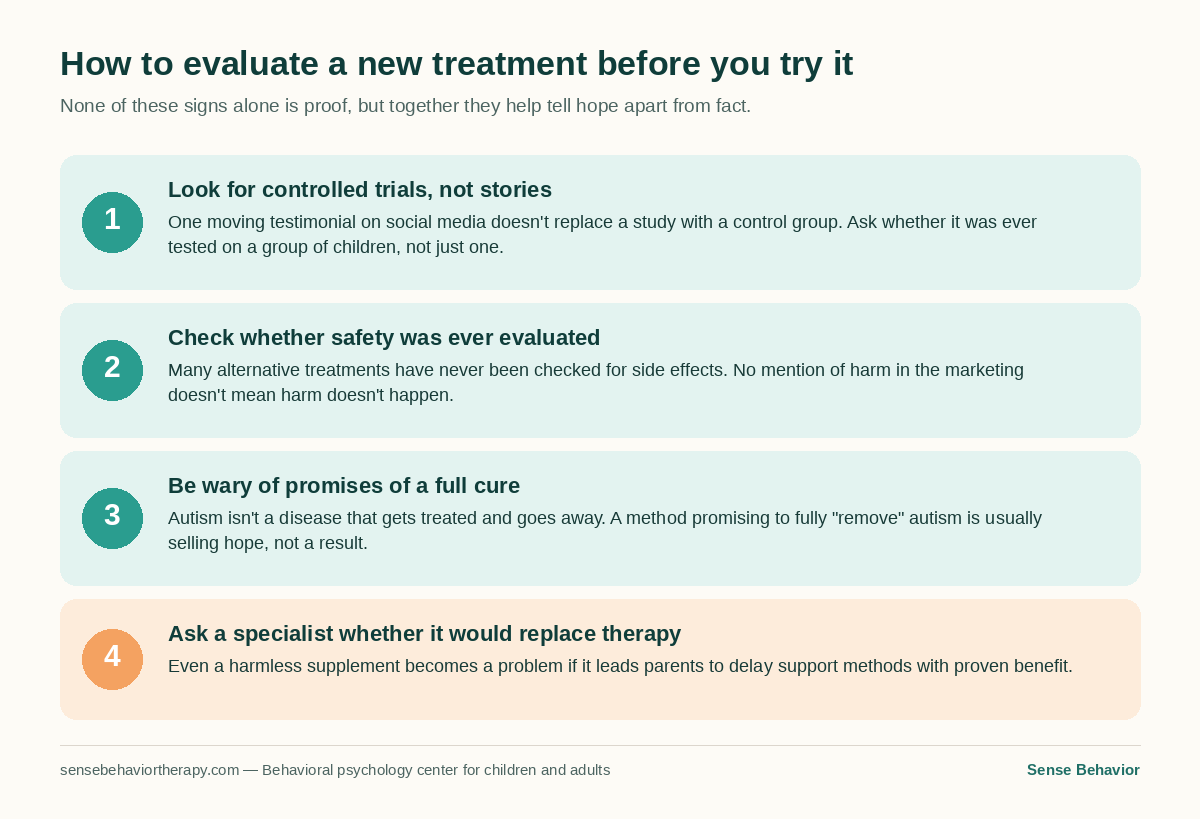
How to evaluate a new treatment before you try it
- Look for controlled trials, not stories. One moving testimonial on social media doesn't replace a study with a control group. Ask whether it was ever tested on a group of children, not just one.
- Check whether safety was ever evaluated. Many alternative treatments have never been checked for side effects. No mention of harm in the marketing doesn't mean harm doesn't happen.
- Be wary of promises of a full cure. Autism isn't a disease that gets treated and goes away. A method promising to fully "remove" autism is usually selling hope, not a result.
- Ask a specialist whether it would replace therapy. Even a harmless supplement becomes a problem if it leads parents to delay support methods with proven benefit.
How this factors into Sense Behavior's programs
Unlike most alternative methods in this review, applied behavior analysis has been tested in dozens of controlled studies over decades, which is exactly why we build programs on it rather than on individual promises. If you're just deciding where to start supporting your child, you can start with a broader look at that question: how to accept your child's diagnosis.
You can start with a free thirty-minute consultation, where we'll talk honestly about which of the methods offered to you are backed by evidence and which aren't.