Online Therapy for Children With Autism: How It Works

Online therapy for children with autism is set up so that a parent works with the child and a specialist joins by video to guide the parent as it happens. The child is not sitting in front of a monitor. They play at home with familiar toys while the adult beside them learns new techniques. This format is called parent coaching, and below you can see how it runs, who it suits and where its limits lie.
If you have moved and your former specialist stayed in another country, or nobody nearby speaks your language, doubts about video sessions are understandable. Booking a room is one thing and trusting a screen is another. So the structure comes first, and how help looks in your own country is at the end of the article.
How online therapy for children with autism works
The specialist and the parent meet by video, the parent does the tasks with the child at home, and the specialist watches, advises and later reviews recordings. Sessions happen in the child's usual surroundings, so a skill forms where it is needed.
At Sense Behavior the work follows four stages.
- Consultation. A free conversation about the family's situation and goals.
- Assessment. A check of current skills with the VB-MAPP or the ABLLS-R.
- Program. An individual plan with specific goals.
- Support. Weekly video sessions, review of recordings and a monthly report.
How online sessions differ from in-person ones
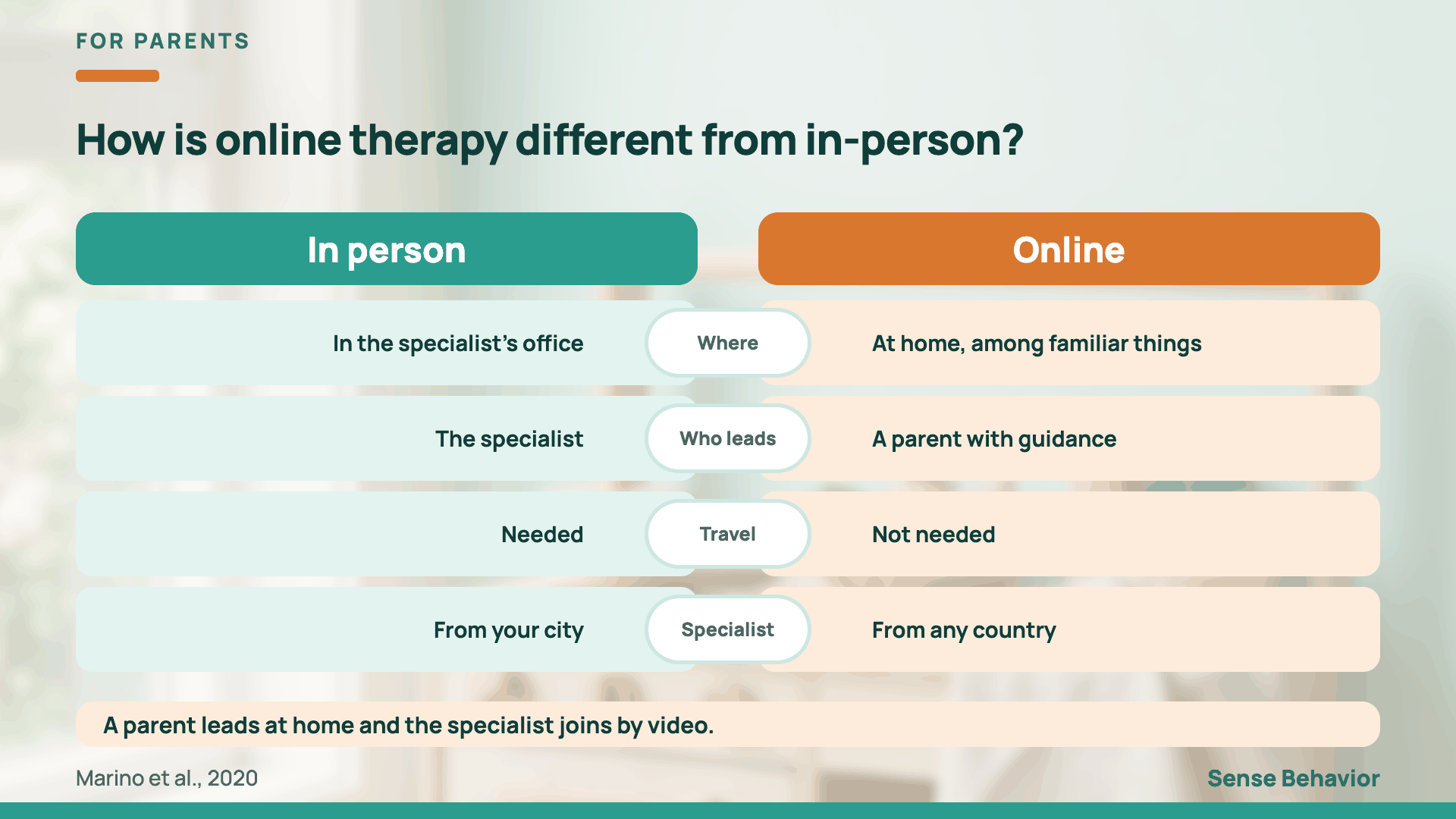
The main difference is who is next to the child. Instead of a specialist in an office, a parent leads the session at home and the specialist joins by video.
- Where. At home, among the child's familiar things.
- Who leads. A parent, guided by the specialist.
- Travel. None, and times are set to fit your time zone.
- Specialist. From any country, in your language.
Who online therapy suits and where its limits are
The format suits families where a parent can take part in sessions every week and there is no specialist nearby in the right language, or the waiting list is long. It does not replace in-person care where physical contact or a doctor's supervision is needed.
It is especially convenient in these situations.
- There is nobody nearby who speaks your language.
- The waiting list for in-person sessions is long, or the family moves often.
- A parent is ready to take part and film short videos.
In-person support is needed as well if any of this is true.
- Physical contact is required, for example shaping sounds with the hands.
- There is a condition that needs a doctor's supervision in person.
- A parent cannot take part in sessions at all.
For more on how well this format works, see the article on online ABA therapy.
What the research says
In a randomized trial by Marino and colleagues (Marino et al., 2020, Brain Sciences), 42 parents of children aged 30 months to 10 years took part. They were randomly assigned to 12 sessions of an applied behavior analysis (ABA) program, with or without tele-assistance. In the tele-assisted group parents reported a better understanding and handling of their child's behavior and lower stress.
This is a small study. It shows the potential of the format and gives no guarantee of results for every family. A newer study of a remote program for parents is covered in the article on parent coaching in ABA therapy.
What you need to begin
You need a device with a camera, a stable internet connection and a parent's time every week. An official diagnosis is not required to start.
- A phone, tablet or computer with a camera.
- A quiet corner and the child's familiar toys.
- Time for the session and a few minutes to record short videos.
- A personal chat with a specialist, with a reply within 24 hours.
What you can do yourself between sessions is described in the article on ABA therapy at home with a parent.
Where to start today
One evening is enough.
- Write down three situations from today where you needed help.
- Film one or two short videos of an ordinary evening.
- Make a list of questions for the specialist, including ones about the limits of the format.
If you would like to see whether this format fits your family, the first consultation at Sense Behavior is free and takes about 30 minutes. You can write to us using the link at the bottom of the page.
How help works in your country
Access to help depends a lot on the country, so each has its own article.