Waking up with anxiety: causes and what helps

Waking up with anxiety is how many people describe a morning that begins with a tight chest before the first task. Most often a few understandable things stand behind it: the normal morning rise in cortisol, short or broken sleep, caffeine, accumulated stress and the expectation of the day. Below we look at what happens in the body, what helps in the first 15 minutes and what to change in the evening.
If you are reading this in the morning with a heavy feeling inside, go straight to the section on the first 15 minutes. The rest can wait until it eases.
Why waking up with anxiety happens in the morning
Morning anxiety arises where sleep, the hormonal rhythm and thoughts about the coming day meet. The brain is only switching on while the to-do list is already in place, and the sense of threat arrives before you can check it.
How it feels differs from person to person. Among the signs of an anxiety disorder the NHS names stomach problems, a noticeable heartbeat, lightheadedness and trouble sleeping. In the morning it often looks like this.
- A lump in the chest or throat right after waking.
- A quickened heartbeat without physical effort.
- Nausea or an unpleasant tightness in the stomach.
- Thoughts about tasks and problems going round in circles.
- A clenched jaw and tight shoulders.
Usually several factors contribute at once.
- Sleep. When there is too little or it is broken, anxiety rises. In the study by Ben Simon and colleagues (Nature Human Behaviour, 2020), even modest reductions in sleep predicted higher anxiety the next day.
- Caffeine, alcohol, nicotine. The NHS names them among the common causes of insomnia. In the review by Klevebrant and Frick (2022), a panic attack followed caffeine in 53.9% of patients with panic disorder and in 1.7% of healthy participants.
- Load and the expectation of the day. Thoughts about tasks switch on at the moment of waking and fill the head at once.
- Physical causes. Among the causes of insomnia the NHS lists, for example, an overactive thyroid, so long-lasting morning states are worth discussing with a doctor.
One anxious day is no reason to worry. The NHS offers a rule of thumb: an anxiety disorder is more likely when you feel anxious most of the time and it affects everyday life. A single morning after a hard week usually does not fit that description.
Anticipatory anxiety deserves a separate mention. When the previous day was hard or an important meeting lies ahead, the brain prepares for a threat in advance, and the morning is the moment this preparation switches on at full strength.
General causes of anxiety without an obvious trigger are covered in the piece on anxiety for no reason. Here the focus is different: the morning and the night.
The morning cortisol rise: what it is and how it relates to anxiety
Cortisol is a hormone that helps the body switch on. After waking, its level normally rises quickly. According to the review by Clow, Hucklebridge and Thorn (2010), this rise peaks about 30–45 minutes after waking, is triggered by waking itself and is considered a normal part of the daily rhythm.
The morning combines several things at once: the normal hormone rise, a body that has not fully rested yet and the first meeting with thoughts about tasks. That is why these minutes feel the heaviest, even if the state eases later in the day.
The clarification matters. The review does not claim that the rise causes anxiety. It describes a normal process that coincides in time with that very morning state, and knowing about it helps you avoid mistaking it for a sign of illness.
The link with psychological factors is more complicated. In the meta-analysis by Chida and Steptoe (2009), which gathered 147 studies, the cortisol rise after waking was higher with work stress and general life stress and lower with fatigue, burnout and exhaustion. The morning reflects the state in which you entered the day, and one hormone cannot tell you the state.
What can you do with this knowledge? Save a phrase for the morning in your phone notes: “This is the time when sensations peak, and they fade from here.” It is not a treatment, but it restores a sense of frame and helps you avoid mistaking a normal rhythm for a catastrophe.
Waking up with anxiety at night: early awakenings
Waking in the night or far too early is familiar to many. The NHS lists waking early and being unable to fall back asleep among the symptoms of insomnia. Insomnia shorter than three months is called short-term, and from three months it is long-term.
The more tension has built up during the day, the easier it is to wake in the middle of the night. Do not count how many hours are left before the alarm: such sums add fuel to the fire and push sleep further away.
Lying there and replaying thoughts is not helpful. Many specialists advise getting up if sleep does not return within about twenty minutes doing something quiet under soft light and going back to bed when you feel sleepy.
- Do not check the time or pick up your phone.
- Write the thought in a notebook by the bed so you can return to it in the morning.
- Take a few slow breaths out, longer than the breath in.
- Sip some water.
If night awakenings repeat, write down a few facts for the doctor.
- What time you wake and how many times a night.
- Whether you fall asleep again and how soon.
- What you feel in those minutes: fear, heaviness, thoughts about tasks.
- What happened the evening before: coffee, alcohol, late work.
If you wake with a strong heartbeat and fear, read the piece on panic attacks and what to do in that moment. It has both a 10-minute plan and the signs that call for an ambulance.
What helps in the first 15 minutes after waking
The task of the first minutes is simple: give the body a clear order that is the same every day. Predictability lowers the sense of surprise, and in behavioural programmes routine is considered the foundation. At Sense Behavior we rely on the same principle: small repeatable steps that can be checked against notes. There are no promises of results here, but you can see what works for you in particular.
- Minutes 1–3. Do not grab your phone. Lie still and take a few slow breaths with a long exhale.
- Minutes 3–6. Open the curtain or switch on a light, so the body finds it easier to orient to the time of day.
- Minutes 6–9. Drink a glass of water.
- Minutes 9–12. Move: stretch your shoulders and neck, walk around the flat.
- Minutes 12–15. Name the main task of the day in one line. The rest can wait.
What is better avoided in the first minutes:
- Reading the news and work email right away.
- Scrolling a feed until the anxiety passes.
- Ordering yourself to stop worrying.
- Checking your pulse and how you feel every minute.
If some steps do not work out, keep one, the easiest. Regularity is what counts: one step every day beats five steps once a month. To see what works, write a few lines each morning.
- When you woke up.
- Your anxiety rated from 0 to 10.
- What you did in the first 15 minutes.
- How much coffee and tea you drank the day before.
If coffee intensifies the anxiety, try moving it to after breakfast and note how you feel. More everyday methods are gathered in the piece on how to cope with anxiety.
These steps take fifteen minutes and require nothing but attention. In the first days it may seem that they change nothing. Judge the result by a week of notes, because one morning shows nothing.
What to change in the evening
The morning is largely prepared the night before. Sleep and caffeine close a loop in which a short night gives an anxious morning, and an anxious morning pushes you toward coffee and late sleep.
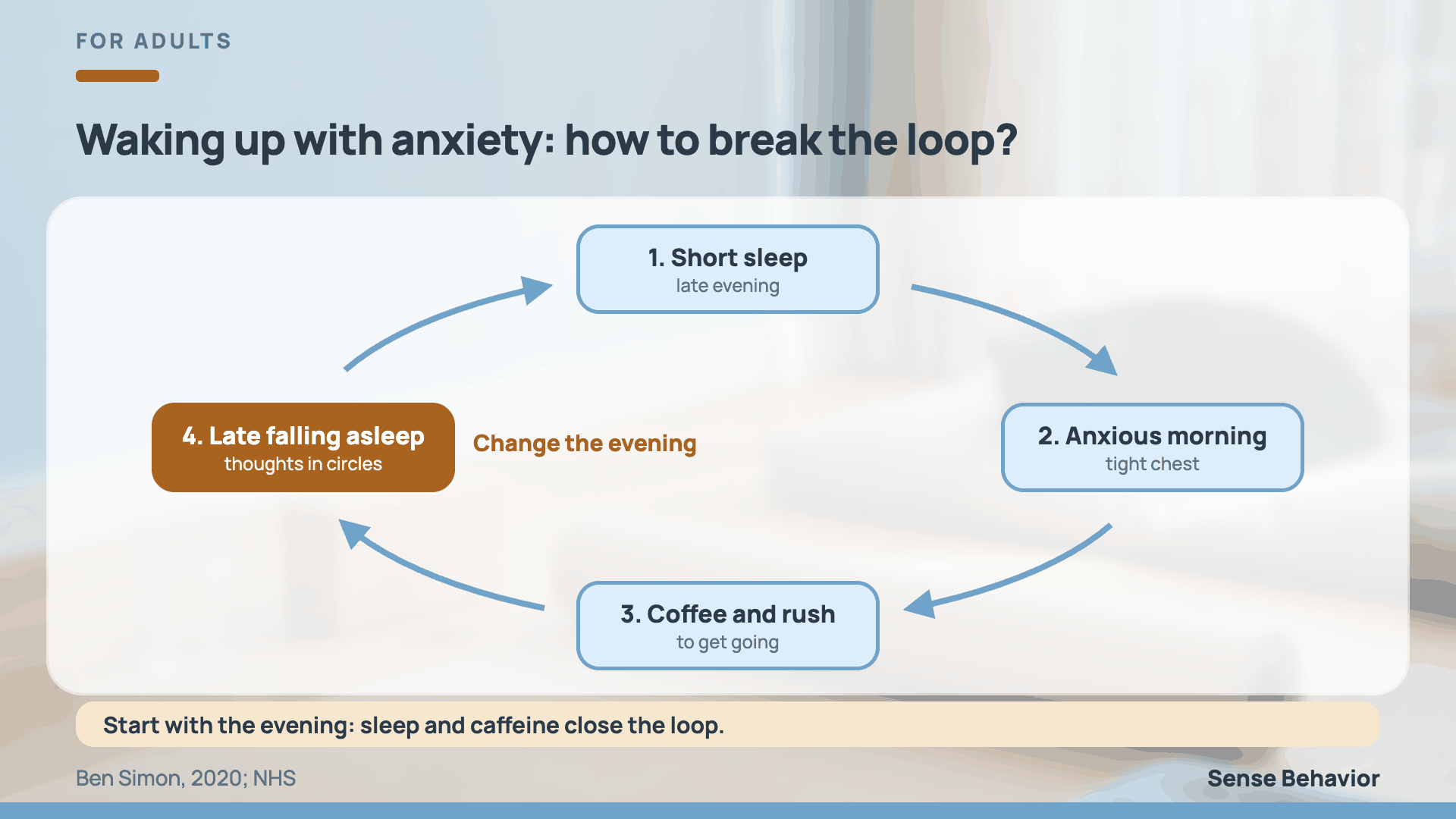
The loop is easiest to break in the evening.
- Go to bed and get up at the same time. Adults, according to the NHS, need 7–9 hours of sleep.
- Move the last cup of coffee, tea or energy drink to the first half of the day.
- Do not use alcohol as a sleep aid: the NHS names it among the causes of insomnia.
- An hour before bed put screens away and write down tomorrow’s tasks.
- Keep notes: when you fell asleep, when you woke and how you felt in the morning.
Do not wait for the perfect evening. If today you only managed to move your coffee, that is already a step. Change one item a week and compare your notes.
It helps to add a short ten-minute evening block. Write down what remains unfinished and the first action for tomorrow. That makes it easier for the mind to let the day go, and in the morning you do not have to hold everything in memory.
After a week compare the notes. They will show whether the morning tightness is linked to late sleep, coffee or workload. If keeping a routine is hard because of absent-mindedness and putting things off, read about ADHD and anxiety, which explains how they affect each other.
When it is a reason to see a doctor
Book a doctor if the morning anxiety lasts more than a few weeks and interferes with work, relationships or sleep. In the following cases do not put the visit off.
- Insomnia has lasted three months or longer, which is the long-term form in the NHS description.
- For several weeks in a row you have lost interest in what used to bring joy.
- The morning anxiety comes with chest pain, severe breathlessness or numbness.
- Thoughts of death or of harming yourself have appeared.
Tell the doctor about sleep, coffee, alcohol and your morning routine, and show your notes. Concrete facts help to understand more precisely what is going on and to choose the next step.
You can start with a general practitioner or family doctor. They will rule out physical causes and then refer you to a psychotherapist, a psychiatrist or a doctor who works with sleep. If the morning anxiety is mostly tied to work, that is a legitimate topic for the conversation too: according to Chida and Steptoe (2009), work stress is linked to a change in the morning cortisol rise.
In a meta-analysis of 21 studies (Baglioni and colleagues, 2011), people without depression but with insomnia had about twice the risk of developing depression, with an odds ratio of 2.10. This fact does not amount to a diagnosis, and nobody determines depression from a description. It is simply a reason not to put off the conversation about sleep.
Morning anxiety rarely calls for urgent action, but a lasting one deserves attention. The sooner you tell a doctor about your sleep and how you feel, the easier it is to choose steps. The visit itself decides nothing for you, it just brings more information.
If thoughts of death or self-harm appear, seek urgent help at your local emergency number or a crisis line. The international directory lists lines by country. We describe the wider picture of anxiety in adults in the piece on anxiety in adults.
If you want to talk through your situation, write to us using the link at the bottom of the page.
Sources
- Clow A., Hucklebridge F., Thorn L. (2010). The cortisol awakening response in context. International Review of Neurobiology, 93, 153–175.
- Chida Y., Steptoe A. (2009). Cortisol awakening response and psychosocial factors: a systematic review and meta-analysis. Biological Psychology, 80(3), 265–278.
- Ben Simon E., Rossi A., Harvey A. G., Walker M. P. (2020). Overanxious and underslept. Nature Human Behaviour, 4, 100–110.
- Klevebrant L., Frick A. (2022). Effects of caffeine on anxiety and panic attacks in patients with panic disorder: a systematic review and meta-analysis. General Hospital Psychiatry, 74, 22–31.
- Baglioni C. et al. (2011). Insomnia as a predictor of depression: a meta-analytic evaluation of longitudinal epidemiological studies. Journal of Affective Disorders, 135(1–3), 10–19.
- NHS. Insomnia: symptoms, causes and how much sleep adults need.
- Find A Helpline: международный каталог кризисных и экстренных линий по странам.
This material is for informational purposes only and does not replace a consultation with a specialist.