Phone call anxiety: why it happens and what helps

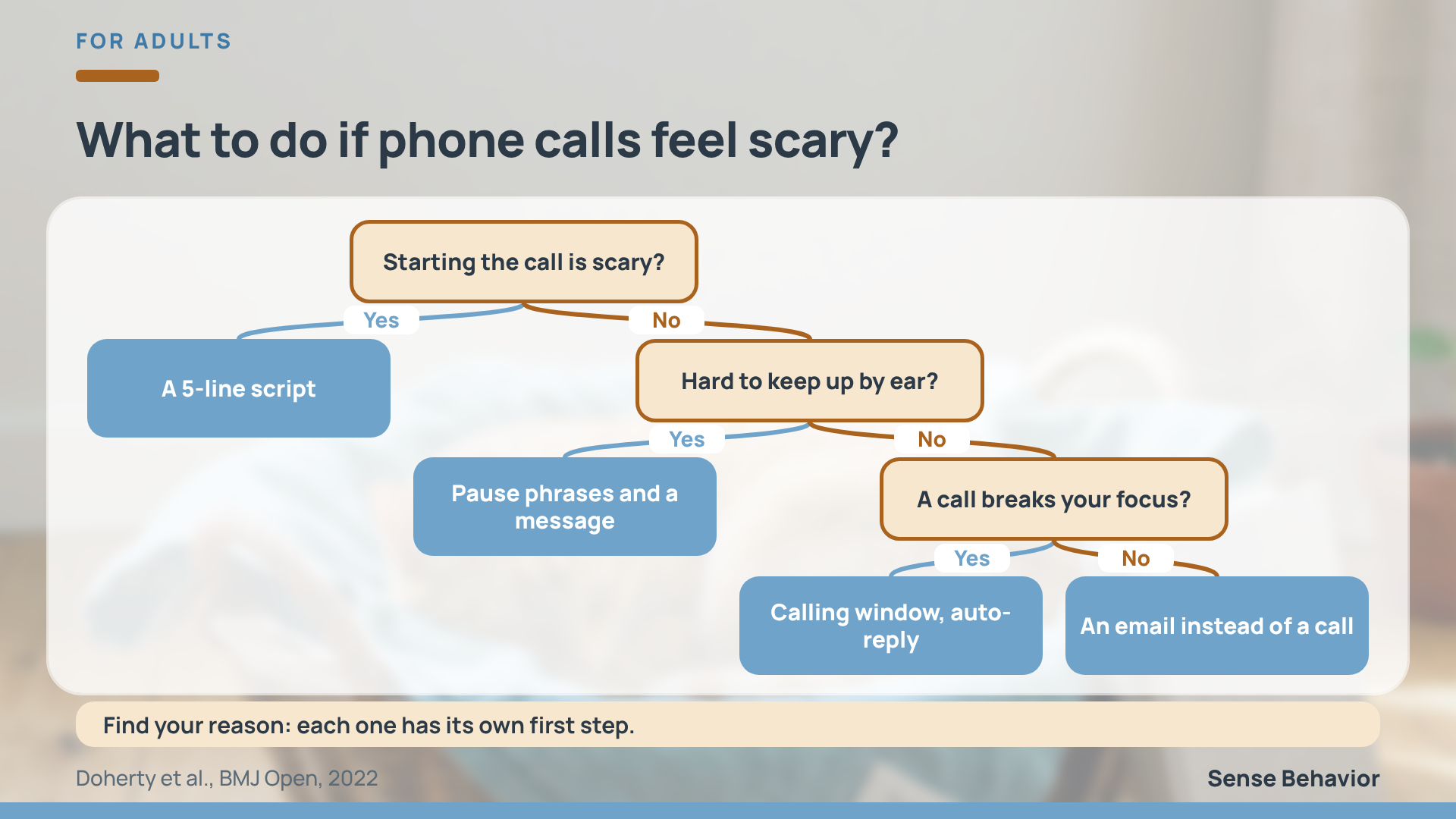
When people describe phone call anxiety, it usually comes from one of three places: starting the conversation feels frightening, keeping up with speech by ear is hard, or the call barges in without warning. Each reason has its own first step. Below you will find a short decision guide, ready phrases for the call and an email that can replace it.
A familiar situation: the doctor's appointment has been postponed for a third day, the phone lies face down, and your head has already replayed every awkward version of the conversation. Laziness and weakness have little to do with it. For many people a call is harder than text, and the difficulty can be broken into clear parts.
Phone call anxiety: what it is made of
A call combines several hard things at once. You must speak first, understand someone without a face or gestures, answer quickly and still remember why you called. If even one of these links is hard, the whole call feels impossible.
In an international survey conducted over the internet (Doherty and colleagues, 2022), 507 autistic adults described difficulties reaching a doctor, alongside 157 adults who were not autistic. Among the autistic adults, 62% named making an appointment by telephone as a difficulty, the second most common answer after doubts about whether symptoms justify a visit at all (72%). Participants also found booking through a website and an email describing the reason for the visit helpful. These are self-reports from people recruited through autistic communities, so they do not describe all autistic adults. Still, they show that phone anxiety is linked to how a person processes speech, noise and surprises, and willpower explains little of it.
Phone anxiety does not prove autism, ADHD or an anxiety disorder. People without any diagnosis feel it too. This article is about what you can do right now without labelling yourself.
How to tell which reason is yours
Recall your last unpleasant call and answer four questions. They will help you pick the branch below.
- What is hardest? The first words before they answer, or the conversation itself with answers on the fly.
- What happens to the other person's words? You lose the thread, ask twice, cannot write things down in time.
- When does a call throw you most? When you dial yourself, or when the phone rings in the middle of a task.
- What do you do afterwards? Replay the conversation for hours, or forget it quickly.
If starting is hard, go to the first branch. If listening and keeping up is hard, go to the second. If a call knocks you out of a task, go to the third. Often there are two reasons, and then you take one step from each.
If starting is scary: a 5-line call script
The fear of starting eases when the first minute of the conversation is written in advance. Write the script on a sheet or sticky note and put it in front of you. Reading from a page is nothing to be ashamed of, people who call every day do it too.
- Line 1. Who you are. «Hello, my name is Anna Petrenko.»
- Line 2. Why you are calling. «I am calling to book an appointment with a GP.»
- Line 3. The main question. «Do you have a free slot this week?»
- Line 4. Confirmation. «Could you repeat the date and time, I will write it down.»
- Line 5. Closing. «Thank you, goodbye. What should I bring to the appointment?»
Before dialling, breathe in and out three times, then press call. If your voice shakes, usually only you can hear it. Saying the script aloud once before the call helps even more.
If I cannot follow by ear: phrases that buy a pause
When the difficulty is holding on to what you hear, what helps is a pause and a written anchor. Prepare phrases that give you time, and do not apologise for them.
- «Hold on a second, I need to write this down.»
- «Could you repeat that in numbers: the day and the hour?»
- «Could you spell the surname so I do not get it wrong?»
- «Can you also send this by email or in a message?»
Right after the call, write down the key points: date, name, address. If you doubt that you understood everything, call back and check one item, which is normal practice. Noise around you gets in the way too: step into a quiet room or use a headset with a microphone.
If the call barges in and throws you off a task
Sometimes the frightening part is a call in the middle of work: it knocks you out of the task and getting back is hard. Here settings and agreements do the work.
- A calling window. Choose one hour a day for all calls and keep the phone silent the rest of the time.
- Do not disturb. Let calls through from a few numbers only, the rest go to voicemail.
- An auto-reply. «I cannot talk right now, please send a message. I will answer within the day.»
- A heads-up for family. «If it is urgent, call twice in a row. Write the rest.»
If what drains you is specifically waiting for a call, for example an answer from a doctor or an employer, agree on a time: «Please call me after 3 pm.» Then you do not have to hold the tension all day.
What to say when someone calls you
An incoming call is often harder than an outgoing one: you did not prepare and have to answer at once. Three short phrases cover most cases, and you can learn them like a times table.
- If you cannot talk: «I cannot talk right now. Please send me a message and I will reply today.»
- If you need time to think: «I need to think this over. I will call you back tomorrow at 11:00, does that suit you?»
- If you lost the thread: «Sorry, I lost track. Could you say the main point again in one sentence?»
Naming an exact callback time matters: the other person knows what to expect and you get room to prepare. And do call back at the promised time, even if the conversation is short.
What can replace a call: an email or a message
In many cases a booking, a question or a complaint can be sent in writing. This is an ordinary, legitimate route. Here is a template for a doctor's appointment, a salon or a service desk.
- Subject. «Appointment request, Anna Petrenko».
- The point. «Hello! Please book me an appointment with a GP this week.»
- Convenient time. «Tuesday and Thursday after 4 pm would suit me.»
- How to reply. «Please confirm by replying to this email. Thank you!»
Sometimes an organisation takes bookings only by phone. Then you can write: «Could you tell me whether booking through the website or a messenger is possible? Phone calls are difficult for me.» Often such an option exists.
Examples: calling a doctor, a bank and work
The same fear looks different in different calls, so preparation differs too. Three examples show what to have at hand.
- A doctor. Before the call, write down two or three complaints and convenient days. Keep your insurance card or file number nearby. At the end ask for the room number and what to bring.
- A bank. Open the app, find the contract number and put your question in one sentence. If the call is long, ask the employee to send a summary by email.
- Work. If you need to report sickness or lateness, prepare one sentence in advance: «I am ill and cannot come in today, I am available by message.»
The general rule: the less you have to invent on the spot, the easier the call. Prepare everything you can, and the rest will sort itself out during the conversation.
How to practise calls step by step
If you want to call more freely, practice goes from easy to hard. A rough guide: one attempt every two or three days until the next step feels routine.
- Step 1. Call a number where an answering machine or information line replies and ask one simple question.
- Step 2. Call a shop or a pharmacy and ask «Do you have this in stock?» The conversation takes a minute.
- Step 3. Call to book, using the 5-line script.
- Step 4. Call with a question whose answer you cannot predict, for example a support line.
Common mistakes: starting with the hardest call, reading the script in a monotone without pauses, and scolding yourself after a stumble. A reward for each step works better than self-criticism: a cup of tea, a walk, a short note in a call diary.
When phone anxiety is worth discussing with a specialist
Consider seeing a psychologist or a psychiatrist if the fear makes you put off doctor visits, payments, contact with work or the bank, and if it lasts for months and reaches beyond the phone. For social anxiety, NICE guidance (2013) offers adults individual cognitive behavioural therapy developed specifically for that condition. Only a specialist can tell what is going on for you, so this article does not diagnose.
For other sides of fear of judgement and talking to people, read the article on social anxiety. General tools for anxious days are collected in how to cope with anxiety. If calls and other incoming interruptions regularly break your concentration, see how to manage ADHD without medication.
A plan for today if you need to make a call
Pick one small step. It takes ten minutes, and the call itself can wait until tomorrow.
- Write a 5-line script on a sticky note for one call you are putting off.
- Decide whether this call can be replaced by an email, and prepare a draft.
- Set a calling window or do-not-disturb mode on your phone for tonight.
Sources
- Doherty M., Neilson S., O'Sullivan J., Carravallah L., Johnson M., Cullen W., Shaw S.C.K. (2022). Barriers to healthcare and self-reported adverse outcomes for autistic adults: a cross-sectional study. BMJ Open, 12(2), e056904.
- NICE (2013). Social anxiety disorder: recognition, assessment and treatment. Clinical guideline CG159.
This material is for informational purposes only and does not replace a consultation with a specialist.