ADHD anger outbursts in adults: why they happen and what helps

ADHD anger outbursts in adults are familiar to many: a small thing sets you off in a second, you say what you did not mean to, and the shame lingers for hours. This is not a character flaw or the result of poor upbringing. Emotional instability is common in adults with ADHD, and there are ways to work with it. Below is what is known and what you can do.
ADHD anger outbursts in adults: what they feel like from the inside
People describe it differently, but one thing is shared: the reaction comes fast and is bigger than the trigger. These are the descriptions heard most often:
- Irritation flares up from noise, rush or an interrupted thought.
- Words come out before you have time to think them through.
- The peak passes quickly, while shame and tiredness stay for hours.
- People close to you notice the swings before you do.
If you recognise yourself in several points, it is a reason to look closer, but not yet a conclusion. Irritation is familiar to everyone, and nobody can name the cause from a description.
Why adults with ADHD have outbursts: what a meta-analysis found
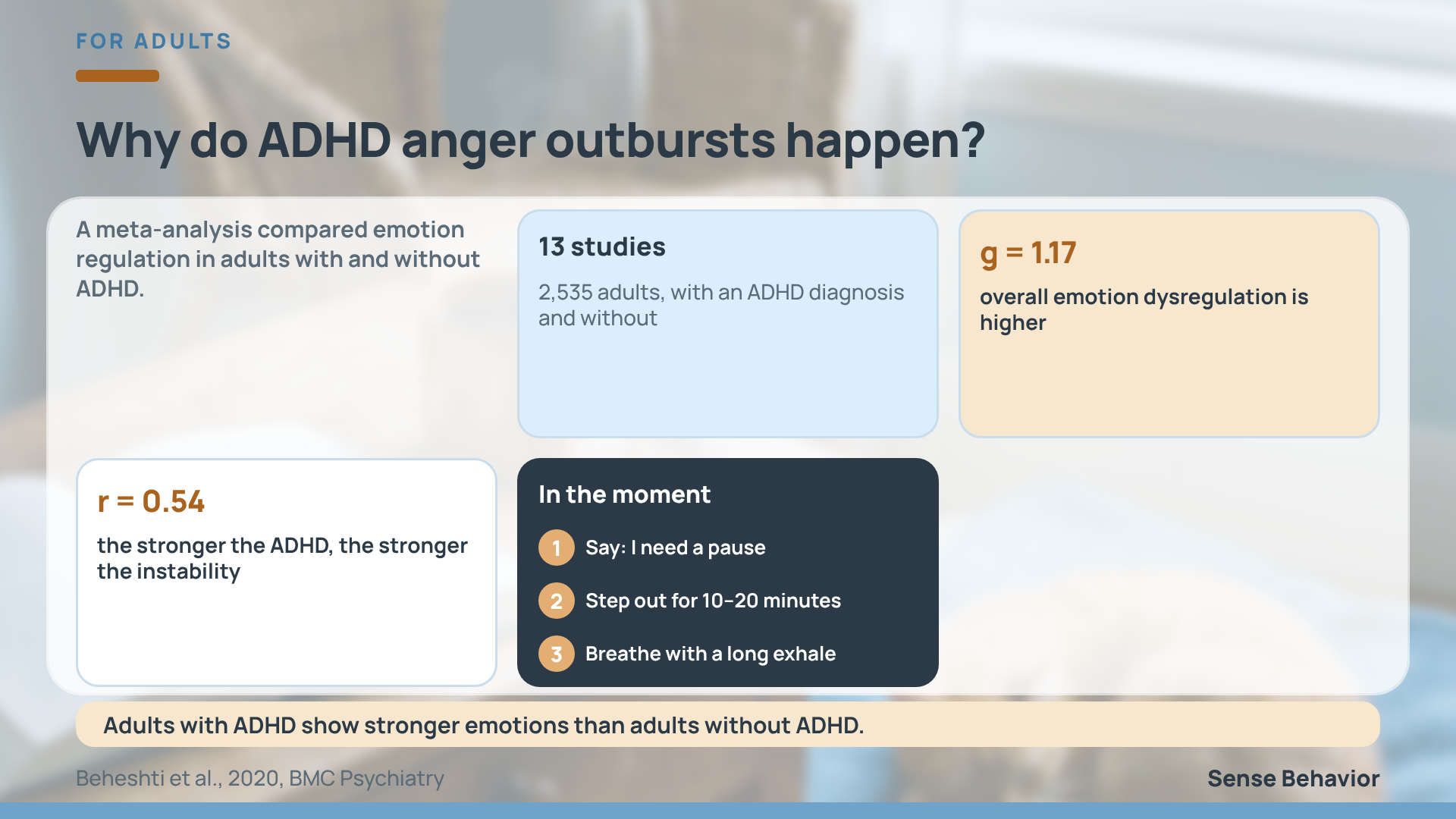
A 2020 meta-analysis by Beheshti and colleagues (BMC Psychiatry) combined 13 studies with 2,535 adults. People diagnosed with ADHD were compared with people without it. Overall emotion dysregulation was higher in adults with ADHD (Hedges’ g of 1.17). The biggest difference was in emotional lability, meaning quick mood swings (g of 1.20). The more severe the ADHD symptoms, the stronger the emotional instability (correlation r of 0.54).
Values around one are usually read as a large difference between groups. Still, the study shows an association and not a cause, and the authors note that incomplete reporting in the studies kept them from testing the role of individual factors. The practical takeaway is gentle: an outburst points to overload and difficulty with regulation, and says nothing bad about you as a person.
What to do in the moment of an outburst
You cannot stop the wave completely, but you can shorten its aftermath. These are general techniques and not a proven protocol, so pick the ones that suit you:
- Say aloud or to yourself: “I am boiling over, I need a pause.”
- Leave the room for 10 to 20 minutes if the conversation is heavy.
- Breathe slowly and let the exhale run longer than the inhale.
- Drink some water or splash cool water on your face.
- Return to the conversation once the peak has passed and start with the main thing you wanted to say.
What helps to have fewer outbursts
A 2022 meta-analysis by Guo and colleagues (Journal of Attention Disorders) looked at 44 randomised trials of non-drug treatments, 21 of them with adults with ADHD. In adults, cognitive behavioural therapy (CBT) improved emotional symptoms right after the course and at follow-up. Results differ from person to person, and a specialist chooses the method. On your own, these steps help:
- Write down what happened in the hour before an outburst: sleep, hunger, noise, urgent tasks.
- Agree on a signal word for a pause with people close to you.
- Leave a buffer in your schedule if rushing sets off your irritation.
- Ask a doctor whether an assessment and treatment are needed, and ask about CBT.
What to do today: write down your latest outburst in the form “before, during, after”. What happened in the hour before, what you said and did, how long the tension lasted. One note is enough, and in a week there will be three, so a pattern becomes easier to see. These notes help at an appointment too.
Who to see if anger outbursts get in the way of life
You can start with a family doctor, who will listen and refer you. A psychiatrist carries out an ADHD assessment and discusses treatment, and a psychotherapist, for example in CBT format, helps work on habitual reactions. There is a separate article on the assessment: adult ADHD diagnosis. If outbursts come with sharp pain from criticism, see rejection sensitive dysphoria in ADHD, and the article how to cope with adult ADHD without medication covers everyday techniques.
If outbursts lead you to hurt yourself or others, do not wait for an appointment: contact a doctor or a crisis line in your country.
Sources
- Beheshti A., Chavanon M.L., Christiansen H. (2020). Emotion dysregulation in adults with attention deficit hyperactivity disorder: a meta-analysis. BMC Psychiatry, 20, 120.
- Guo C., Assumpcao L., Hu Z. (2022). Efficacy of Non-pharmacological Treatments on Emotional Symptoms of Children and Adults with Attention-Deficit/Hyperactivity Disorder: A Meta-Analysis. Journal of Attention Disorders, 26(4), 508–524.
This material is for informational purposes only and does not replace a consultation with a specialist.