ADHD and insomnia: why you cannot fall asleep and what to do

ADHD and insomnia often go side by side. In a review of 13 studies by Díaz-Román, Mitchell and Cortese (2018), adults with ADHD reported more sleep problems than adults without it, and this showed up in questionnaires and partly in devices that track movement during the night. Why this happens is still not fully understood.
If you go to bed late, replay the day in your head and struggle to get up in the morning, many people know that story. Sleep problems say nothing about laziness or weak willpower. Below is what the research says, what you can try this evening and when it is time to see a doctor.
ADHD and insomnia: what the research showed
Díaz-Román, Mitchell and Cortese (2018) selected 13 studies and compared the sleep of adults with and without ADHD.
- In questionnaires, adults with ADHD differed from others in 7 of 9 sleep measures.
- An actigraph, a wristband that estimates sleep from movement, found 2 differences out of 5: falling asleep took longer and sleep efficiency was lower.
- Laboratory sleep recording (polysomnography) showed no significant differences.
The authors suggest asking every adult with ADHD about sleep at the appointment, and studying the laboratory differences further. In other words, the feeling of poor sleep is confirmed, while the reasons are still unclear.
Why it is hard to fall asleep with ADHD
The review names no single cause. Below is what people most often describe themselves. These are accounts, not findings of the study.
- Thoughts do not switch off when the room is quiet and there are no tasks.
- The evening feels like the only time “for me”, so bedtime slides later.
- Tasks that did not get done by day move into the night.
- Other things get in the way too: anxiety, caffeine, snoring, medication.
If constant tension comes with the sleeplessness, see the guide on how ADHD and anxiety are linked.
What to do in the evening if ADHD keeps you awake
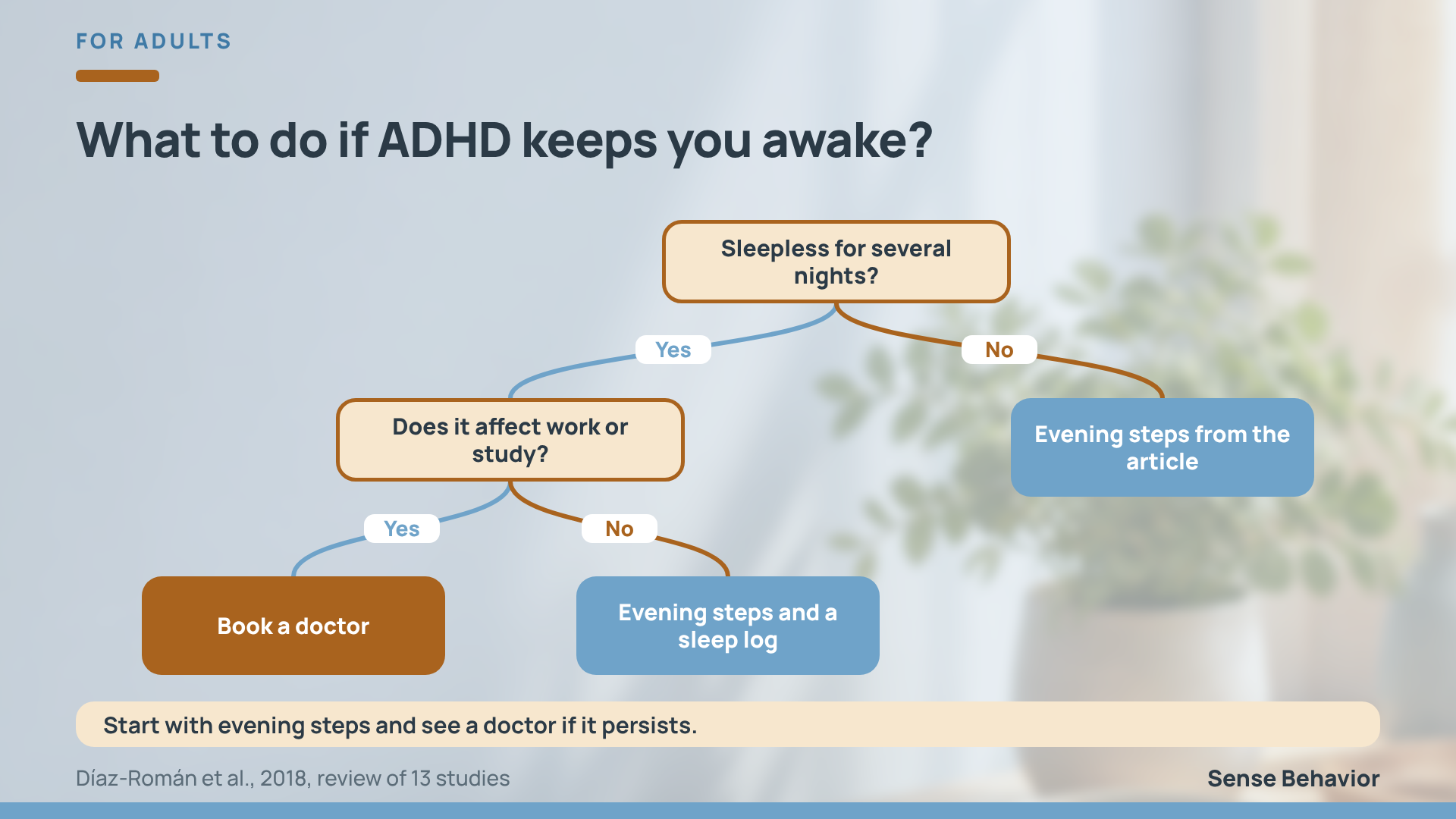
These steps are general, and the review did not test them in people with ADHD specifically. Try them one at a time and see what helps you.
- Pick a bedtime and put bright screens away an hour before.
- Write everything circling in your head on a sheet and leave it until tomorrow.
- Build a short ritual: a shower, warm caffeine-free tea, a book under dim light.
- Get up at the same time every day, roughly the same on weekends.
- Keep coffee and energy drinks for the first half of the day.
If you take ADHD medication, discuss timing and dose with your doctor and do not change them yourself. More everyday tools are described in the guide on managing ADHD without medication.
When insomnia with ADHD calls for a doctor
- Insomnia lasts several weeks and gets in the way of work or study.
- You fall asleep only after alcohol or a sleeping pill.
- You feel heavy daytime sleepiness, and at night there is snoring or pauses in breathing.
- Dark thoughts or strong anxiety have appeared.
A doctor, for example a psychiatrist or a sleep specialist, can help work out what is behind the insomnia: ADHD, anxiety, breathing during sleep or several causes at once. How a doctor approaches therapy is covered in the article on ADHD treatment in adults.
How to start tonight
- Choose a bedtime that you can agree to.
- Write down three thoughts that keep you awake and set them aside until morning.
- Put the screen away an hour before sleep.
- In the morning, note when you fell asleep and how you feel.
If tonight goes badly again, it is not a failure. After a week the notes will show a picture.
This material is for informational purposes only and does not replace a consultation with a specialist.