Alternative communication, PECS cards: where to start at home

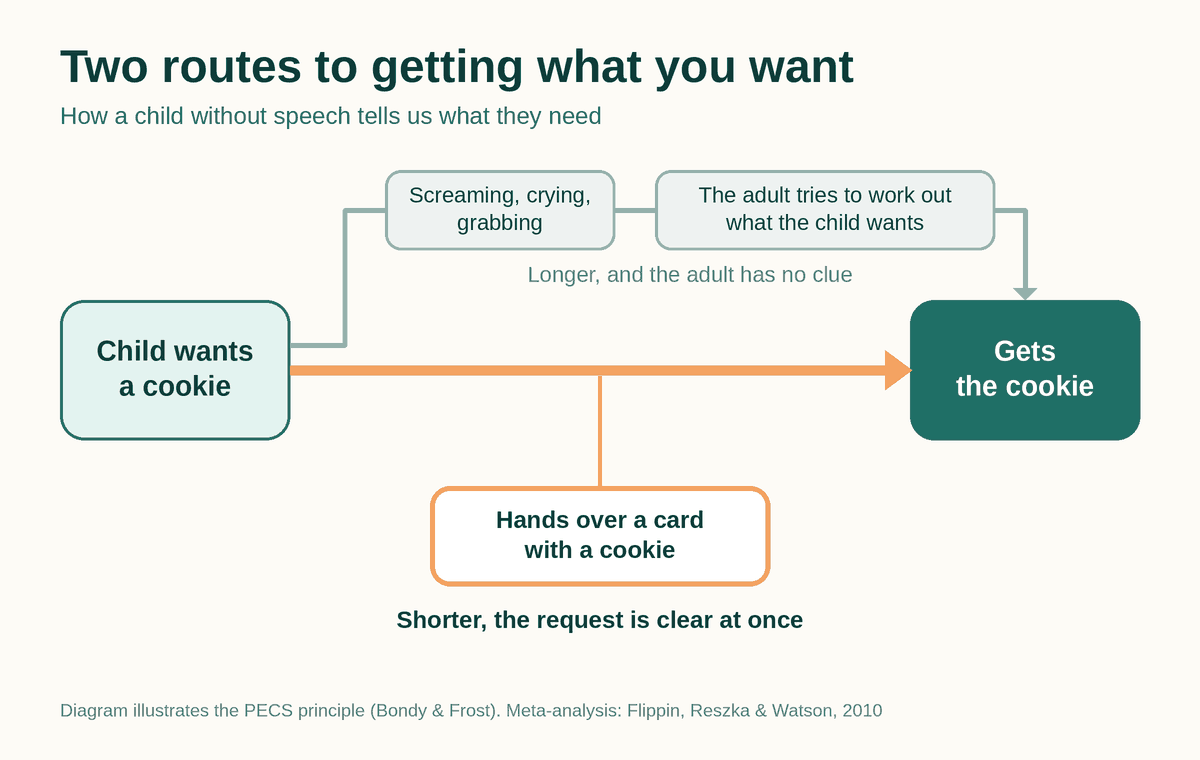
Alternative communication, PECS cards: these are the words parents hear first when a child is not speaking yet. Behind them is a simple idea. The child hands an adult a picture of what they want and gets it at once. You can start at home with a single card, and you do not need to wait for first words. Cards do not forbid speech. They simply give the child a working way to say “I want” right now.
What is PECS, and how is it different from ordinary picture cards?
PECS (Picture Exchange Communication System) was created by Andy Bondy and Lori Frost as a picture-exchange system for children whose speech comes late or has not come yet. It is one type of augmentative and alternative communication, alongside gestures, signs and speech-generating tablets, and it is often used by ABA (applied behavior analysis) practitioners. The main difference from teaching flashcards is who starts the conversation. With flashcards, the adult shows a picture and asks “what is this?”. In PECS the child takes the initiative, walks up to a person and hands over the card because they need something.
The system has six phases. First the child learns simply to exchange one card for a favorite item. Then the child travels further to reach the card, chooses among several, builds a short “I want” sentence, and over time answers “what do you want?” and begins to comment on what they see. The first phase is the simplest, and it can be tried at home.
What research shows about PECS
In 2010 a meta-analysis was published of PECS studies in children on the autism spectrum, covering work from 1994 to June 2009 (Flippin, Reszka and Watson, 2010). The authors concluded that PECS helps children communicate with pictures, with a small to moderate effect. Evidence that it helps spoken speech appear was thinner and weaker.
So it is reasonable to expect better communication from cards, but not a guarantee that words will follow. That is a limit of the method, and it is better to know it in advance. The study cannot tell you whether PECS suits your particular child. A specialist decides that after seeing how your child asks and what motivates them.
How to start at home: alternative communication, PECS cards step by step
Full PECS training happens with a trained specialist, but you can try the first phase yourselves.
- Pick one item your child definitely loves. A cookie, soap bubbles, a particular toy. The strength of the wish matters more here than anything else.
- Make one card. Photograph that item, or print a clear picture and glue it to sturdy cardboard. Just one card for now, with no choice.
- Bring in a second adult. One sits facing the child with the item in view, the other sits slightly behind and gently helps the child pick up the card and hold it out. That is how the first phase is designed. There is no need to say “say it” at this moment.
- Hand over the item straight away. As soon as the card is in a hand, name the item in one word and give it. The child should feel that the exchange works.
- Repeat in short rounds through the day when the wish is real, and gradually reduce the help from behind.
If the general principle of teaching requests matters to you, the article how to teach a child to ask instead of screaming covers it in detail and also names card exchange as one option.
How to make your first PECS card at home
Pick an item and make one card. That is ten minutes or so, no more. The rest can wait for a specialist at your first meeting.
When you need a specialist for PECS and alternative communication
If you have tried cards for a week or two and the exchange does not happen, or your child takes the card but does not hand it over, that is a reason to show the situation to a specialist. It does not necessarily mean the method does not suit your child. If there are no words yet and you are unsure whether that is within the age norm, first look at child not talking at 3: wait or act. And if words were there and then disappeared, it is better to open the article on what to do when a child has stopped talking.
At Sense Behavior, a BCBA specialist looks at how your child asks right now, chooses the form (cards, gestures or words) and teaches parents to run it at home. You can start with a free thirty-minute consultation, where we will go through your situation and suggest a first step.