A year of therapy and no progress: what to do and how to tell if it is working

"We have been at it for a year and there is no progress, what do we do?" Parents ask this when their energy is nearly gone and the picture is still unclear, because nobody ever showed them what to count as a step forward. Until there is a written starting point and a trend for specific skills, "no progress" stays a feeling of a tired adult, and that feeling can be right or misleading. So the first step is very practical, and it means turning the feeling into a comparison.
How to check whether there is progress
Living next to a child every day distorts the picture, because small wins dissolve into routine while hard evenings stay vivid. Comparing specific skills with where they were at the start is more reliable. Any sound program begins with a baseline, a recorded level of skills before sessions, most often from an assessment such as the VB-MAPP, and we wrote separately about how that assessment works and what it shows. If there was no baseline, or you were never shown the results, ask for them, because it is an ordinary request from a parent.
Look at three layers at once. The first layer is the skill itself, for example asking, imitating or waiting for a turn. The second is stability, meaning whether the skill works without a prompt, in another room and with another adult. The third is behavior, whether the things that make family life hard have become less frequent. A shift in one layer while the others stand still is still progress, just not complete yet.
What research says about the pace of progress
The Cochrane review of early intensive behavioral intervention (Reichow and colleagues, 2018) pooled five studies with 219 children, followed for 24 to 36 months. The authors found weak evidence that after roughly two years children in such programs did better than children receiving usual special education services in adaptive behavior (everyday skills), intelligence scores and language. No differences between the groups were found in the severity of autism symptoms or in problem behavior, and no study reported adverse events. The Cochrane review itself is available at the link.
Two practical points follow from this. The quality of the evidence is low, so nobody is entitled to promise a specific pace for a specific child. Also, areas of development move unevenly, and if therapy is judged only by whether difficult behavior has disappeared, a year can look empty even while skills are clearly growing.
A year of therapy and no progress: what to do step by step
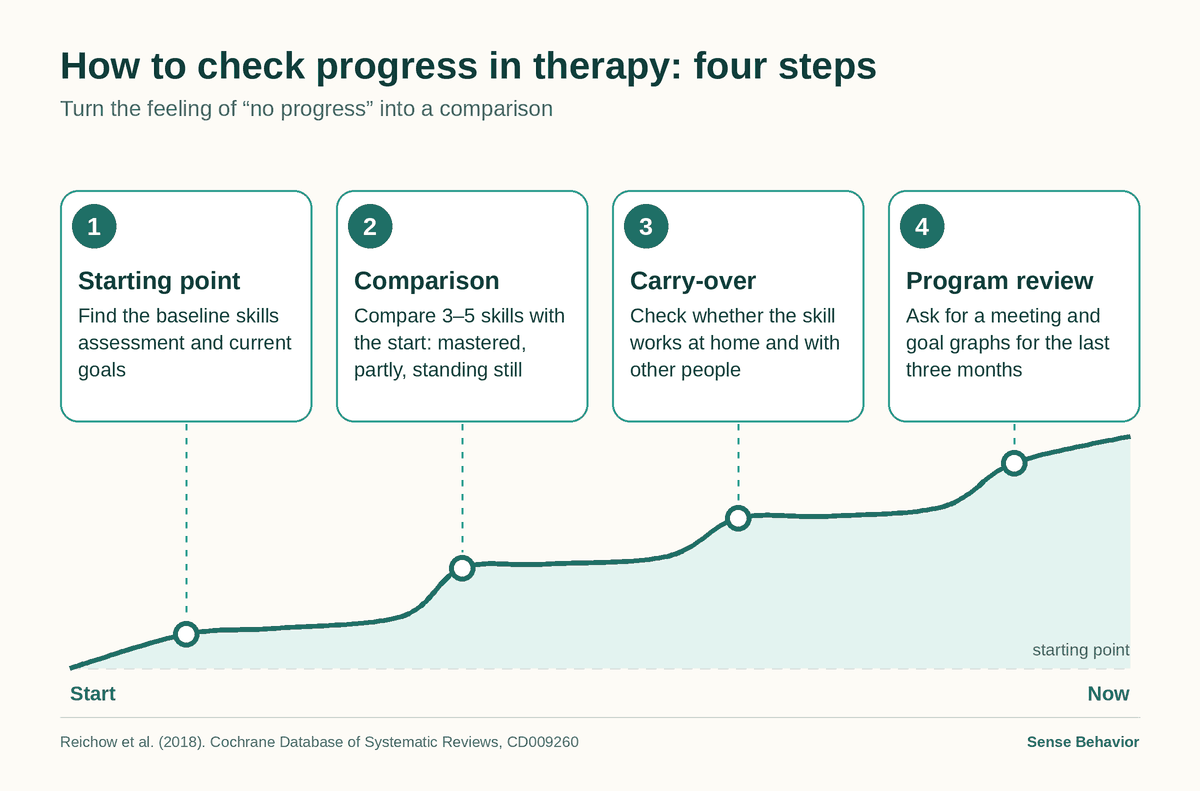
- Ask for the data. The baseline assessment, current goals and graphs for them over the last two or three months. A specialist who keeps data can show it in a few minutes.
- Compare with the start. Take three to five skills from the first goals and mark where each one is now: mastered, partly mastered or standing still.
- Find the stuck goals. If the same goal has hung around for months, it usually needs to be broken into smaller steps or given different prompts.
- Check the carry-over. A skill that works only in the session room or only with one adult is not yet secure. Ask how the program teaches it to transfer home, and see what research says about the parent's role in this.
- Schedule a program review. Ask for a separate meeting where the specialist explains what changed during the year and what is planned for the coming months.
If a hard situation remains the main worry while sessions revolve around other goals, it helps to go back with the team to the question of why the child does it. Our article on the function of behavior explains how to find out and why the whole plan depends on the answer.
What to ask your specialist
- Which goals did we start with, and how many are mastered now?
- How do you measure success for each skill, and how often do you review the goals?
- What did you change in the program over the last three months when nothing was moving?
- How do skills transfer home, and what should I be doing between sessions?
- What signs will tell you it is time to change the approach?
The content of the answer matters, and its form matters just as much. Concrete numbers, examples and a readiness to show graphs point to systematic work, while general phrases such as "things are going their own way" with no facts attached are a fair reason to ask for more detail.
When to change the specialist or the approach
Changing the plan is reasonable when there is no data at all, when goals sit unchanged for months with no explanation, or when direct questions get evasive answers. It is an ordinary right of a family to understand where its time and money go. If the data shows growth, even slow growth, adjusting goals and prompts is usually enough, and a repeat assessment with the same tool a few months later gives a clear comparison with the starting point.
How to ask your specialist for goals and progress graphs
Take a sheet of paper and write down five things your child can do now that they could not do a year ago, and next to them three things you would like to see in the coming months. Then send the specialist one question: "Could you please show me the goals and graphs for the last three months?" The reply to that request will tell you more about the program than any impression.
At Sense Behavior, the team supports each family through weekly sessions, video review with feedback within 24 hours and regular supervision of the program inside the team of specialists, so that progress rests on data rather than on the mood of one particular evening.