The motherhood penalty: why earnings fall for years after a first child
The short answer: after a first child is born, a woman's earnings fall and do not recover for years — across countries the gap ranges from 21% to 61% and persists for at least a decade. Men's earnings, meanwhile, barely move. Economists call this the motherhood penalty, and they measure it as routinely as inflation. Here is where those figures come from, why the gap is even wider in families where a child needs regular therapy, and what actually shifts it.
What the motherhood penalty is
The motherhood penalty (also called the child penalty) measures how far a woman's earnings after her first child fall behind what they would have been without a child, and behind men's earnings over the same period.
It is calculated from large datasets rather than impressions. The method is simple in principle: take people who have had a first child and track their earnings for five years before the birth and ten years after, adjusting for age and general economic trends. Before the birth, men's and women's earnings curves run in parallel. Afterwards they diverge sharply.
How large the gap is: figures by country
The most cited comparison comes from a team of economists led by Henrik Kleven, who applied an identical method to six countries so the numbers could be compared directly (Kleven et al., 2019). Below is the long-run earnings gap, averaged over years five to ten after the first birth.
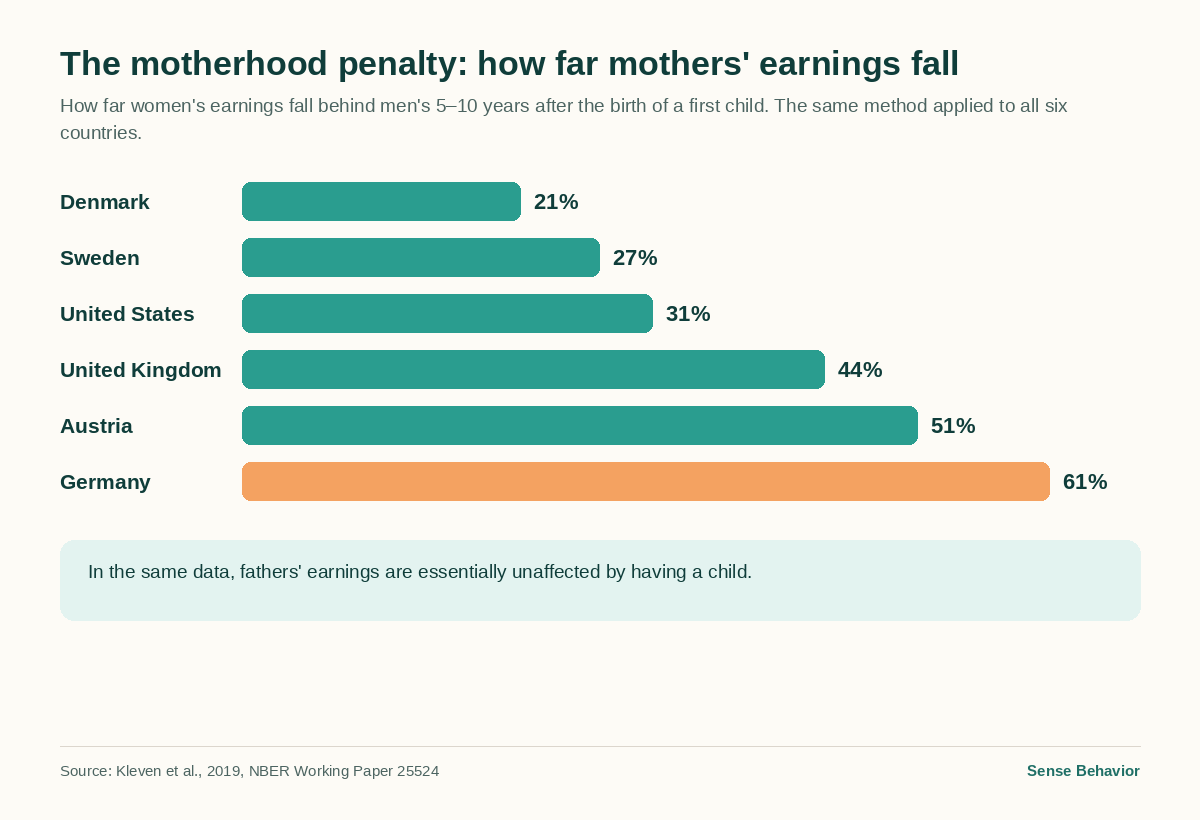
Two things in this data are worth stating explicitly.
First: this is not a one-off dip covering parental leave. Ten years after the birth the curves have already plateaued — meaning women have not caught up by that point and, on this evidence, will not. The gap becomes permanent.
Second: in the same data, having a child barely affects men's earnings. The one exception is Sweden, where fathers show a small short-run dip; the authors link this to leave that is reserved specifically for fathers.
Why the difference between countries is so large
Intuitively it seems to be about state support: longer paid leave and more accessible childcare should mean a smaller gap. The data does not bear this out.
The authors tested family policy separately and found that, in the long run, the length of paid leave and the availability of childcare have almost no effect on the size of the gap. There is a short-run effect — longer leave produces a deeper dip in the first years — but it dissolves within a few years.
The gap is far more strongly linked to something else: beliefs about whether the mother of a young child should work. The researchers compared the size of the penalty with responses to an international survey question on whether a woman with a preschool-age child should work outside the home or stay at home. The relationship was almost linear: the higher the share of people who agree that mothers should stay home, the larger the motherhood penalty. Scandinavia sits at one pole, the German-speaking countries at the other.
A separate case: when a child needs regular therapy
Everything above concerns the average family. Where a child needs regular sessions with specialists, the mechanism is the same but the scale is different.
A study published in Pediatrics compared parental earnings and employment using data from a national survey of medical expenditure in the US. Three groups were compared: families of children with autism, families of children with other health limitations, and families of children with no limitations (Cidav, Marcus & Mandell, 2012).
- Mothers of children with autism earn on average 56% less than mothers of children with no health limitation, and 35% less than mothers of children with other limitations.
- They are 6% less likely to be employed and work on average 7 hours less per week.
- Overall family income is 28% lower compared with families of children without limitations.
- No statistically significant differences were found in fathers' earnings.
That last point is worth rereading. The additional load is not shared between parents — it falls almost entirely on one of them, and the data shows this with complete clarity.
The reason parents themselves give in surveys is not the diagnosis but the logistics. Session schedules, travel, waiting in a corridor, the impossibility of planning a week, the requirement to be present. A session lasts an hour, and half a working day disappears.
What actually makes a difference, and what doesn't
Since government policy barely moves the long-run gap and norms change slowly, what remains is to look at what lies within one family's reach.
Works poorly:
- Trying to «just fit everything in». This is not a question of organisation: when an adult is interrupted every ten minutes, a long task does not get done at all, however carefully it is planned.
- Waiting for it to get easier by itself. The data shows the opposite — the gap sets rather than dissolves.
- Guilt as a motivator. It consumes the very resource being fought over.
Works better:
- Take travel out of the equation. The round trip often costs more than the session itself — not in money, but in hours and in the impossibility of planning.
- Treat the child's independence as a goal in its own right. Being able to occupy themselves for even twenty minutes is not a domestic convenience but working time returned directly.
- Redistribute rather than optimise. The data on fathers shows exactly where the unused capacity sits. A conversation about who drives to sessions and who stays home when a child is ill moves the numbers more than any time management.
- Learn the method yourself rather than only ferrying the child. When a parent has the method, part of the work moves into ordinary home situations and stops requiring its own slot in the schedule.
On building independence deliberately — how to teach a child to play independently. On the parent's own reserves, if they are already low — parental burnout.
How this works at Sense Behavior
We do not solve the economic problem in full — no centre does. But two specific items from the list above are exactly how the format is built:
- Sessions are online, so what disappears from the schedule is not one hour but three: travel, waiting, travel back. Times are chosen around the parent's working day rather than the other way round.
- Parent coaching means the specialist teaches the parent rather than working with the child instead of them. The skill stays in the family and works in ordinary situations — over breakfast, on a walk, while getting ready — not only during the hours a specialist is present.
- The child's independence is written into the programme as a distinct goal, not a side effect. Occupying oneself, waiting, completing a familiar action without an adult — we plan for these deliberately, partly because they return hours to the parent directly.
- The programme can be built around the family's real life. If a parent is returning to work, if there are two children, if there is no support around — these are inputs to the plan, not obstacles that are awkward to mention.
The first consultation is free and takes thirty minutes — enough to see whether this format fits into your week. On the online format itself and the evidence behind it — separately here.