Child understands everything but does not talk: what it means and what to do

When a child understands everything but does not talk, parents often see the same picture: the child follows requests, recognises names of objects, laughs at your jokes, and words are few or absent. Understanding speech is considered a good sign for talking later. It does not cancel an assessment, though: a specialist needs to find out why words are not coming, and it is better to do this now and not put it off for six months.
Below are the questions that usually come one after another: what it means, how to check understanding, why it happens, how long to wait and what to do at home.
Child understands everything but does not talk: a good sign or a reason to worry
More a good sign, with a caveat. A 2017 review by Fisher combined 20 samples with 2,134 late-talking toddlers. Vocabulary size in toddlerhood and receptive language were among the factors linked to how speech developed by preschool age. Gender and family history did not show a significant link.
The takeaway is simple. Good understanding improves the odds but does not explain why words are missing. The reason is looked for at an assessment, and waiting for the child to start on their own is not needed for that.
How to check that your child understands speech
Test without gestures or glances that give the answer away, otherwise you are testing how well your child guesses. The US Centers for Disease Control and Prevention (CDC) describe these markers of understanding:
- By 18 months: follows a simple request without a gesture, such as handing you a toy when you say “Give it to me.”
- By 2 years: points to things in a book when you ask, and points to two body parts on request.
- By 30 months: follows a two-step request, such as “Put the toy down and close the door.”
If the child responds only in a familiar routine, that is not yet understanding of words. On “Let’s go outside” the child walks to the door because the jacket is in sight. Try a request that is a surprise: “Bring the bear from the other room” while the child is busy with something else.
Why a child may understand but stay quiet
A cause cannot be named from a description, that takes an in-person assessment. Specialists most often consider these options:
- Late start of speech. The child understands well while the vocabulary builds more slowly than in peers.
- Reduced hearing, for example after frequent ear infections. A hearing check takes one visit and settles an important question.
- Difficulty producing sounds and words. The child knows what to say, but the movements of speech are hard.
- Differences in development, including autism. Other signs usually show up too: little pointing, little eye contact during interaction, no response to the name, more in the article on responding to the name.
- Speech in two languages. Words in both should be counted, and a specialist should hear about it.
How long to wait if your child understands everything
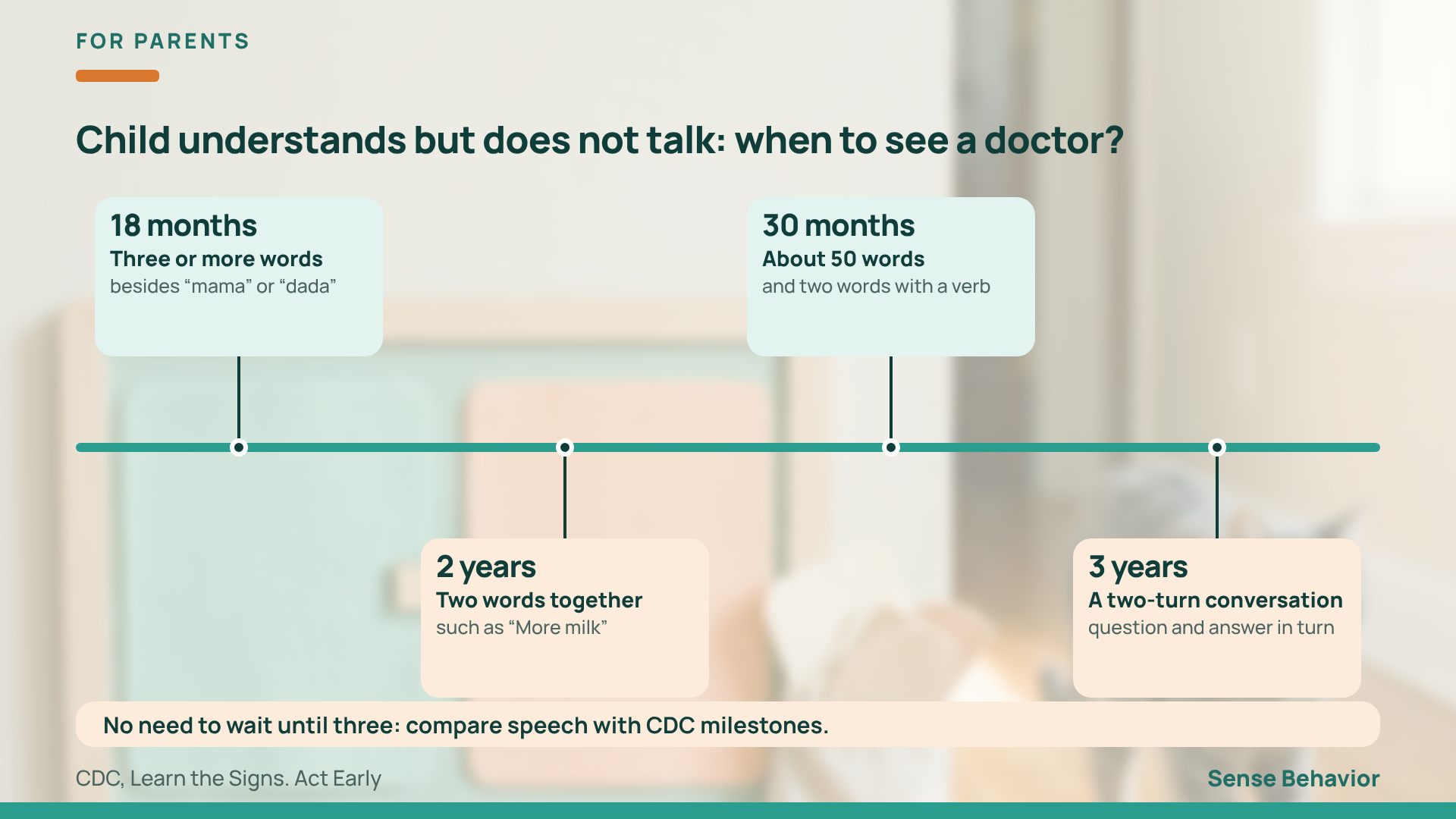
There is no need to wait until age three. The CDC advises not to delay: if a child is missing one or more milestones, has lost skills, or something worries you, talk to the doctor and ask about developmental screening. Milestones for the child’s own speech look like this:
- By 18 months: tries to say three or more words besides “mama” or “dada.”
- By 2 years: puts two words together, such as “More milk.”
- By 30 months: says about 50 words and combines two words with an action word, such as “Doggie run.”
- By 3 years: holds a conversation with at least two back-and-forth exchanges.
The milestones come from CDC pages for 18 months, 2 years, 30 months and 3 years. If the gap is clear, there is a fuller walk-through in the article child not talking at 3.
What to do at home to help your child start talking
A few simple actions are enough for today.
- Name what the child is looking at in one or two words: “Ball,” “Going.”
- Offer a choice of two objects and wait a few seconds without prompting the word.
- Do not ask “say it.” Welcome any signal: a gesture, a sound, a point.
- Read the same short book for several days in a row and point to the pictures.
- Record two or three short videos of how the child asks and points. They help at the appointment.
What to do today: go through the lists above, mark which milestone the child is at, and write down the date. With that note the conversation at the appointment goes faster.
Which doctor to see if a child does not talk but understands
Start with the pediatrician and a hearing check. A speech therapist, a child psychologist and a neurologist may follow. The order of steps is in the article where to go if you suspect autism. If there is no speech yet and it is unclear where to begin, see nonspeaking child: where to start.
This article does not replace an assessment, and nobody can diagnose from a description. If something in the lists matched, it is a reason to book a visit. There is no one to blame.
Sources
- Fisher E.L. (2017). A Systematic Review and Meta-Analysis of Predictors of Expressive-Language Outcomes Among Late Talkers. Journal of Speech, Language, and Hearing Research, 60(10), 2935–2948.
- CDC. Milestones at 18 months (Learn the Signs. Act Early).
- CDC. Milestones at 2 years (Learn the Signs. Act Early).
- CDC. Milestones at 30 months (Learn the Signs. Act Early).
- CDC. Milestones at 3 years (Learn the Signs. Act Early).