Aggression in Children With ASD: Causes and What to Do

Aggression in children with ASD is most often a way of saying what words cannot yet say: “this is hard,” “I want it,” “I don't want it.” Safety comes first: protect yourself and your child and stop the outburst briefly and calmly. The cause is sorted out later, when everyone has calmed down. Below is where aggression comes from, what to do in the moment and when to bring in a specialist.
If you are bruised and in tears right now and it feels like you are completely alone, that exhaustion makes sense. Aggression is one of the most draining kinds of difficult behavior, and nobody has to cope with it alone. Here is an order of steps you can start with today.
Why aggression in children with ASD happens: common causes
There is rarely one cause. Usually several add up, and in different children different ones come first.
- Cannot say it. When there are no words, a hit or a pinch becomes the fastest way to say “I want” or “I don't want.”
- Overload. Noise, bright light, crowds and sudden changes fill a child up, and the tension comes out.
- The body. Pain, itching, hunger, lack of sleep or constipation shorten patience, and the child cannot explain what hurts.
- A demand. Getting dressed, tidying up, going where the child would rather not go. The outburst ends the demand, so it sticks.
- Attention. If calm behavior gets no response and an outburst brings everyone running, the outburst becomes a way to call.
In ABA these jobs are called functions of behavior, and they are covered in the article on the function of a child’s behavior. If outbursts happen mostly in noisy places, read about sensory overload in children.
How common is aggression in ASD
It is common, and it is not your fault. In the study by Kanne and Mazurek (2011) 1380 children and teenagers with ASD took part. According to their parents, 68% had shown aggression at least once toward the caregivers looking after them and 49% toward other people. The authors found no link with the severity of ASD symptoms, intelligence or the child's sex. Aggression was more often reported in younger children, in those who repeat the same actions and in those with more difficulty in social communication.
This is a picture of a large group and it does not predict what will happen with your child. It does show that you are not alone.
What to do in the moment of an outburst
In the moment the goal is single: make everyone safer and give the child a short, clear signal.
- Protect yourself. Move the hand away, step back, remove fragile and sharp objects.
- Say it briefly. “No hitting. Calm hands,” in the same words every time, with no lecture and no shouting.
- Give space. Dim the noise and light and step back until the child calms down.
- Do not punish or persuade. In the middle of an outburst explanations do not land, there will be time for them later.
- Return to the task. When it is calm, carry on with what you were doing in a simpler form.
How to find out what is behind the aggression
For two weeks write down three things: what happened right before the outburst, what went on during it and how it ended. A note on your phone is enough and takes a minute. After a few notes a pattern usually appears: outbursts cluster around demands, waiting or noisy places.
What to teach a child instead of aggression
If aggression says “I want” or “I don't want,” the child needs another way to say the same thing, faster and easier than a hit. The child is taught to ask with a word, a gesture or a card, and aggression stops being the shortest path.
- Wants something. Teach asking with a word or a card.
- Wants it to stop. Teach asking for a break.
- Needs attention. Teach calling “Mom, look” and notice the calm minutes.
- Overload. Move to a quiet place early and prepare for changes.
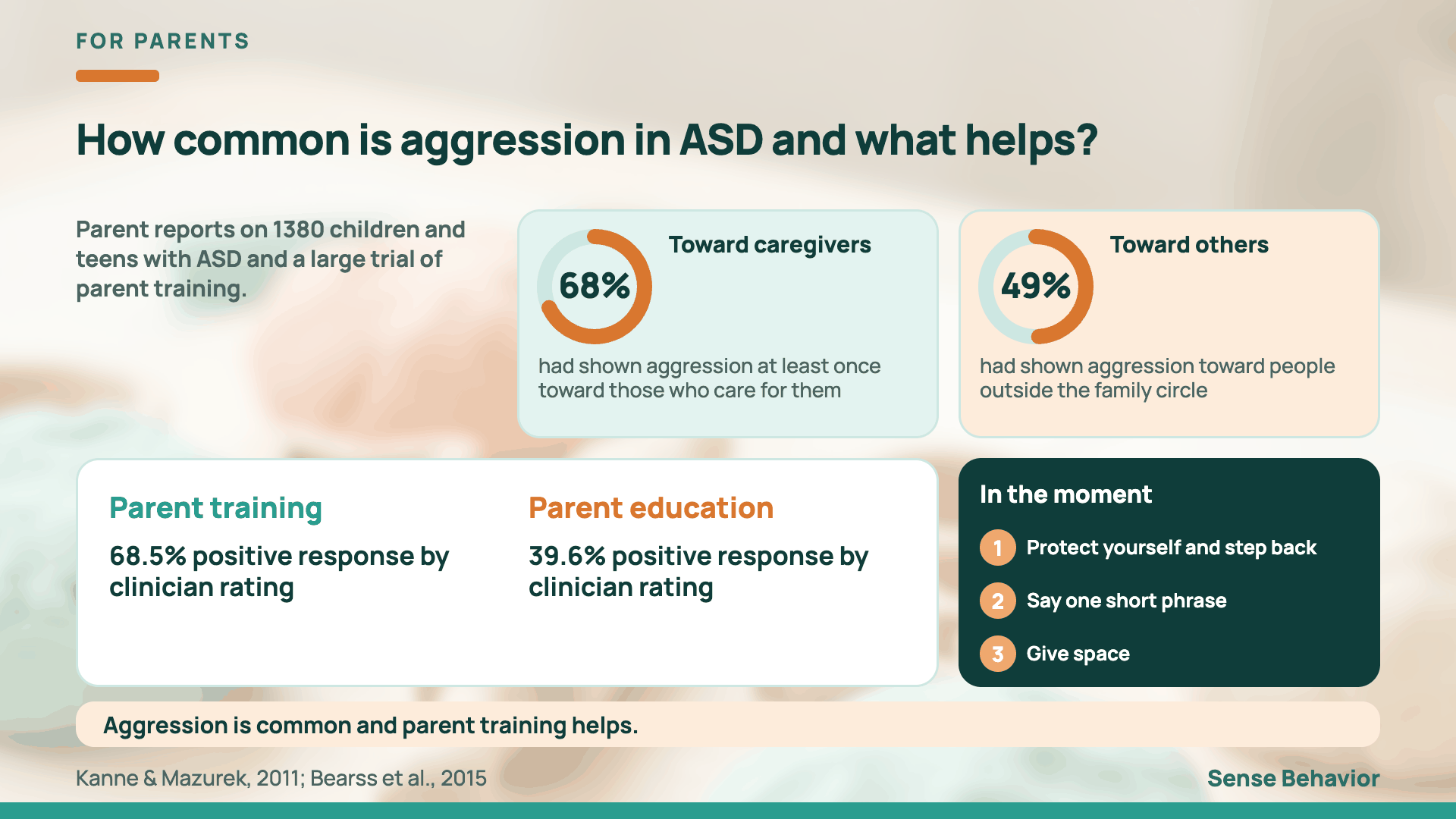
What helps was tested in a large trial. In the work by Bearss and colleagues (2015, JAMA) 180 children aged 3 to 7 with ASD and disruptive behavior took part. Some parents were taught to manage behavior in a program of 11 core sessions (parent training), others were given information about autism without techniques (parent education).
After 24 weeks a positive response, rated by a clinician who did not know the groups, was seen in 68.5% of children in the first group and 39.6% in the second. The irritability score on parent scales fell by 47.7% versus 31.8%. The authors note that the clinical importance of the improvement on parent-rated scales remains unclear.
When to call a specialist about aggression in a child
A behavior specialist (a BCBA or an educator with ABA experience) and a pediatrician are worth calling if any of this is true.
- Bruises or injuries stay after outbursts, on you or on the child.
- The aggression is aimed at other children and at adults outside the family.
- Over a few weeks the outbursts became more frequent or more severe.
- You are afraid to be alone with the child.
- Behavior changed sharply after an illness or a change, in which case the pediatrician looks first.
Medication, if it is needed, is prescribed only by a doctor and should never be chosen on your own.
Where to start today
Pick one short phrase for outbursts (“No hitting, calm hands”), tell it to every adult in the family and tonight write down the first outburst in three points: before, during and after.
If the aggression is aimed at you in particular, there are steps in order in the article on what to do when a child hits mom. If your child bites, see the guide on biting, and for hitting themselves read child hits their own head.
If you would like to talk through your family's situation the Sense Behavior specialists work online with parents in different countries. You can write to us using the link at the bottom of the page.
Sources
- Kanne S. M., Mazurek M. O. (2011). Aggression in children and adolescents with ASD: prevalence and risk factors. Journal of Autism and Developmental Disorders, 41(7), 926–937.
- Bearss K. et al. (2015). Effect of parent training vs parent education on behavioral problems in children with autism spectrum disorder: a randomized clinical trial. JAMA, 313(15), 1524–1533.