Sensory overload in children: what to do

Sensory overload in children, what to do? First remove the extra input: move to a quiet place, dim the light and sound, and say less, more softly. Save demands, explanations and lessons for later. Overload happens when there are more sounds, lights, smells or touches around than a child's brain can process at once, and the body answers with tears, shouting, running away or freezing.
If you are standing with a crying child in the middle of a shop or a party while people look on, it is exhausting. Your parenting has nothing to do with it, and it is rarely a tantrum meant to get something. The child is telling you it is too much right now, and you can learn to respond to that.
How to tell that a child is sensory overloaded
An overloaded child looks different from one day to the next, and no single sign settles it. These are the most common things parents notice.
- Covers the ears, eyes or face, winces at noise, light or clothing.
- Gets irritable suddenly, cries or shouts where they usually cope: a shop, a party, nursery by the end of the day.
- Runs off, hides under a table or in a corner, or clings to you and will not let go.
- Freezes, stops answering and looking at you, as if switching off.
- Becomes limp and tired after a loud day, even though nothing special seemed to happen.
Sensory overload in children: what to do right now
In the moment, the task is one thing: reduce the flow of input. Explaining, arguing and persuading are wasted effort, because the child cannot take in your words right now.
- Move the child away from the source: out of the crowd, out of the room with music, away from bright light. A quiet corner, a corridor or the car will do.
- Speak softly and briefly. One sentence such as "I'm here. Let's go somewhere quiet" beats a long explanation.
- Give time and do not rush. It often takes from a few minutes up to half an hour to recover, and that is normal.
- Return to the task later. If the demand has not gone away, offer it again once the child has calmed down, and make it smaller.
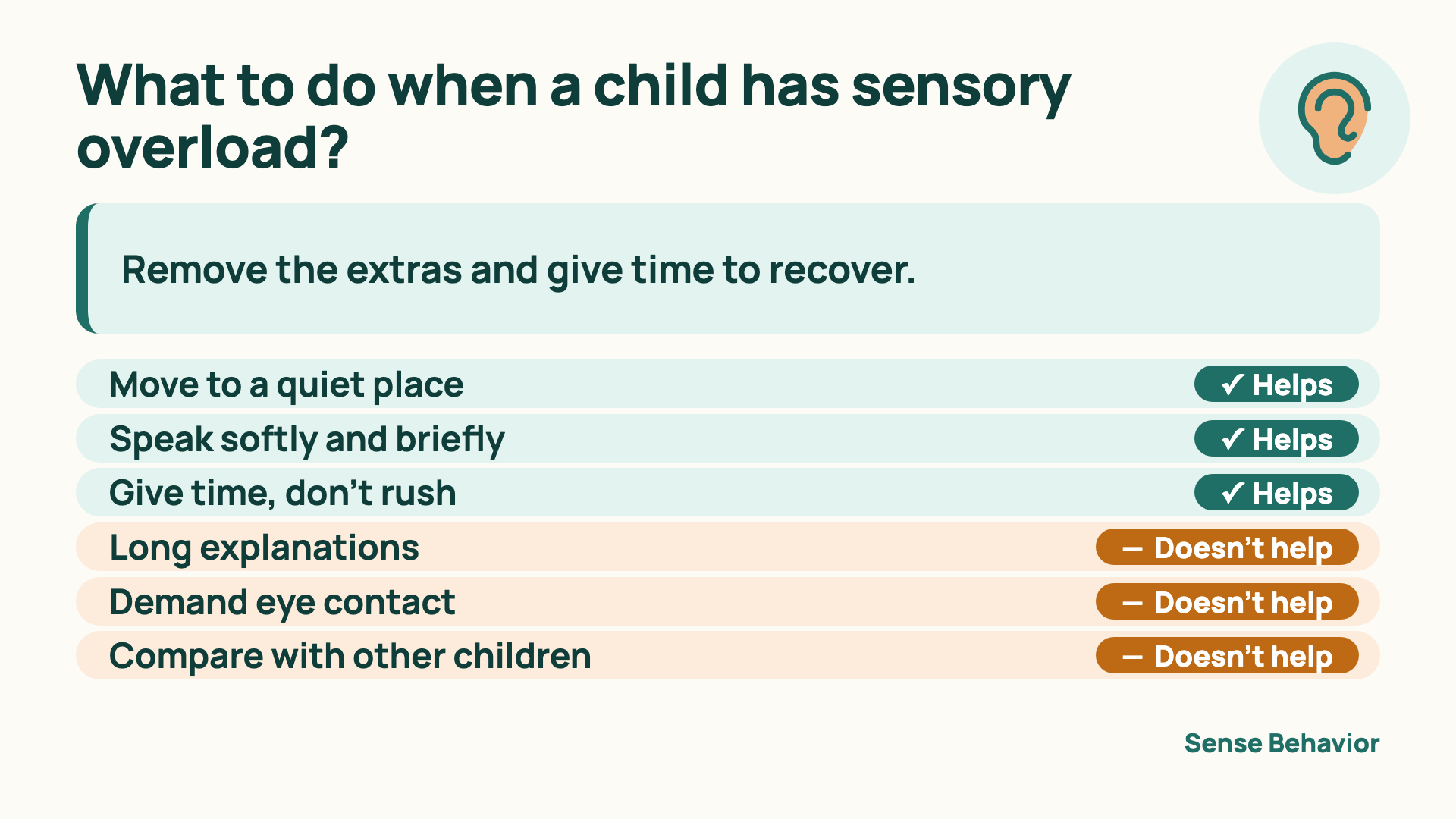
Do not insist on eye contact, demand an apology or compare the child with others. While a child is overloaded, every extra demand adds one more thing to cope with.
What research says about sensory overload in children
In August 2026 the Journal of the American Academy of Child and Adolescent Psychiatry published a study by researchers at WashU Medicine in St. Louis. They pooled data from about 15,700 children across five cohorts: three community samples and two where autism was more common.
According to the university's report, sensory over-responsivity went along with anxiety and autistic traits but not with ADHD. Even mild sensory difficulties were linked to differences in brain connectivity in scans of a subset of the children. Senior author Rebecca Schwarzlose says these reactions point to differences in the nervous system, and children without autism can find noisy environments hard too.
We rely on the university's news release and have not read the full paper. The study shows links and does not prove causes, and neither it nor this article can diagnose a child. The practical takeaway is modest: a strong reaction to noise or light is not always stubbornness.
How to reduce sensory overload at home and outside
Preventing overload is easier than stopping it. Small, steady habits help.
- Warn in advance: "We are going to the shop, it will be noisy, we will be quick." Predictability lowers tension.
- Take noise-cancelling headphones or earplugs, a cap or sunglasses for bright light, and a favourite object.
- Plan breaks. Leave time in a quiet place between loud activities.
- Check clothing: labels, seams and rough fabric bother many children.
- Set up a quiet corner at home that the child can go to alone, and never use it as a punishment.
What to do today. Pick the one situation where overload happens most, for example a trip to the shop, and prepare one measure for it: a warning in advance or headphones.
How sensory overload differs from a tantrum and from stimming
They can look alike while needing different help. In a tantrum a child is more often trying to get something or avoid something, and then the function of the behaviour matters, which we cover in the article on tantrums in children. Stimming, the repeated movements and sounds, often helps the child calm down, and we wrote about it in the piece on stimming in children. In overload the cause is the flow of input: remove it and the child is visibly more at ease. If haircuts, hair brushing or tooth brushing set it off, the article on sensory stress around haircuts and tooth brushing will help.
When to see a specialist about sensory overload in children
It is worth seeing a specialist if overload happens every day, gets in the way of eating, sleeping or going to nursery or school, or the child hurts themselves. You can start with a paediatrician, a neurologist or a child psychologist who works with development. An ABA specialist with BCBA certification looks at what happens before and after the hard moments, helps teach the child to ask for a break with a word, a card or a gesture, and prepares the difficult places. That work does not remove the sensory differences. It helps the child signal overload and the family build the day around it. A diagnosis cannot be made from a description in an article.