What to do when a child bites: reasons and first steps

What to do when a child bites? First stop the bite calmly and briefly, then work out what it was for. A bite nearly always says something: “I want it”, “I don’t want this”, “it’s too loud” or “it hurts”. When a child has few words, teeth are the fastest way to say it.
If you have just been bitten again, perhaps in front of other children or your mother-in-law, it is exhausting and it can feel embarrassing. That does not mean you are parenting wrongly. Biting is common in small children and usually fades once they have another way to get their message across.
Why a child bites: four common reasons
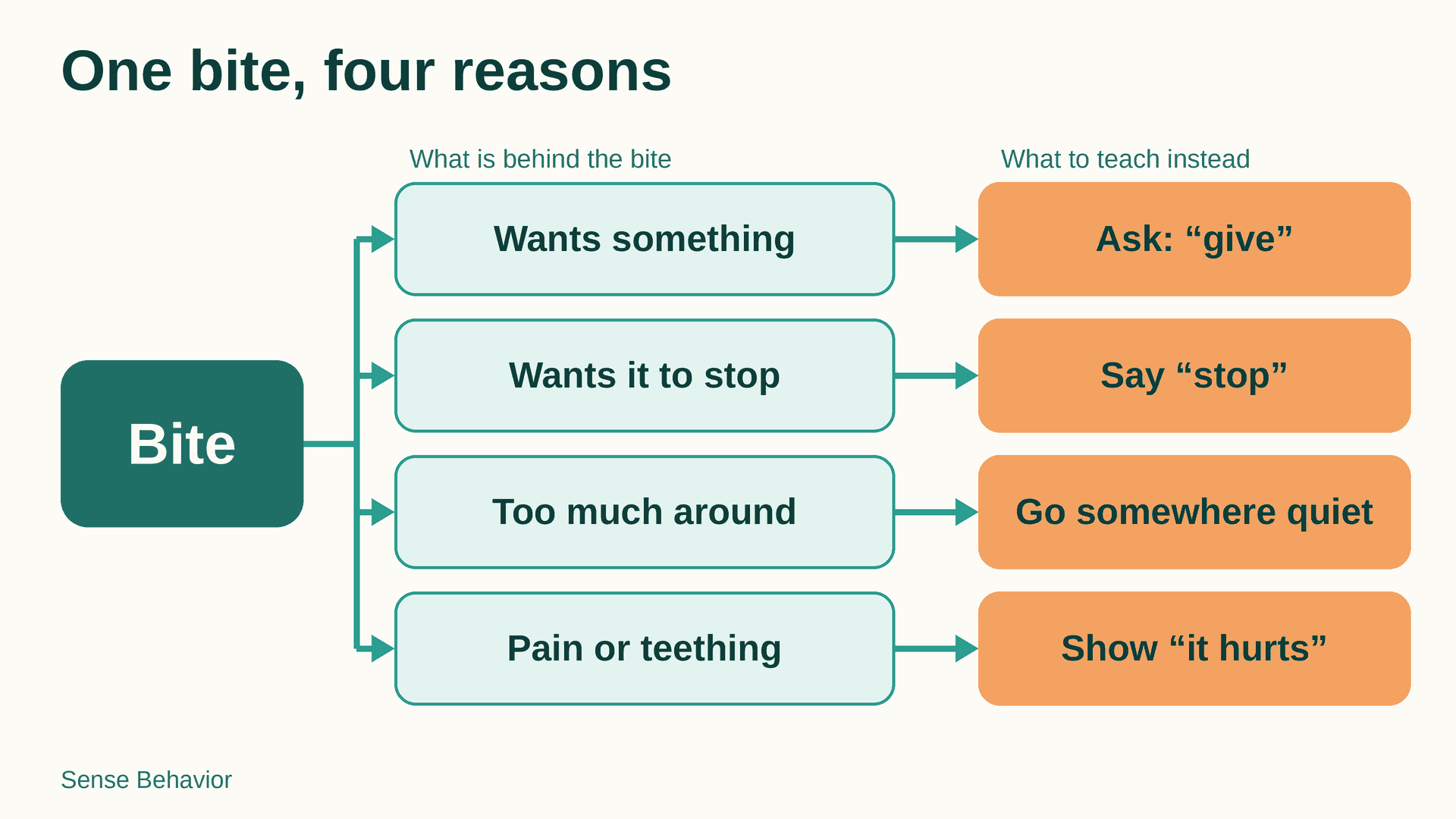
The behavior is one, the reasons differ, and the reason decides the answer. How this works is explained in the article on the function of a child’s behavior.
- Wants something. A toy, food, your hand or your attention. The bite worked, and the child remembers it is faster.
- Wants it to stop. Getting dressed, leaving the playground, sitting at the table. A bite ends an unwelcome demand.
- Too much around. Noise, crowds, tiredness. The child is overloaded and protects themselves the only way they can.
- Pain or sore gums. Teething, an earache, discomfort in the mouth. In that case a pediatrician comes first.
What to do when a child bites right now
In the moment, a short routine that is the same every time works best.
- Calmly move the child away or step back so the bite ends. Shouting and long lectures are unnecessary, and extra attention can make the bite stick.
- Say one short sentence: “No biting. That hurts.” Skip the five-minute explanation.
- If someone else was bitten, look after them first. The child sees that attention moves to the person who is hurt.
- When everyone has calmed down, offer the right way: give what the child wanted, or show a card that says give.
Biting back or smacking is best avoided. The child learns only one thing: pain gets results.
How to find out why a child bites
For a few days, write down three things: what happened before the bite, the bite itself and what happened right after. In ABA therapy this is called ABC analysis. After a week a pattern usually shows up. Well, or at least a hint of one: bites before lunch, at transitions or in crowds. Then it is clearer where the child needs help.
What to teach a child instead of biting
A bite stops being needed once there is an easier, painless way to say the same thing. This is called functional communication training. The 2015 meta-analysis by Heath and colleagues combined 36 studies published between 1980 and 2011. It found that teaching a replacement way to communicate clearly reduced challenging behavior, including aggression, in people with autism, and the effect was large. Nearly all the studies were single-case designs with few participants, so the finding points the way reliably but does not promise a result for everyone.
At home, start with one request: “give” by word, gesture or card. For a step-by-step method, read How to teach a child to ask instead of screaming. And if the child directs the hits at themselves rather than at others, see the material on self-injury.
What to try at home if a child bites
Take a sheet of paper and over the next few days mark every bite: time, place, what came before and what came after. Pick one of the four reasons and prepare one answer for it, for example a card that says stop. If you suspect pain, book a pediatrician or a dentist.
When to see a specialist if a child bites
See a specialist if biting goes on for several weeks, leaves marks on the skin, has no clear reason, or other children have started to keep away. A pediatrician can come first to rule out pain. If the cause is behavioral, an individual plan from a BCBA specialist helps.
Sense Behavior specialists review such cases remotely: they look at what happens before and after a bite and choose with you the skill that will replace it. An official diagnosis is not needed for a consultation, and you can write to us through the link at the bottom of the page.