Child hits mom, what to do: reasons and how to respond

When a child hits mom, what to do first is simple: stop the hit calmly and briefly, step back or shield yourself, and work out later what the child is trying to say. Most of the time a hit works as a message. It says “I want”, “I don’t want”, “this is too much” or “look at me” when the words are not there yet. Punishment alone does not show a child what to do instead, while another way to say the same thing does.
If you are covered in bruises and tears right now, you are not alone. This is one of the most draining kinds of challenging behavior: the person being hit is the closest one, and protecting yourself without hurting back is hard. Let’s go through the reasons, the first steps, and what you can teach instead of hitting.
Why does a child hit mom: four common reasons
A hit rarely comes out of nowhere. Usually one of four goals sits behind it, and one child may have several at once.
- To get something. The child wants a snack, a tablet or to be picked up, but cannot ask, or the request went unheard.
- To escape something. Getting dressed, tidying toys, going to the bathroom. A hit makes the demand stop.
- To get attention. When mom is on the phone or talking, even a loud reaction beats silence.
- To cope with overload. Noise, crowds, tiredness or hunger when patience has run out. The hit releases the tension.
These goals are called the functions of behavior. We cover them in more detail in the article on the function of a child’s behavior. Sometimes the cause is physical, such as an ear or tooth ache, so if behavior changes suddenly, ask a pediatrician to take a look.
Child hits mom, what to do right now
In the moment of a hit the goal is simple: make everyone safer and give the child a short, clear signal.
- Protect yourself. Move the hand aside, step back, shield your face or gently catch the arm.
- Say it briefly. “No hitting. Calm hands,” in the same words every time, with no lecture and no shouting.
- Do not hit back. Force in return does not show what to do instead and usually adds tension.
- Help the child settle. If it is overload, remove noise and bright light, offer water and stay close and quiet.
- Do not hand over the wanted thing that second. Pause calmly first, help the child ask, and only then say yes.
If the outbursts come with overload, see the article on sensory overload in children.
How to tell why your child hits
For two weeks, jot down three things: what happened right before the hit, the hit itself, and what happened right after. A phone note is enough. Each note takes a minute, maybe two. After a few entries a pattern usually appears: hits come more often when the tablet is taken away, when mom is busy, or in a noisy place. This record is called ABC analysis (antecedent, behavior, consequence). It helps you and any specialist you see later.
What to teach a child instead of hitting
The idea is simple: if a hit says “I want” or “I don’t want”, the child needs another way to say the same thing, one that is faster and easier than a hit. In ABA this approach is called functional communication training. The child learns to ask with a word, a gesture or a card, and the hit stops bringing the result it used to bring.
- Wants to get something. Teach asking with a word or a card.
- Wants it to stop. Teach asking for a break.
- Needs attention. Teach calling “Mom, look” and notice the calm minutes.
- Overload. Move to a quiet place early.
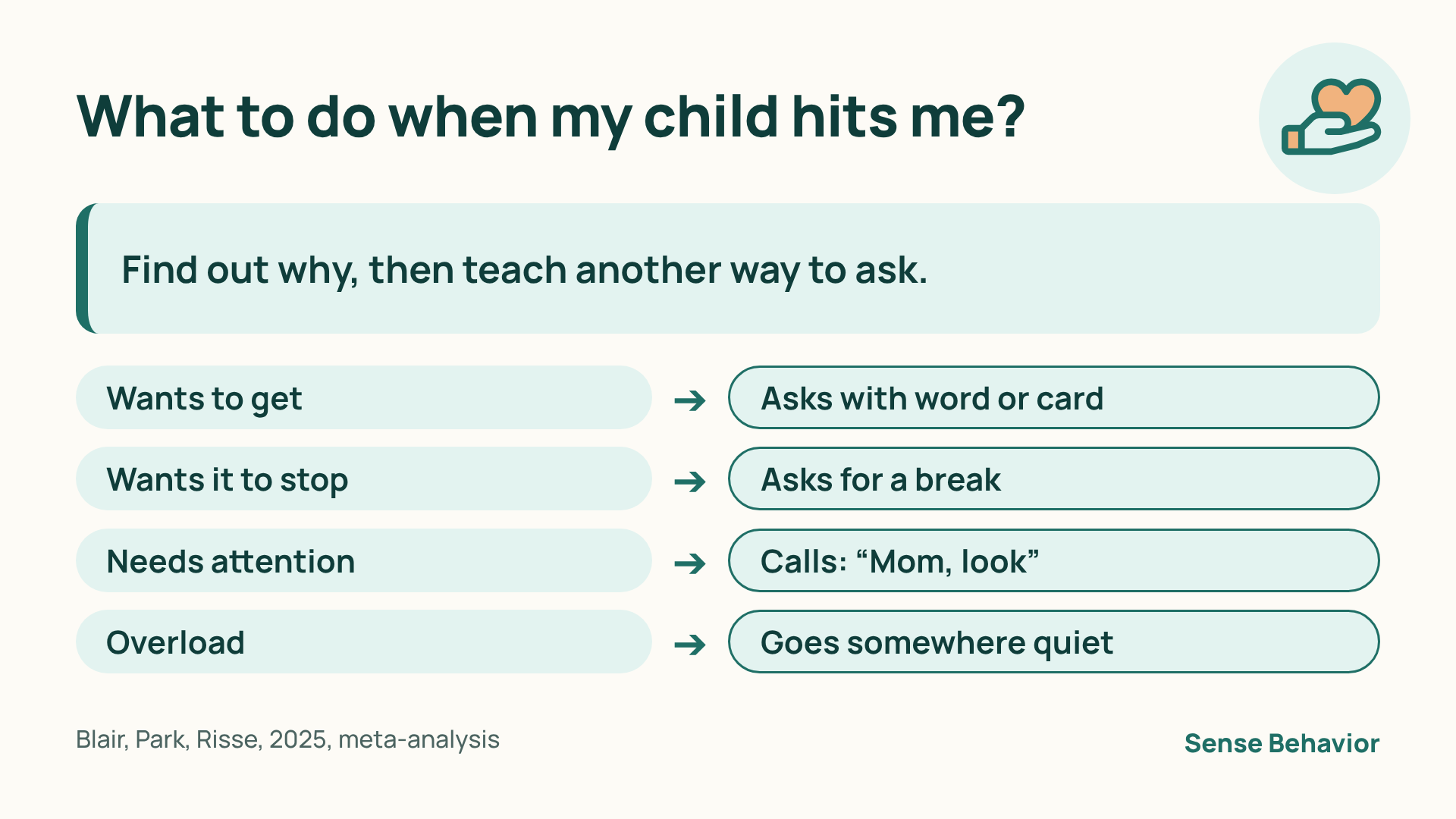
A 2025 meta-analysis by Blair, Park and Risse shows how this works. The authors pooled 34 studies from 1996–2021 that involved young children with an ASD diagnosis. Training a child to replace challenging behavior with communication gave a large effect in reducing that behavior. Only 29.4% of the studies met What Works Clearinghouse standards, and the effect was clearly larger at school than at home. The method has been studied and the authors’ conclusions lean in its favor, but the quality of part of the work is limited, and at home the result is harder to reach without a specialist’s support. For how to teach asking, see How to teach a child to ask instead of screaming.
When to see a specialist if your child hits mom
Reach out to a behavior specialist (a BCBA or a teacher with ABA experience) if the hits leave bruises or injuries, the child hits others too, the situation keeps growing over several weeks, or you are afraid to be alone with the child. A specialist will look at what comes before the hit and build a plan for your family. Nobody can give a diagnosis from a description, but a behavior analysis can start without one. If your child also hits themselves, read about self-injury.
Where to start if your child hits mom
Pick one phrase (“No hitting, calm hands”) and one way to ask (a card or a word), tell every adult at home, and tonight write down the first three incidents in your notes.