Autistic Inertia: Why Starting, Stopping and Switching Feel So Hard

Autistic inertia is a difficulty starting an action, stopping it or switching to another, described by autistic adults. You know what needs doing and you want to do it, yet the start does not happen. This is not laziness or weak willpower. If you recognise yourself, it is a reason to look closer at how you are and, if you wish, to talk it over with a specialist, but it is not a diagnosis.
Below we look at what the first study built on participants' own accounts tells us, how it shows up in life and what helped.
What is autistic inertia and where does the knowledge come from?
The term circulated in autistic communities for years, and research on it began only recently. A study by Buckle and colleagues (2021) included 32 autistic adults aged 23 to 64. They shared their experience in six focus groups, four held in person and two as written online discussions. The lead author is autistic too.
Participants described trouble with three actions: starting, stopping and switching. Starting was the hardest, in their words. One person explained that once in motion things go fine, but getting started can take a very long time.
What does it look like? What the participants described
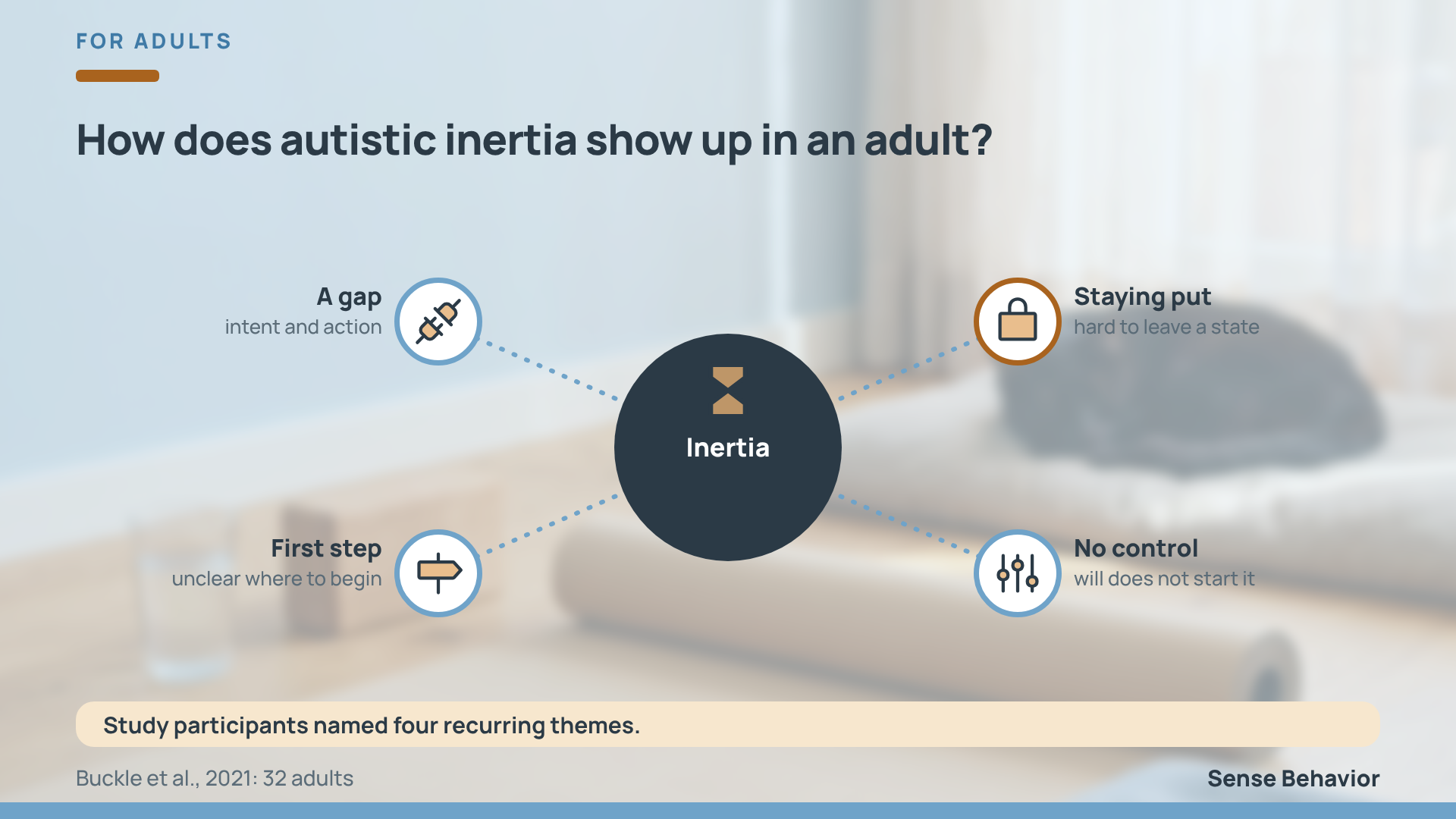
The researchers identified four themes:
- Staying in one state. It is hard to move out of what you are doing, or not doing, right now.
- Lack of voluntary control. The intention is there, but starting on your own will does not work.
- Finding the first step. It is unclear where exactly to begin.
- A gap between intention and action. Some described feeling physically unable to move, and passivity.
Participants named weighty consequences: constant exhaustion, stress, unmet basic needs such as eating, drinking and self-care, lower productivity at work and trouble keeping friendships and relationships. Anxiety and low mood could worsen inertia, yet many said it happens on even days too.
How is inertia different from laziness, depression and ADHD?
Nobody can tell them apart from a description, and a specialist does that after an assessment. A few pointers still help. Participants stressed that the wish to act is there and the start does not happen. Low mood and anxiety can worsen the difficulty, and inertia was also described outside bad moods.
It shares some features with ADHD, for example trouble starting tasks. We wrote about this in the piece on executive function in ADHD, and how the two conditions differ and overlap is covered in autism and ADHD in adults. The study authors noted that some accounts had features resembling catatonia, so if you suddenly cannot move or speak for a long time, tell a doctor straight away.
What helps with inertia? What participants reported
Participants named help that worked for them:
- Another person starts the task or is simply nearby. Some agreed on a "stuck buddy" they could text.
- Someone works close by without interfering.
- A deadline or an appointment at a set time, although a deadline could add stress.
- Very small steps and talking to yourself aloud.
- A familiar routine and cues in the surroundings.
Alarms, lists and reminders mostly did not help. That is curious, since they are what people advise first.
The study has limits. It involved 32 people, many of whom came to a special event for autistic people, and people with minimal speech did not take part. It describes experience and does not show how common inertia is, so not everyone will find themselves in it.
Where to start today if you recognise yourself
- Name the smallest first step. Instead of "tidy up", try "pick up one cup".
- Ask someone close to sit nearby while you begin, or to text you at the right time.
- Write down three or four times the start failed: what you were doing, what was around and what helped.
- If you cannot eat, drink or get up for many hours in a row, see a doctor the same day.
If getting stuck keeps happening and affects work and relationships, talking to a specialist will help find the cause. How an assessment goes is described in autism diagnosis in adults, and how built-up exhaustion turns into a crash is covered in masking and burnout.
This material is for informational purposes only and does not replace a consultation with a specialist.