Mom Cannot Work Because of Her Child: What Can Be Changed

A mom cannot work because of her child more often than people say aloud, and the reason is usually not unwillingness. Therapy schedules, doctors, a kindergarten that will not take the child and nights without sleep simply leave no windows. Before deciding “work or not,” it is worth looking at what can be changed. Below are five levers and an order to start in.
If you are at home now and feel guilt or anger, that makes sense. These feelings are familiar to many mothers and they do not mean you chose wrongly. Why family income falls for years is covered in the article on the motherhood penalty, and this one is about what can be moved.

Why a mom cannot work because of her child: what is behind it
Usually there is a whole set of obstacles at once.
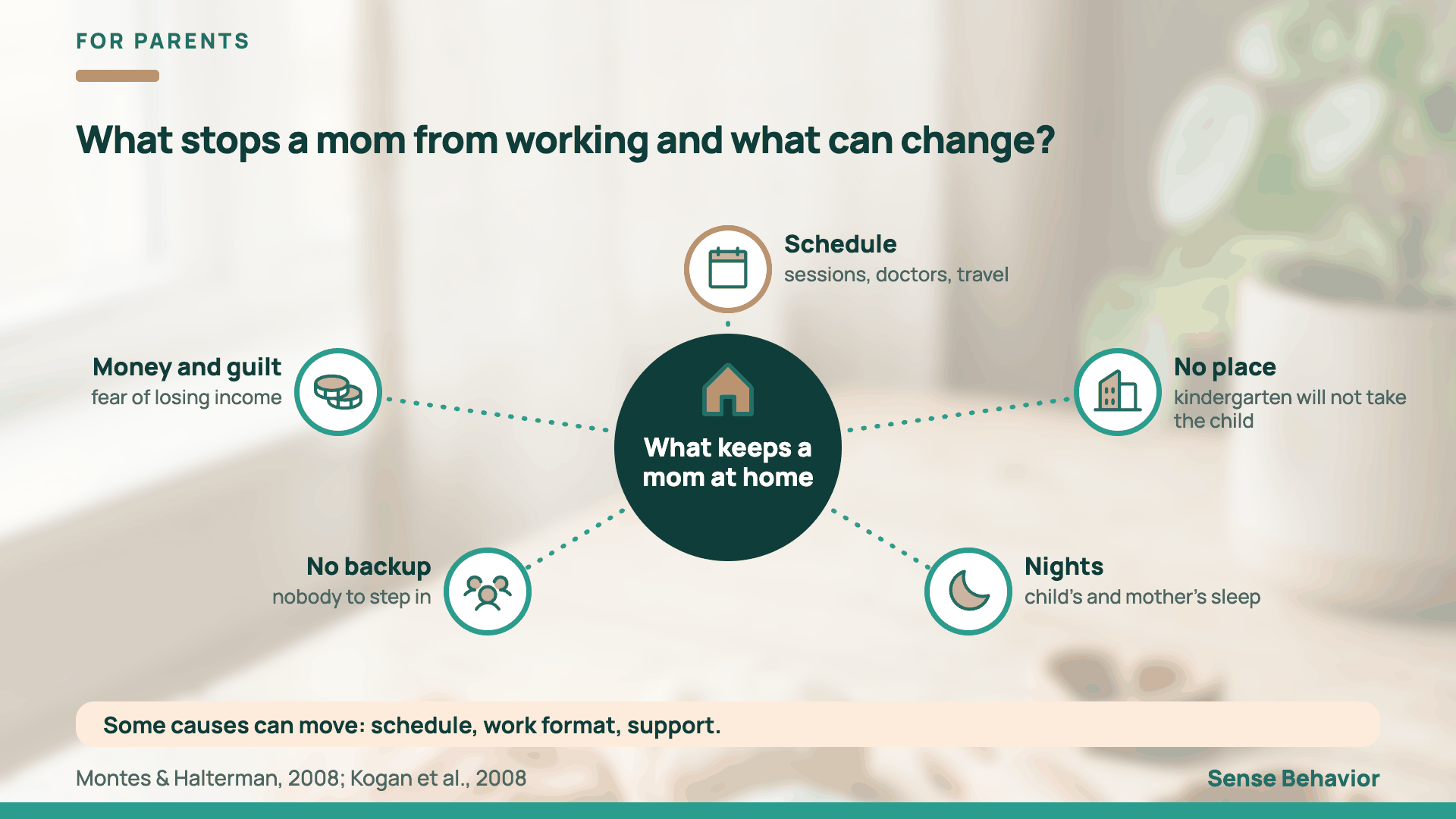
- The schedule. Sessions, doctors and travel take the daytime hours, and only the evening is left for work.
- No place for the child. Kindergarten or school will not take the child and a nanny with the right experience cannot be found, see the article on what to do if a child is not accepted to daycare.
- Nights. If a child sleeps badly, there is no energy for work in the day, and that is not laziness.
- No second pair of hands. There is no adult nearby to step in even for a few hours.
- Money and guilt. The fear of losing income goes together with the feeling that a mother must always be there.
What research shows about mothers and work
A US national survey from 2005–2006 (Kogan et al., 2008) compared 2088 children with ASD aged 3 to 17 with other children with special health care needs. Families of children with ASD more often reported financial problems, more often cut back or stopped work because of the child's condition and more often spent 10 hours a week or more providing or coordinating care.
Another study (Montes & Halterman, 2008) estimated income loss from a survey of the parents of 11,684 schoolchildren. Having a child with ASD was linked to lost income: on average 6200 dollars a year, or 14% of family income. These are American data, but they show you are not alone in this situation.
What can be changed: five levers
All five move a little at a time, and it is enough to start with one.
- The schedule. Ask the specialist to shorten, combine or move some sessions so that whole blocks of time appear.
- The work format. Remote work, projects or part time often fit better than full time.
- Support. Kindergarten, a nanny, relatives and a group of other parents. Two adults in reserve matter more than one very strong one.
- Money. Draw up a budget for a hard period and find out about benefits and allowances in your country.
- Rest. At least one free block a week, otherwise the other levers will not hold.
Where to start if you cannot work right now
Not working right now is also a decision, and it can be reviewed.
- Write down three specific reasons that get in the way, not a general “it is not working.”
- Pick one lever for a month and change nothing else.
- Keep a link with your profession: one course, one small project or a talk with former colleagues.
If relatives do not understand why it is so hard, the article on explaining autism to relatives can help. And if exhaustion has been building for weeks, read about burnout in mothers.
When to ask for help
It is worth seeing a psychologist or a doctor if any of this is true.
- Low mood or anxiety lasts several weeks and gets in the way of looking after yourself.
- Sleep is disturbed even though the child sleeps calmly at night.
- Thoughts that you are not coping repeat every day.
Where to start today
Write down three reasons that stop you from working and mark which one can be moved first. That is enough for one evening.
If you would like to talk through your family's situation the Sense Behavior specialists work online with parents in different countries. You can write to us using the link at the bottom of the page.
Sources
- Kogan M. D. et al. (2008). A national profile of the health care experiences and family impact of autism spectrum disorder among children in the United States, 2005–2006. Pediatrics, 122(6), e1149–e1158.
- Montes G., Halterman J. S. (2008). Association of childhood autism spectrum disorders and loss of family income. Pediatrics, 121(4), e821–e826.