Co-regulation for a child with autism: what it is and how using your own calm works
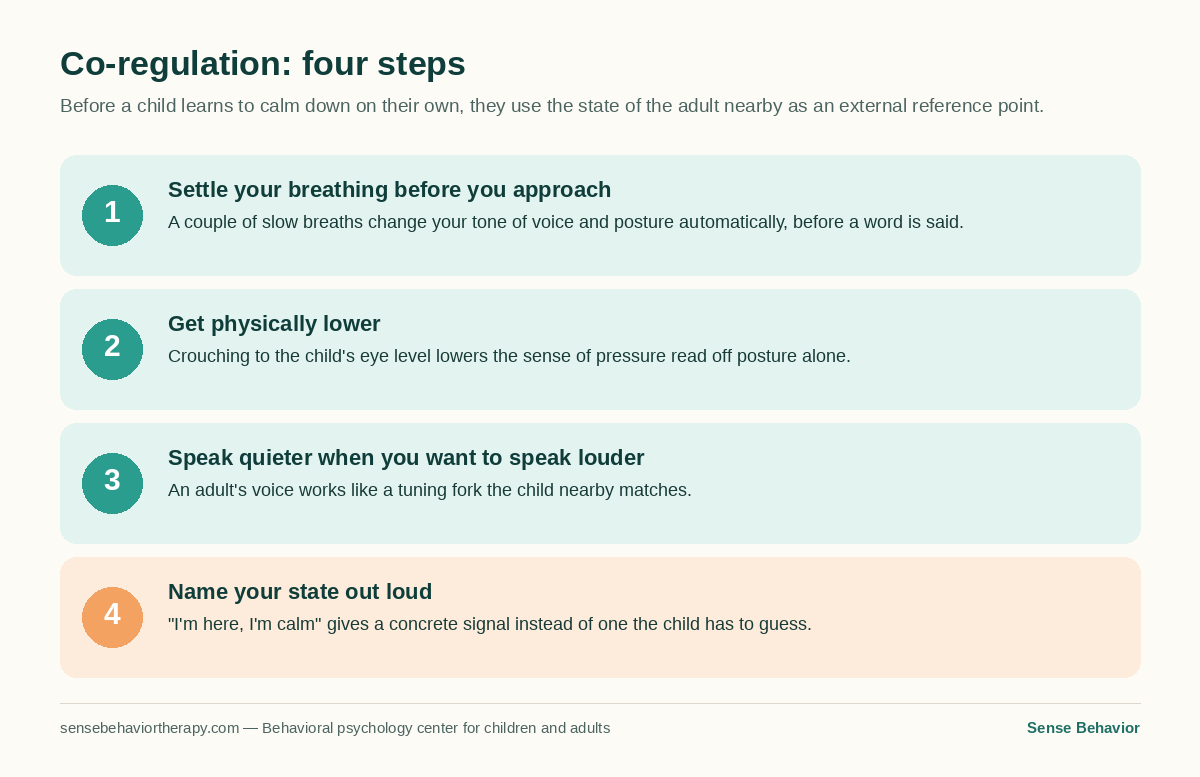
Co-regulation for a child with autism has become one of the most talked-about ideas in parenting circles in 2026, with a whole movement now built around it called «polyvagal parenting.» Behind the trendy label is a simple idea: before a child learns to calm down on their own, they use the state of the adult nearby as an external reference point. If a voice shakes, breathing gets ragged, and shoulders tense up, a child reads that before a single word is spoken. For a family raising a child with autism, this isn't abstract psychology, it's a working tool that's actually been tested.
What the research shows
In 2017, Canadian researchers studied 51 parent-child pairs, with school-aged children on the autism spectrum, and looked at how a parent's co-regulation strategies, a child's emotion regulation, and behavioral difficulties connect (Weiss et al., 2017). It turned out that specifically how a parent scaffolds a child through rising stress predicted the level of externalizing difficulties like aggression and defiance, and that link held even after controlling for the child's age and IQ. For internalizing difficulties like anxiety, the link was less clear-cut, so the researchers are cautious about broad conclusions there. But for the most common parenting concern, behavior directed outward, a parent's own state turned out to have a measurable role.
What co-regulation looks like in practice
Co-regulation doesn't mean staying unflappable or hiding emotion. It means managing what the child actually sees and hears in a moment they can't yet manage on their own.
- Settle your own breathing before you approach. A couple of slow breaths before walking up to a child mid-meltdown changes your tone of voice and posture automatically, before you say a word.
- Get physically lower. Crouching to the child's eye level instead of standing over them lowers the sense of pressure a child reads off an adult's posture alone.
- Speak quieter when you want to speak louder. An adult's voice works like a tuning fork: raise it along with the child's screaming and you both escalate together, lower it and the child has something to match instead.
- Name your own state out loud, briefly. «I'm here, I'm calm» sounds simple, but it gives the child a concrete signal about what's happening with the adult right now, instead of one they have to guess at.
What to do when you're at your own limit
Co-regulation only works when the adult has at least some reserve left to share. Demanding calm from yourself on empty doesn't work, and faking it usually gets read by the child even faster than real irritation does. If you realize you're approaching a child already at your limit, it's more honest to give yourself thirty seconds first, step into another room for a breath, or hand off to a second adult if one's around, than to walk in with a raw voice. If that state of being at the limit isn't occasional but constant, it's worth addressing on its own, not just the specific meltdown in front of you: parent burnout.
How this factors into Sense Behavior's programs
In consultations, we often hear that a parent has already tried every technique and none of it worked, but going through the specific situation together usually reveals that the technique itself was the right one, it was just applied at a moment when the adult was already at the peak of their own stress. A specialist at Sense Behavior looks not only at the child's reaction but at what state a parent is usually in at the moment a crisis hits, and works with the family to find a realistic way to lower that tension ahead of time, rather than heroically fighting through it again each time.
You can start with a free thirty-minute consultation, where we'll walk through a typical crisis scenario in your family and what's happening on both sides in that moment.