Time Blindness in ADHD: Why Time Slips Away and What Helps

Time blindness in ADHD is the everyday name for trouble sensing time. An hour feels like five minutes, “just a little longer” runs into the night, and there is never enough time for the trip. Laziness has nothing to do with it, and the term is not a diagnosis either, since it is not among the diagnostic criteria. Research confirms the idea only unevenly so far.
Plenty of confident claims circle this topic, from “just pull yourself together” to “I definitely have ADHD”. Here are the five most common and what stands behind each. If this sounds familiar, it is a reason to look closer at your own experience. It is not a conclusion about ADHD, since a specialist makes that diagnosis after an assessment.
People usually mean something like this by the term.
- A task feels shorter than it is, and the deadline arrives by surprise.
- Absorbed in something, you miss that two hours have passed.
- You left “on time” and were late anyway.
- There is “now” and “urgent”, and the stretch between them is hard to feel.
Time blindness in ADHD: five claims and what the data say
The most recent review on adults comes from Mette (2023). The author searched a decade of work on time perception in adults with ADHD. Of 535 papers read in full, 9 made it into the review, and the author calls the evidence very scarce. So every verdict below is cautious.
Claim 1. “It is a diagnosis.” Verdict: no. There is no such diagnosis. The term is an everyday one and is not among the diagnostic criteria.
Claim 2. “Research has proven that adults with ADHD have a distorted sense of time.” Verdict: uneven so far. Time estimation is worse in adults with ADHD in some studies and shows no clear difference in others. Accuracy when reproducing intervals was lower in some work, with larger gaps over longer intervals. The author’s conclusion is cautious: difficulties with timing are described, but results are mixed.
Claim 3. “It is the same as ordinary lateness.” Verdict: it cannot be told apart from a description. That takes an in-person assessment, and poor sleep, anxiety and low mood also distort the sense of time, so the same complaints appear in different conditions. These points can help you shape a question for a specialist.
- You want to be on time and cannot manage it, and that feels awkward and stressful.
- The trouble repeats at work, at home and in plans with friends, not in one place only.
- It was there before the stressful or sleepless periods.
If starting and planning are hard too, the article on executive function in adult ADHD covers that neighbouring difficulty.
What to do when pulling yourself together is not enough
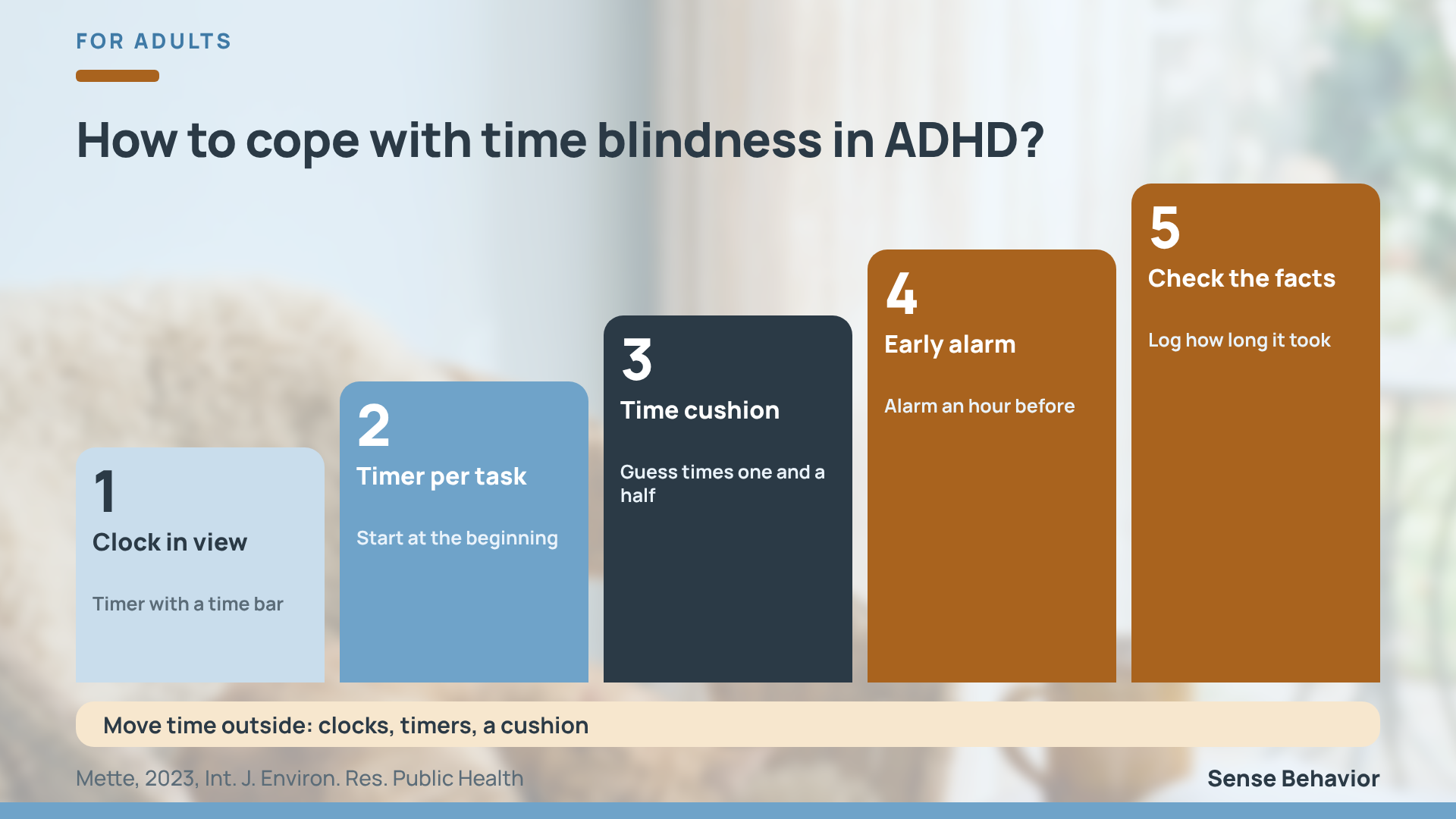
Claim 4. “You just need to pull yourself together.” Verdict: you can act differently. If your inner sense of time is hard to trust, you can move it outside. These are practical tips, and direct research on how well they work for time blindness in adults is thin, so try them one at a time and see what holds.
- Clock in view. An analog clock or a timer with a bar of remaining time in your line of sight.
- Timer for the task. Start it at the beginning to watch time go by.
- Time cushion. Multiply your “twenty minutes” guess by one and a half.
- Early alarm. Set the signal an hour before you leave, not at the moment of leaving.
- Check against facts. Write down how long a task took and compare it with your guess.
Other approaches, from coaching to cognitive behavioral therapy, are in the article on coping with adult ADHD without medication. It is the next stop if timers and notes fall short.
When these observations are worth a talk with a specialist
Claim 5. “If this is about me, I have ADHD.” Verdict: the conclusion is premature. This one sign does not make a diagnosis. Talk to a doctor or psychologist if you notice any of the following.
- Lateness and missed deadlines get in the way of work, study or relationships.
- Timer tricks have not helped for several weeks.
- Strong anxiety, low mood or sleep problems come along with it.
Bring notes on where your time disappears. How an assessment works is described in adult ADHD diagnosis, and reading it beforehand helps you arrive prepared.
This material is for informational purposes only and does not replace a consultation with a specialist.