Late autism diagnosis: what adults feel and what to do next

A late autism diagnosis in adults most often brings several feelings at once: relief that there is an explanation and grief for the years lived without one. These feelings sit side by side, and that does not mean you are reacting the wrong way. Studies of people diagnosed after 30, 40 and 50 describe a similar picture. Below is what they found and what you can do in the first weeks.
If your report arrived recently and your head holds “finally” and “why so late” at the same time, many people know that mix. It does not follow a schedule, and nobody has a deadline for it.
What a late autism diagnosis makes adults feel
The three studies discussed below keep returning to the same feelings. Not everyone goes through all of them, and the order differs.
- Relief. An explanation appears for why so much was harder than it seemed to be for others.
- Grief. Thoughts come about the years when nobody knew and about how life might have gone.
- Anger. At people who brushed things aside, gave other diagnoses or advised “just pull yourself together”.
- Confusion. It is unclear who “I” am now and which habits were a mask.
- Belonging. A sense grows that there are people with a similar experience.
How researchers found this out: three studies step by step
First comes the study by Leedham and colleagues (2020) in the journal Autism. The authors interviewed 11 women diagnosed after the age of 40. They identified four themes: a hidden condition (participants “pretended to be normal”), the process of acceptance, the reactions of others and a new identity. For several participants the diagnosis helped move from self-criticism to kinder treatment of themselves and gave a stronger sense of control over their lives. Adjusting to a new identity at that age was painful.
Then Stagg and Belcher (2019) interviewed 9 people over 50 who had been diagnosed recently. Many had earlier received treatment for anxiety and depression, and in childhood they had felt isolated and “alien”. The participants called the diagnosis a positive step: it let them see themselves differently and understand their needs better.
The newest work, Pollock and Krupka (2026), is based on interviews with 10 Australian women diagnosed after 30. Their median age was 47.5 years. The authors found seven themes: frustration at the barriers on the way to a diagnosis, fear and self-doubt, grief at revisiting the past, shock at the new self, anger at being dismissed, relief at being able to be oneself, and pride and belonging. The women also spoke about autistic burnout and about the lack of support after the diagnosis.
Why relief and grief arrive together
An explanation changes the view backwards. When for years you had to adapt, hide tiredness and receive help for anxiety without knowing the cause, a diagnosis lets you see your own story anew. At the same time you can see how much energy it all took. The authors of the first study call this revision of life painful, yet for many participants it proved a needed step towards acceptance.
Masking often appears in such stories, meaning the habit of hiding traits for politeness and safety. It and the burnout linked to it are covered in the article on masking and burnout. Women’s stories are looked at separately in the piece on autism in adult women.
What to do if doubts appear after the diagnosis: “what if it is a mistake”
Self-doubt after a diagnosis is common. In the study by Pollock and Krupka the women spoke about fear and uncertainty on the way to acceptance. The thought “what if I made it all up” does not mean the report is wrong, and it can be checked without rushing.
- Reread the report and underline the wording you recognise in your own life.
- List three or four situations from childhood or school that look different now.
- Ask the specialist directly: “What is the conclusion based on, and what in my case supports it?”
- If the doubts stay, talk them through with a doctor or psychologist. You are entitled to a second opinion.
Doubt does not cancel a diagnosis, and there is no need to fight it by willpower. Time and clear information are enough.
What to do in the first weeks after a late diagnosis
There are usually no urgent decisions after a diagnosis. Below is an order you can take as a guide. The timing is approximate and there is no scientific norm for it.
- First days. Give feelings room: write down what comes up without judging it. Put decisions about work and relationships on hold.
- Weeks 1 and 2. Reread the report and write down questions for the specialist.
- Weeks 2 to 4. Tell one close person who will listen without judgement. Others can wait.
- First month. Pick one habit that lowers the load: breaks from noise, regular sleep, fewer back-to-back calls.
- After that. Find a specialist or a group with experience of working with adults after diagnosis.
What to say to close people and colleagues after the diagnosis: ready phrases
Finding words in the first weeks is hard, so here are a few templates. Swap in your own.
- To a close person: “I got my report. I need time to take it in. It would help if you just listened.”
- To a partner: “This explains a lot of what we ran into. I want to work through it together, without looking for someone to blame.”
- To parents: “I am not asking you to rewrite the past. I want you to know what is happening for me now.”
- To colleagues, telling is optional. Naming the conditions you need is enough: “I work better when tasks come in writing.”
How to decide whether to mention a diagnosis at work is covered in the article on whether to tell your employer.
How to explain the diagnosis to close people: three short lines
- What it is: “My brain processes communication and noise differently, so I need different conditions.”
- What has not changed: “I am the same person, I just know the reasons now.”
- What you need from them: one concrete request, for example a warning about plans a day ahead.
You cannot explain everything in one conversation, and nobody expects that. One clear sentence and one request are enough to begin.
What a late diagnosis looks like in different life situations
Three typical situations without names show how priorities differ at different points in life.
- A diagnosis in the early thirties after burnout. The first job is usually to lower the load and discuss working conditions. Big decisions such as a career change can wait.
- A diagnosis around forty-five, with a family. It matters how a partner hears it and how household tasks are shared. A short talk about specific inconveniences works better than a talk about the entire past.
- A diagnosis after fifty, when a career is behind you. The participants in the study by Stagg and Belcher saw the diagnosis as a chance to understand themselves anew. Support is worth looking for in communities of people of a similar age.
These are general landmarks. Your path is set by your circumstances and your needs.
What to do if close people dismiss the diagnosis
The reactions of others are described separately in the studies: the participants of Leedham and colleagues spoke about stereotyped assumptions, and those of Pollock and Krupka about anger at not being heard. A phrase like “but you look fine” hurts even when it is said without ill intent.
- Answer with a short fact: “A specialist issued the report after an assessment. It matters to me that it is taken seriously.”
- Ask instead of arguing: “You do not have to agree with everything. Try just listening for a month, then we can talk.”
- Take a pause when the talk goes in circles: “Let’s come back to this another time.”
- Find support outside the family: communities where nobody asks you to prove the diagnosis.
You do not have to convince everyone. For a start it is enough that people stop talking you out of your own experience.
Common mistakes in the first months after a diagnosis
- Rewriting a whole life in one night. Memories come in waves. Write them down and return to them bit by bit.
- Comparing yourself with other people’s stories. Everyone has their own path and pace. Someone else’s account is useful as a landmark and fits poorly as a template.
- Making big decisions at the peak of emotion. Quitting a job or ending a relationship is better thought through once the sharpness has passed.
- Expecting close people to react the same way. Studies also note the stereotyped assumptions of others. Give people time and a short explanation instead of a lecture.
- Taking off the mask entirely and at once. Habits are easier to change one at a time.
When to get help from a specialist after a diagnosis
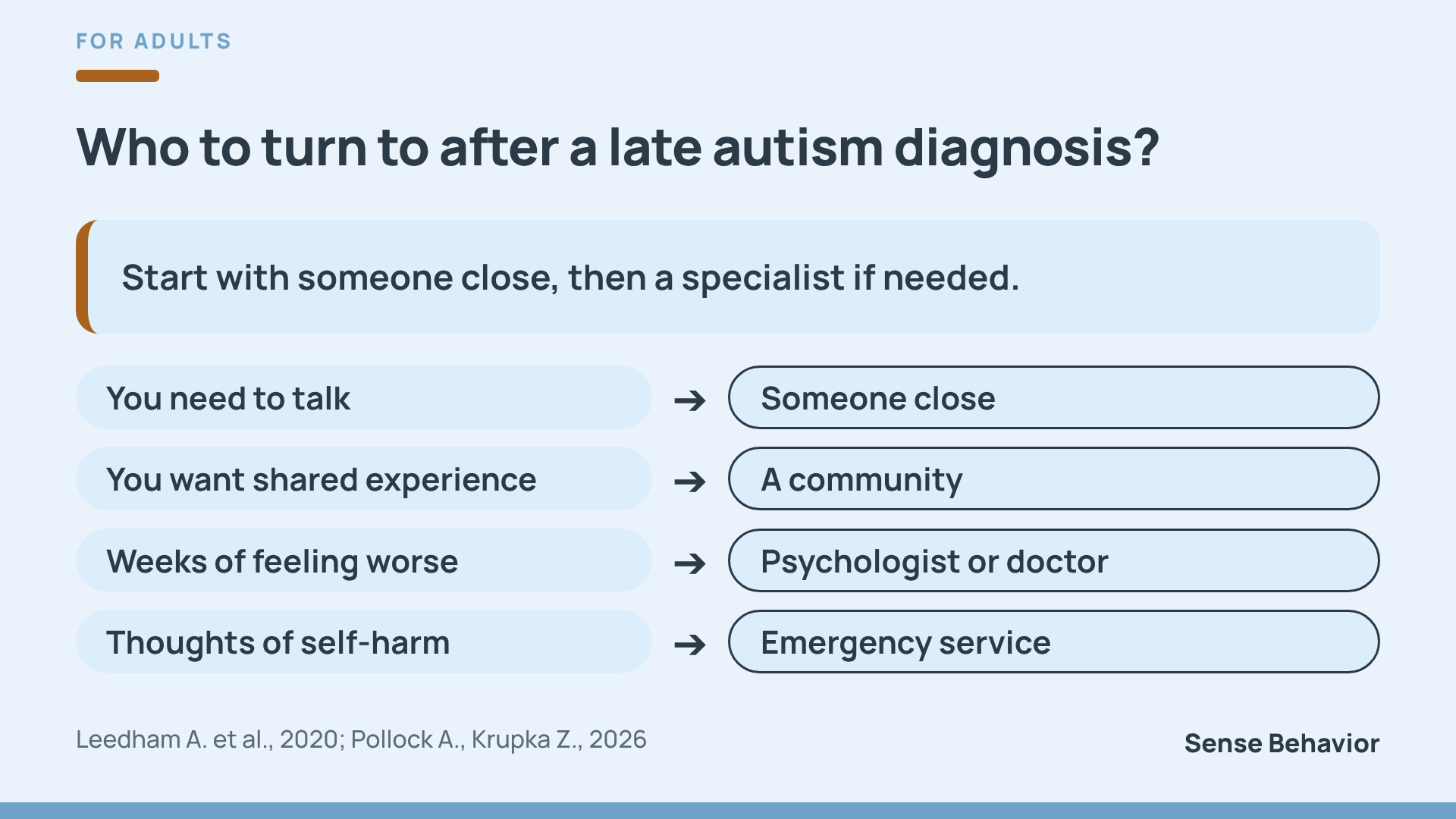
Time and the support of close people help many, but sometimes a specialist is needed. It is worth doing if:
- sleep, appetite or mood has been clearly worse for several weeks.
- anxiety or low mood gets in the way of work and communication.
- thoughts of harming yourself appear. Then contact the emergency service or a crisis line in your country.
- you do not understand the report and want it explained by a doctor or psychologist.
If you are only thinking about a diagnosis for now, remember that only a specialist can make one, and how an assessment goes is described in the article on autism diagnosis in adults.
What these studies cannot tell you
All three studies involved small groups: 11, 9 and 10 people. Two of them included only women, and these are interviews about experience and not a forecast for each person. Countries and health systems also differ, so your path may look different. The studies show which feelings turn up more often and help you see that you are not alone, but they cannot predict your own reaction.
Sources
- Leedham A., Thompson A.R., Smith R., Freeth M. (2020). «I was exhausted trying to figure it out»: The experiences of females receiving an autism diagnosis in middle to late adulthood. Autism, 24(1), 135–146.
- Stagg S.D., Belcher H. (2019). Living with autism without knowing: receiving a diagnosis in later life. Health Psychology and Behavioral Medicine, 7(1), 348–361.
- Pollock A., Krupka Z. (2026). Late bloomers: Exploring the emotional landscape of Australian women's experiences of a late Autism diagnosis. Autism, 30(2), 426–438.
This material is for informational purposes only and does not replace a consultation with a specialist.