ADOS-2 for adults: what it is and whether you can take it online

ADOS-2 for adults is carried out by a trained specialist as a structured conversation with set tasks. A questionnaire filled in at home works differently, and you cannot assign ADOS-2 to yourself. Sometimes it runs over video, and even then a specialist sits on the other side of the screen.
If you searched for an “ADOS test online” and found dozens of forms, that confusion is common. Below we look at how ADOS-2 differs from self-check tests, how the appointment goes and what is known about the video version.
What ADOS-2 for adults is and when it is used
ADOS-2 (Autism Diagnostic Observation Schedule, second edition) is a standardized observation of communication, interaction and behavior. Fluent-speaking teenagers and adults have their own Module 4. It is usually used when a person’s history and questionnaires leave the picture unclear.
A specialist with dedicated training runs it. According to the Texas Autism Network, the session takes 40 to 60 minutes.
How an ADOS-2 assessment goes for an adult
The appointment feels like a conversation with a few tasks. The specialist does not ask about a diagnosis directly. They observe.
- A conversation about daily life, relationships and work.
- A few tasks that show how you communicate and explain things.
- After the session the specialist codes the observations and totals the score.
Can you take ADOS-2 online by yourself
No. There is no self-test version of ADOS-2, because giving and scoring it takes special training. A page titled “ADOS test online” is most likely a questionnaire such as the AQ or RAADS-R. Those forms help you gather your thoughts before a doctor’s visit, but they do not give a diagnosis.
We explained how those questionnaires work in our guide to the AQ and RAADS-R tests, and there is a wider overview in the article on the autism test for adults.
Does ADOS-2 work the same over video
An online adaptation of Module 4 was compared with the in-person version at a UK adult service. The study by Blackmore and colleagues (2023) compared 163 adults assessed online with 198 adults assessed in person.
- The average total score was 6.5 online and 7.0 in person, a difference that was not statistically significant.
- The item on unusual eye contact cannot be scored on video.
- 59% of the patients surveyed (27 of 46) would not have preferred an in-person visit.
The study has limits. Only Module 4 was adapted, the work was done at a single service, and a fully online diagnostic route was not tested. So the video format is worth discussing with the clinic beforehand, and it should not be assumed an equal replacement.
Is ADOS-2 alone enough for a diagnosis
No. A diagnosis draws on several sources: an account of childhood, a conversation about present life, a check for other possible causes and observation. ADOS-2 is one element in that set. According to figures cited by the Texas Autism Network, it produced about 30% false positives among adults with psychosis, so a specialist always reads the result alongside the rest of the picture.
The whole route is described in the article on autism diagnosis in adults.
What to do today if you want to take ADOS-2
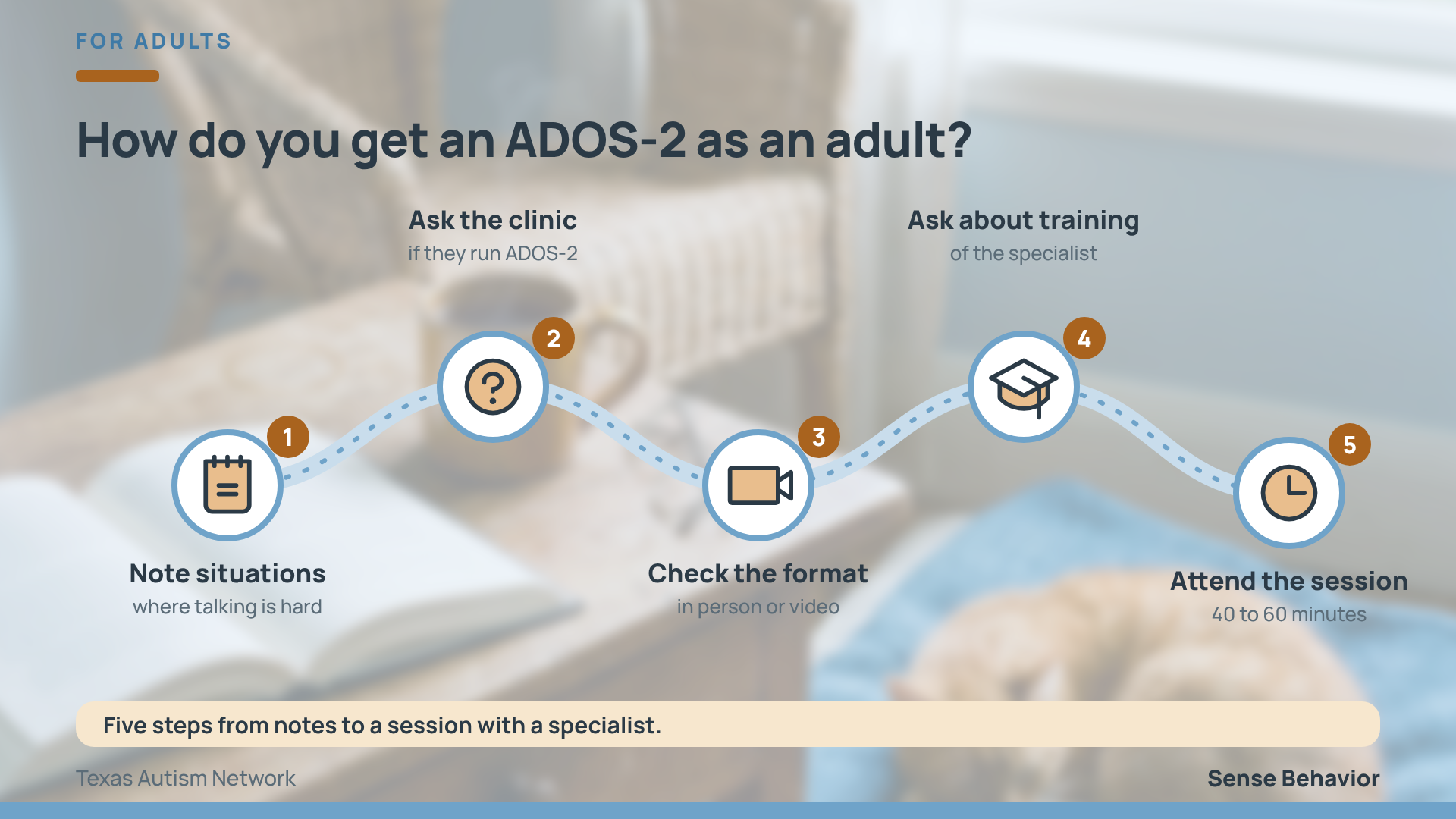
One evening is enough to prepare questions for a clinic.
- Write down three to five situations where communication or noise is hard.
- Ask the clinic which tools they use and whether they run ADOS-2.
- Check whether the session is in person or over video.
- Find out where the specialist trained in ADOS-2.
- If you filled in questionnaires, bring the results.
The final decision belongs to the specialist, and nobody can promise a result in advance.
Sources
- Blackmore C.E., Nolan A., Stoencheva V., Greenwood N., Liu-Thwaites N., Maltezos S., McAlonan G.M. (2023). Comparison of an online adaptation of the Autism Diagnostic Observation Schedule-2 with its in-person version in an adult autism diagnostic service. BJPsych Open, 9(2), e51.
- Texas Autism Network. Autism Diagnostic Observation Schedule, Second Edition (ADOS-2).
This material is for informational purposes only and does not replace a consultation with a specialist.