Token economy for kids: how to start at home, step by step

A token economy for kids works like this: after every finished task the child gets a token right away, and saved tokens are traded for a reward chosen in advance. The shorter the pause between the task and the token, the clearer the link. Below you will find the rules for one card, three ready examples for morning, leaving the house and evening, phrases you can say out loud, the common mistakes and a four-week plan.
If you have already tried stickers, smileys and the line “if you behave, you will get…”, and the evening still ended in bargaining, many families know that picture. The system works when the rules fit on one card and every adult follows them the same way.
What an evening looks like before tokens and what you may notice after two or three weeks
A typical evening without a system goes in circles. “Put on your jacket” is said five times, the reward is promised for “later”, and “later” comes at a different time every day. The child cannot see what led to the reward, the adult is worn out by eight, and every reward turns into a deal: “if I put it on, can I have the tablet?”.
A rough benchmark after two or three weeks: you repeat the request less often, the child checks how many tokens are left, and arguments about rewards shrink to a short talk by the card. This is a benchmark and not a promise, since speed differs from child to child. If nothing changes in two weeks, do not add pressure and go through the “what to change” list below instead.
What a token economy for kids is made of: six parts on one card
Scientific papers often describe token systems only partly. In the 2017 review by Ivy and colleagues, only 18 of 96 papers described all the parts in full. For home use the lesson is simple: until you have written down all six parts, the system is a set of intentions.
- Target behavior. One action you can see from the outside. Good: “puts on the jacket after we say ‘getting dressed’”. Bad: “behaves well”.
- Token. A star, a magnet or a chip the child can hold or see on a board. It should not be a toy that is more fun to play with than to earn.
- Reward. Something the child picked: ten minutes of a favorite game, a choice of cartoon, a walk with mom or dad.
- Tokens per task. At first, one token each time.
- Tokens to a reward. Three at the start, so success arrives the same evening.
- When to trade. The same day at first, right after the last token.
The last three items are called schedules of reinforcement in research. At home they are three numbers worth writing on the card: one task, one token; three tokens, a reward; trade in the evening.
How to start a token system at home: a four-week plan
The order of the launch follows the materials of the Vanderbilt Kennedy Center: begin with an easy success, hand out tokens often and make things harder step by step. The numbers in the plan are starting examples and no kind of standard.
- Preparation (1–2 days). Watch what the child picks when nobody asks. Write down three or four activities, that is your reward menu. Choose one action that already works at least sometimes.
- Week 1: an easy win. One action, three tokens to a reward, trade the same evening. The token comes right away and the child chooses a reward from two or three.
- Week 2: settling in. If tokens are earned almost daily, add a second action or add rewards to the menu. Until success feels routine, do not make it harder.
- Week 3: a small step up. Try four tokens instead of three or move the trade to the next morning. Change one thing at a time.
- Week 4: a check. Look at your notes: on how many days did the child collect the needed tokens. Six or seven days out of seven means you can go on. Three or four means step back.
The thresholds “six or seven days out of seven” and “three or four” are a working guide for your notes and not a scientific norm.
What to do today. Pick one action and one reward from the menu, draw three circles on a sheet and start this evening. A colored circle can be the token. You do not need perfect tokens and rewards at the start: what matters is simple rules and a first reward that arrives the same evening. Note the result in one line in a notebook: the date, how many tokens were collected, what went wrong. After two or three weeks these lines are enough to see a pattern.
If your child struggles to hold the order of the day in mind, start with a visual schedule and add tokens later.
What to say to your child: ready phrases
A short phrase that names what went well goes with every token. The Vanderbilt Kennedy Center advises naming the rule that was followed, and you can feel why at home: “good job” explains nothing, while “jacket is on” does.
- How to explain the system on the first evening. “Today we play tokens. Jacket on, you get a token. Three tokens, you pick a reward.” Show the card and do it together once.
- When you hand over a token. “Jacket is on, here is your token.” Calmly, without “finally” and without a long speech.
- When there were not enough tokens. Decide the response in advance. For example: “Today we were one token short. Tomorrow we try again.” No lecture, and tokens are never taken away.
- When the child asks for the reward without tokens. “The reward comes when we have three tokens. Look how many we have.” Do not argue and do not give in.
- What better not to say. “If you behave, you will get…”, “You did not earn it”, “Because of you a token is gone”.
These wordings are examples. Adjust the words to age: one phrase and a picture are enough for a three-year-old, and a six-year-old can look at a card with rules.
Three card examples: morning, leaving for daycare and evening
The examples show how to fill the six parts for different tasks. Put in your own actions and rewards.
- Morning. Task: “brush teeth until the timer sounds”. Token: a magnet on the fridge. Reward: choosing the music in the car. Two magnets for two mornings, trade in the evening.
- Leaving for daycare. Task: “put on the jacket after we say ‘getting dressed’”. Token: a chip in a jar by the door. Reward: ten minutes of a favorite game after daycare. Three chips, trade the same day.
- Evening. Task: “put toys in the box”. Token: a colored circle on a sheet. Reward: choosing the bedtime story. Three circles, trade before bed.
How to adjust the system to age and the child
Age limits are loose, so read them as examples. Look at the child and not at the number in the passport.
- Toddlers aged 2–3. One token per task, an instant reward, a large token that is easy to pick up and drop into a jar. The menu has two pictures: point and get.
- Ages 4–5. Three tokens to a reward, a card with a picture of the action, and the child moves the token into their own jar.
- Ages 6–7. The card can carry words, four or five tokens are fine, and the trade can move to the next morning. The child helps to choose the reward menu.
- If the child speaks little. Show pictures of rewards instead of asking questions and accept a gesture as the answer.
- If changes feel scary. Show the card ahead of time and do not change the rules during the day. Introduce new things in the evening when the child is calm.
Common mistakes and what to do instead
Most breakdowns start with one of these mistakes. Read the list and compare it with your own evening: usually one or two match.
- Tokens are taken away for bad behavior. The Vanderbilt Kennedy Center clearly advises never to remove tokens for inappropriate behavior, since the system then turns from encouragement into punishment. On a hard day the earned tokens stay and new ones are simply not given.
- The reward is promised for “later”. When the trade is postponed without an agreement, the link between the task and the reward fades. Trade right after the last token.
- Too many rules at once. Five goals in the first week confuse both the child and the adults. Start with one action.
- Praise that does not name the task. “Good job” explains nothing. Say: “Toys are in the box, here is your token.”
- An adult picked the reward. If the child does not care, the system does not work. Watch the child and offer a choice of two or three.
- Adults play by different rules. Mom gives a token, grandma hands over a reward without tokens. Hang the card where everyone sees it and agree on one set of rules.
If tokens do not work: what to change, in order
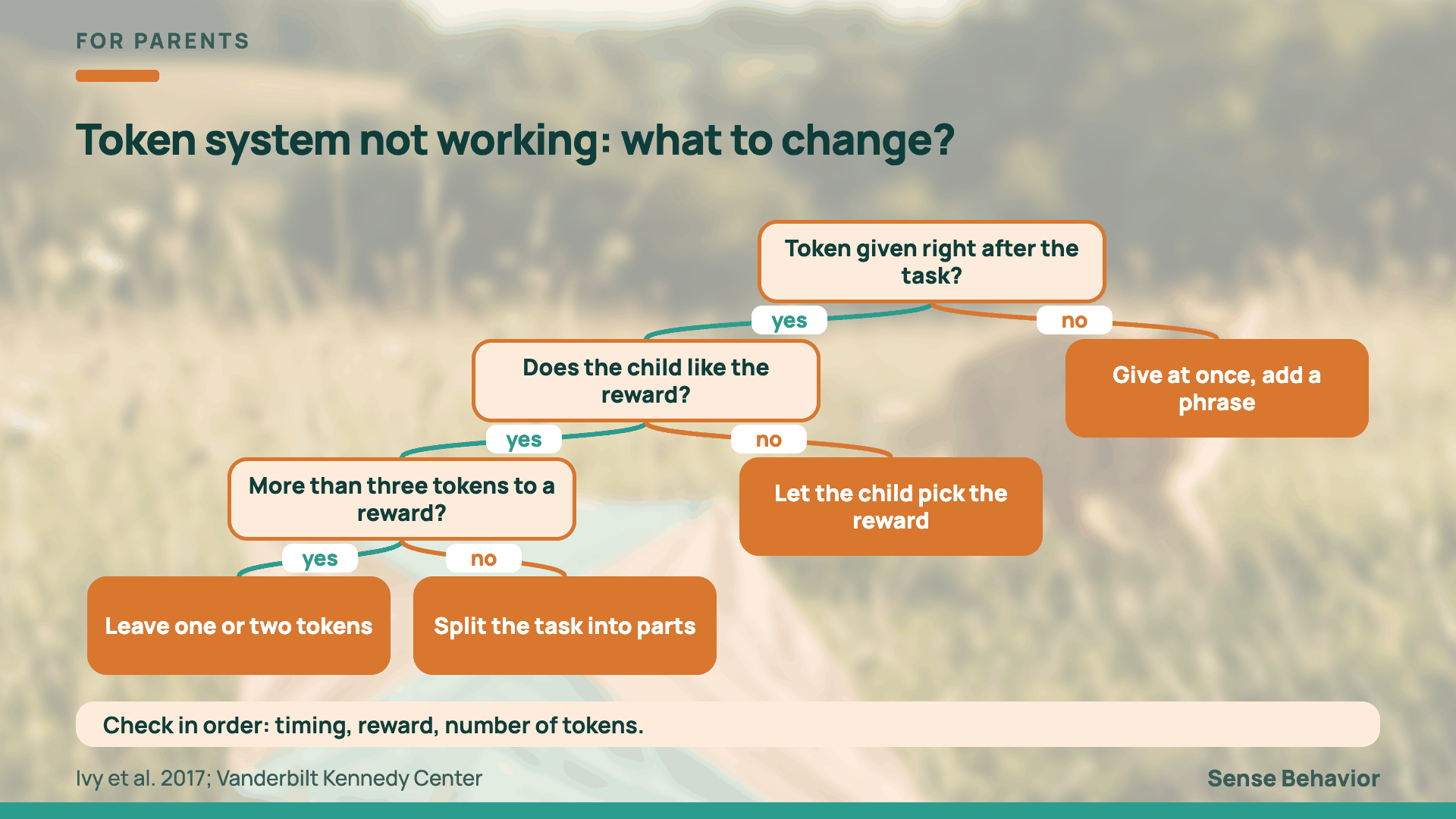
If nothing changes after a week, check the causes in order. Change one thing and watch for another week.
- The token is not given right away: give it right after the task, with a short phrase.
- The reward does not matter to the child: offer a choice of two or three and change the menu.
- The reward is too far away: leave one or two tokens instead of three.
- The task is too hard: split it into parts, for example “got the jacket” and “put in the sleeve” separately.
- Tokens get lost: keep them in view on a board or in a jar.
- Adults act differently: agree and hang the rules in a visible place.
Keep a calendar: mark a plus for every day the tokens were collected. After a week you can see whether the breakdown repeats at the same time of day or after the same task, and then you fix that exact moment and not the whole system.
A token system does not replace the reason behind the behavior. If the child screams to get attention or to avoid a task, tokens will help only partly, and it makes sense to also teach the child to ask. It is handy to write the token rules into a behavior plan for your child.
How to fade tokens once the habit has settled
Tokens are not forever. When the behavior holds, the system is thinned out step by step, and the Vanderbilt Kennedy Center lists the ways to do it. Change one of them every one or two weeks.
- Raise the number of tokens to a reward: three, then four, then five.
- Give tokens less often: not for every success but for every other one.
- Shorten the time the system runs: the whole evening first, then only leaving the house.
- Drop rewards that do not exist in everyday life, such as a tablet, and keep ordinary ones: a walk, a story.
- At the end keep only the phrase and the card, without physical tokens.
If behavior gets worse after a step, go back to the previous one. Timing differs in every family, so all of this is a guide.
When a token system needs an ABA specialist
A simple system for everyday tasks can be set up at home. In three cases it is worth discussing it with a specialist.
- The behavior is dangerous: the child hits themselves or others.
- Three weeks of adjustments have changed nothing.
- The child is not interested in any reward.
An ABA specialist chooses the goal and the reward after observing the child’s behavior. A description in a chat is not enough for that. You can get a consultation at Sense Behavior.