Rituals and Stereotypies in a Child With ASD: Causes and Meaning

Rituals and stereotypies in a child with ASD mostly exist to make the world predictable and to take some of the tension out of a day. A ritual is a set order of actions the child wants repeated exactly the same way, and a stereotypy is a movement or sound that repeats. Usually there is no need to break them, but it helps to understand what they do for your child and to notice when repetition starts taking over too much of daily life.
If you again line up the toys in the old order because otherwise there will be screaming, or have walked the same route to kindergarten for half a year, the tiredness makes sense. Repetitive behavior is common in children and does not mean a diagnosis by itself. Movement repeats are covered in the article on stimming in children, and this one is about order, routine and repetitive interests.
How rituals and stereotypies in a child with ASD differ
A ritual is a sequence of actions the child wants to carry out in exactly the same way. A stereotypy is a movement or sound that repeats without an outside goal. Specialists place both under restricted and repetitive behavior, one of the signs of ASD.
In everyday life it can look like this.
- Rituals and routines. One route, one cup, a strict dressing order, “first this, then that.”
- Repetitive interests. Trains, labels, maps, the same cartoon over and over.
- Stereotypies. Hand flapping, rocking, spinning, repeating words or sounds.
Why a child needs rituals and repetitive movements
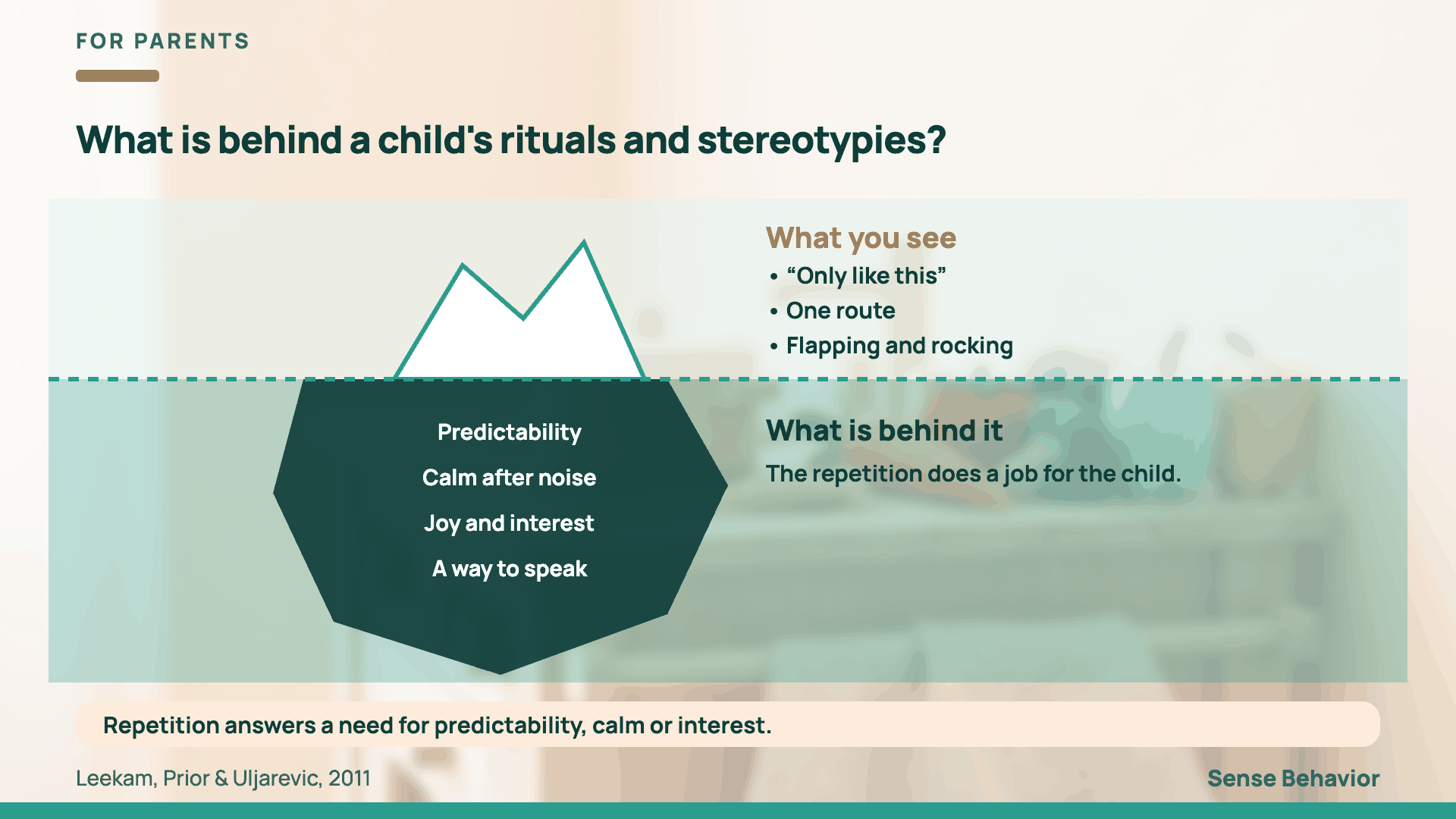
Repetition brings predictability and helps a child settle. For a child who finds it hard to guess what comes next, an identical order works like a map to hold on to.
- Predictability. When everything follows a familiar path, no energy goes into guessing.
- Calming down. A repeated action eases tension after noise, crowds or a change of activity, and the article on sensory overload in children covers that side in more detail.
- Joy and interest. A favorite topic or movement is simply pleasant.
- A way to say something. When words are few, an insistent “only like this” can mean “this is hard for me, make it clearer.”
What the research shows
A review by Leekam, Prior and Uljarevic (2011, Psychological Bulletin) gathered ten years of studies. Among the factors that start and keep this behavior going, the authors name arousal, too little stimulation around the child, and the benefit the repetition gives the child. They also write that repetitive behavior often weakens by itself as children grow and as speech and thinking develop.
Studies of interventions are still few, and of the options available the authors see behavioral methods as the better choice. This is a review, not a recipe for one particular family, and the reasons differ from child to child.
When rituals and stereotypies do not need stopping
If the repetition is safe, does not get in the way of eating, sleeping and contact, and the child is calmer afterwards, it is better to leave it. A ban without a replacement leaves the need with no way to be met.
- Sit nearby and join the rhythm if the child does not mind.
- Allow time for the usual sequence when nobody is in a hurry.
- Change the order only where it gets in the way of the whole family.
When help is needed
Pay attention if any of this is true.
- A ritual takes up most of the day and the child is hard to redirect.
- Any change brings strong panic, screaming or self-injury.
- The repetition interferes with eating, sleep, hygiene or kindergarten.
- Rituals multiply fast or have sharply increased in recent weeks.
In such cases ABA therapy first works out the function of the behavior, then prepares a safe replacement and slowly widens the limits of what feels familiar. The article on the function of a child’s behavior explains how to look for the cause. There are usually several causes and sorting them out is not easy, though sorting them out is worth it.
What to do at home: three steps for a week
Start with watching, since changes can wait.
- For three days write down what the ritual is, when it appears and what happens if it is interrupted.
- Warn about changes ahead of time with a word or a picture, for example “two more times and done.”
- Change one small thing at a time and leave the rest as it was.
When to turn to a specialist
First the child can be seen by a pediatrician to rule out pain, itching or sleep problems. If the cause lies in behavior, an individual plan from a BCBA specialist helps.
Sense Behavior specialists look at such cases remotely: they watch video, help work out why the ritual matters to your child, and decide with you what to keep and what to replace. An official diagnosis is not needed for a consultation, and you can write to us using the link at the bottom of the page.