How to teach a child to play independently: where to start
The short answer to how to teach a child to play independently: start not with persuasion or new toys, but with how the space around them is arranged. If a child won't play alone and comes back every few minutes, it is usually not about temperament or being «too clingy» — it is that the environment doesn't let them move away from an adult calmly. Here is what the research says and what you can actually change at home.
Independent play is a skill, not a personality trait
Parents often describe the situation as a property of the child: «that's just how he is, he always needs someone next to him». It's an understandable reading, but it leads nowhere — you can't do much about a personality trait, whereas a skill can be worked on.
Independent play — described in the research literature as less-structured activity, self-controlled activity or free play — is exactly that: a skill. It is built out of several simpler abilities: holding attention on one activity, deciding what to do next, tolerating mild boredom, not panicking when the adult leaves the room. Each of these develops gradually and depends noticeably on the conditions the child is in.
That is why the question «how do I teach my child to play independently» is better rephrased: not «how do I make my child play alone», but «what is stopping them from doing it right now».
What the research shows about free and independent play
There is a common worry: if a child spends a long time pottering about alone, they must be short on attention and stimulation. The data suggests rather the opposite — provided this is part of the day alongside interaction, not a replacement for it.
Researchers at the University of Colorado looked at the daily schedules of 70 children aged 6–7 and compared them with how well each child could set a goal and pursue it without adult prompting. The more time was taken up by less-structured activities — free play, reading for oneself, doing nothing in particular — the higher the measure of self-directed control. For tightly structured activities, where an adult sets everything out, the relationship ran the other way (Barker et al., 2014).
An important caveat: this is a correlational study on a small sample. It does not prove that clubs and lessons «damage» self-regulation — families with a particular way of life may both schedule their children less and parent differently. But the direction of the relationship is consistent.
A larger study tested the same idea with 2,213 children within the Longitudinal Study of Australian Children. Parents kept 24-hour time-use diaries at ages 2–3 and 4–5, and self-regulation was assessed two years later through parent, teacher and observer reports (Colliver et al., 2022).
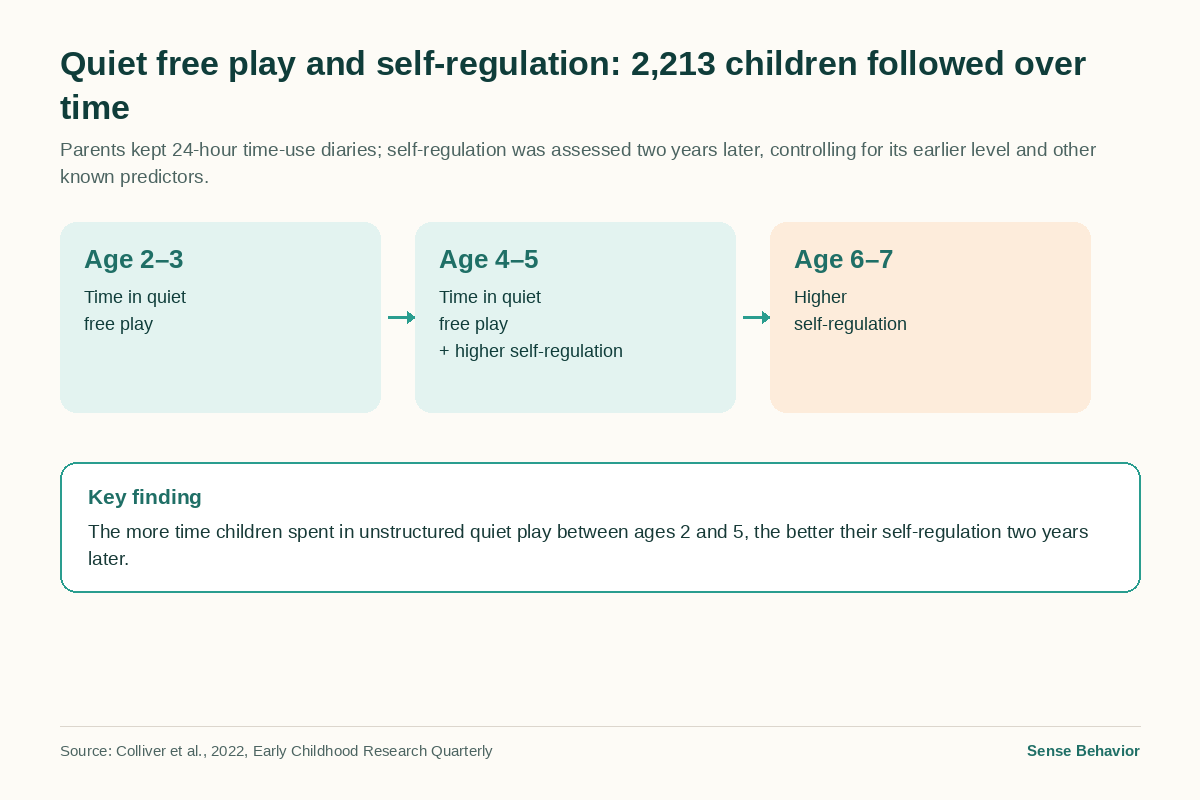
This is a direct argument against parental guilt: quiet pottering about with blocks is not neglect, it is a contribution to the child's later ability to manage themselves.
A third study explains a familiar everyday puzzle — why a child flits between toys and settles on nothing. In an experiment with children aged 18–30 months, each child was given free play in two conditions: with four toys and with sixteen. With four toys, children played with each one roughly twice as long and in more varied ways: instead of simply stacking and dropping, they invented new uses for an object (Dauch et al., 2018).
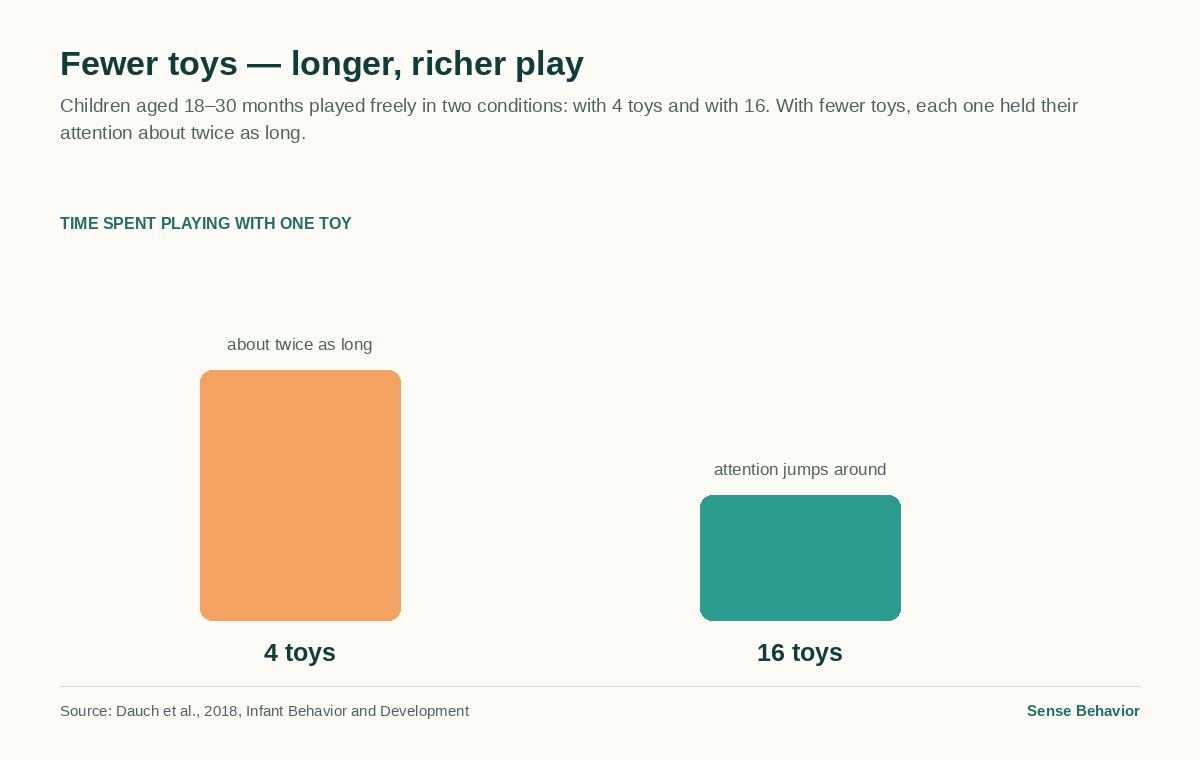
The practical conclusion: if a child can't occupy themselves, the problem may not be a deficit of attention but an excess of choice.
Condition one: a safe space
Until the room is safe, the adult physically cannot relax — and the child reads that instantly.
Picture a typical scene: the child heads for a shelf unit with a heavy vase on it. The adult jumps up, intercepts, says «no». Three minutes later, the same by a socket. Five minutes after that, at a glass door. Half an hour brings fifteen such episodes. Technically the adult was present the whole time, but no independent play happened: every few minutes the child received a «stop» signal, and the adult never once got more than a minute to themselves.
What is worth doing before teaching a child to play alone:
- Anchor to the wall anything that can topple: shelf units, chests of drawers, floor mirrors. Not «placed more securely» — actually anchored.
- Move heavy, breakable and small items out of reach, to high shelves or another room. Temporarily, not forever.
- Cover cables, sockets and sharp corners. Check that doors can't trap fingers.
- Crawl through the room on all fours. It sounds comical, but from adult height you simply cannot see half the risks and half the opportunities.
A word about aesthetics. A home with foam mats, socket covers and boxes on the floor does not look the way you would like. But the period when all this is needed is short — whereas the nerves spent on fifteen «don'ts» an hour do not come back. The interior will return; the parent's reserves may not. If you are already running low, there is a separate piece on this: parental burnout — what to do when there is nothing left.
Condition two: everything needed at the child's level
The second barrier is not danger but inaccessibility. An adult sees the room from above and thinks in layers: a box on a box, a shelf above a shelf, a basket behind an armchair. A child does not see it that way. For them, what exists is exactly what is in view and reachable without help.
A simple test: sit on the floor in the child's room and look around from that height. Everything visible and reachable is their real set of options. From the point of view of independent play, everything else does not exist, because it requires going to an adult — which interrupts both of you.
- Toys on low open shelves, not in a deep box where everything is piled together. From a box a child tips out everything at once and doesn't choose: there is nothing to choose between when it is all in a heap.
- No more than four to six items available at a time; rotate the rest every week or two.
- A fixed place for each thing. A predictable environment in itself reduces the need to ask an adult «where is it».
- Water, wipes, a favourite book — also within reach. Every small thing that requires calling an adult is one more interruption.
This way of organising a play space is a core Montessori principle, and it also fits how applied behaviour analysis treats the environment: the environment either helps a skill emerge or gets in its way, and adjusting it is easier than re-teaching the child.
A caveat: if your child has difficulties with speech or requesting
There is a point here that popular advice almost never spells out, and it matters.
The rule «everything needed within free reach» serves independence. But it has a flip side: if a child can reach everything themselves, no reason arises to turn to an adult at all. For a child whose speech and communication are developing typically this is not a problem — they communicate for plenty of other reasons. But for a child who barely speaks yet or cannot request, a fully «self-sufficient» environment can quietly remove the very situations in which a request might have been born.
When working on speech, specialists usually do the opposite: some desirable items are deliberately kept in sight but out of reach, so that the child has a natural reason to turn to an adult — and at that moment the right form of request can be prompted. This is not teasing; it is creating opportunities for communication where they do not arise on their own.
So two sensible goals pull the environment in opposite directions: more independence means everything is available and no adult is needed; more communication means some things are available only through an adult.
The right answer is not to pick one but to distribute. Usually it looks like this: basic things — water, familiar toys, books — are freely available and provide independence, while a few especially desirable items sit in view but high up and work as reasons to make a request. The proportion depends on where the child currently is with speech and communication, and this is exactly the case where guessing is a poor strategy.
On where to start in that situation: a child not talking at 3 — wait or act. And on how a request is built long before speech appears: teaching a child to ask instead of screaming.
How to teach a child to play independently: five steps
A common mistake is to read all of the above as «set the room up and walk out». For a child who until now has only played with an adult, an abrupt exit is not freedom but anxiety, and they will quite reasonably follow.
The logic is the same as teaching any other skill by gradually fading a prompt — the way learning to dress independently is built, for instance. Only here what fades is not a physical prompt but the adult's presence itself.
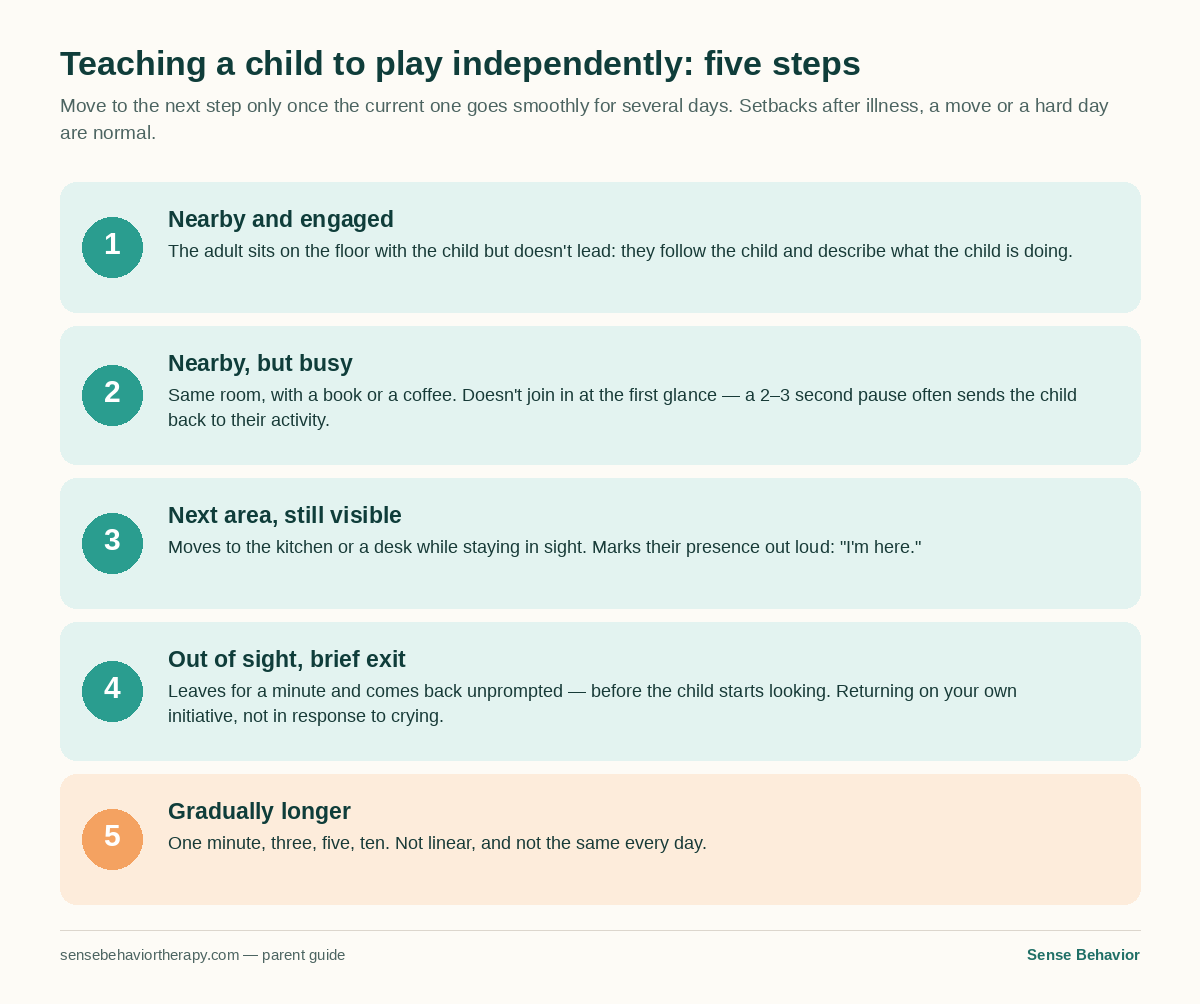
One principle holds at every step: move on only once the current step goes calmly for several days in a row. Rushing almost always sets things back.
How long can a child actually play alone
Expectations are often too high, and a parent concludes «it isn't working» when in fact things are going normally. Rough ranges for a child in whom the skill has already begun to form:
- 1–2 years — from a few minutes up to 5–10. And «alone» here usually means «in the same room as an adult, checking in with a glance now and then».
- 2–3 years — 10–15 minutes, if the activity is genuinely interesting and familiar.
- 3–4 years — 15–30 minutes; play in the next room becomes possible.
- 4–5 years — up to 30–45 minutes in an absorbing activity.
These are reference points, not norms. The spread between children is wide, and the same child produces very different times on different days. It is more useful to watch the trend than the absolute figure: three minutes a month ago, eight minutes now.
Something else matters too: the goal is not for a child to play alone as long as possible. Quiet independent play is valuable as part of the day, not as its main content. Joint play develops other things — turn-taking, dialogue, imitation — and one does not replace the other. If joint play is a particular difficulty, there is more here: when a child doesn't play with other children.
Why a child won't let go — and why it isn't manipulation
A separate source of parental guilt is the sense that the child «deliberately won't let me get anything done». From outside it does look like a fight for attention, particularly when the adult sits down to work and at that exact second the child appears.
It is more useful to look at this through the idea of the function of behaviour: any persistent behaviour serves something. A child who comes over every five minutes may be after attention — or may be signalling that they have become anxious, bored, overwhelmed by noise or physically uncomfortable. These are different causes and they are handled differently. That logic is unpacked separately: the function of a child's behaviour.
A second point concerns attachment. A child's ability to move away calmly and get on with something rests on confidence that the adult is available. The more secure that base, the further from it a child is willing to go. Attempts to «train» independence through ignoring therefore tend to backfire: the child starts monitoring the adult more, not less.
And third: if the only reliable way to get attention is to come over and pull a sleeve, that is what a child will use. Once a more convenient way to signal a need appears — a gesture, a word, a card — the tugging usually decreases on its own.
Common mistakes that hold independent play back
- Responding instantly to every approach. A pause before answering is not harshness; it is the space in which a child gets a chance to solve something themselves.
- Commenting and praising constantly. «Well done!», «now try the red one!», «look how it's done» — each such line interrupts concentration.
- Judging how the child plays. Lining cars up for forty minutes is also play. Demanding that they «play properly» turns a free activity into an assignment.
- Starting at the wrong moment. A hungry, under-slept or over-excited child will not occupy themselves — and that says nothing about the skill.
- Expecting linear progress. After illness, a trip, starting nursery or the arrival of a sibling, a setback is normal, not a loss of progress.
- Leaving out lots of toys «to keep it interesting». It works precisely the other way round.
When to consult a specialist
Building independent play takes weeks and months, and a slow pace is not in itself cause for concern. But there are situations where waiting is not the best move:
- The child is over three and does not stay with any activity longer than a minute or two, even when the space is set up and nothing is distracting them.
- Play barely changes for months and consists of one or two repeated actions with no development.
- The adult leaving the room causes not upset but severe panic that does not ease with gradual habituation.
- Independent play is absent alongside other difficulties — delayed speech, trouble switching activities, marked challenging behaviour.
In these cases it helps to start not with tips on arranging the space but with a structured skills assessment: it shows which components — attention, independence, play skills, communication — are already in place and which are not. What the procedure involves and why sessions often run blind without it: VB-MAPP assessment.
How Sense Behavior helps with this
Generic lists like «declutter and lower the shelves» run into one problem: they were not written about your flat or your child. For one family it is a studio with no separate children's room; for another, a child who won't go near a shelf until an adult sits down beside it; for a third, two children with different needs in one room.
So work on independent play is set up not as handing over recommendations but as jointly tuning the environment and the sequence of steps for a particular family:
- We look at the actual space. In an online session the parent shows the room, and the specialist sees what is genuinely available to the child at their height, where the sources of constant «no» are hidden, and where to start in this particular layout rather than an abstract one.
- We identify the starting point. A skills assessment makes clear which step the child is on: whether they need an adult engaged in the play, whether presence nearby is enough, or whether they are ready for the adult to leave the room.
- We teach the parent rather than «running a session». Parent coaching means the specialist works through concrete episodes with the parent: what to do when the child comes over for the third time in five minutes, how long to wait before responding, how to come back before the crying rather than after.
- We watch a recording, not just a description. A short video of play shows what a retelling misses — for example, that the child returns exactly after the adult glances at them.
- We stay available between sessions. When there is a setback there is no need to wait a week: usually one adjustment is enough, not a redesign of the whole programme.
How the online format works and what the research says about its effectiveness — covered separately.
Sources
- Barker et al. (2014). Less-structured time in children's daily lives predicts self-directed executive functioning. Frontiers in Psychology
- Colliver et al. (2022). Free play predicts self-regulation years later. Early Childhood Research Quarterly
- Dauch et al. (2018). The influence of the number of toys in the environment on toddlers' play. Infant Behavior and Development