How many activities does a child with autism need, and why free play with you matters
How many activities does a child with autism actually need, when there's already therapy, daycare or school, and barely any free time left in the schedule? The 2026 parenting trend is running the other way: families are dropping the extra activity en masse to bring back a boring evening in the yard and an hour with no plan at all. For a family raising a child with autism, the decision feels harder, because each added activity was usually chosen for a reason, as one more way to build a skill the child is missing. And here's where it gets interesting: one of the best-studied ways to help a child like this isn't another structured activity, it's ordinary play with the parent.
What the research shows
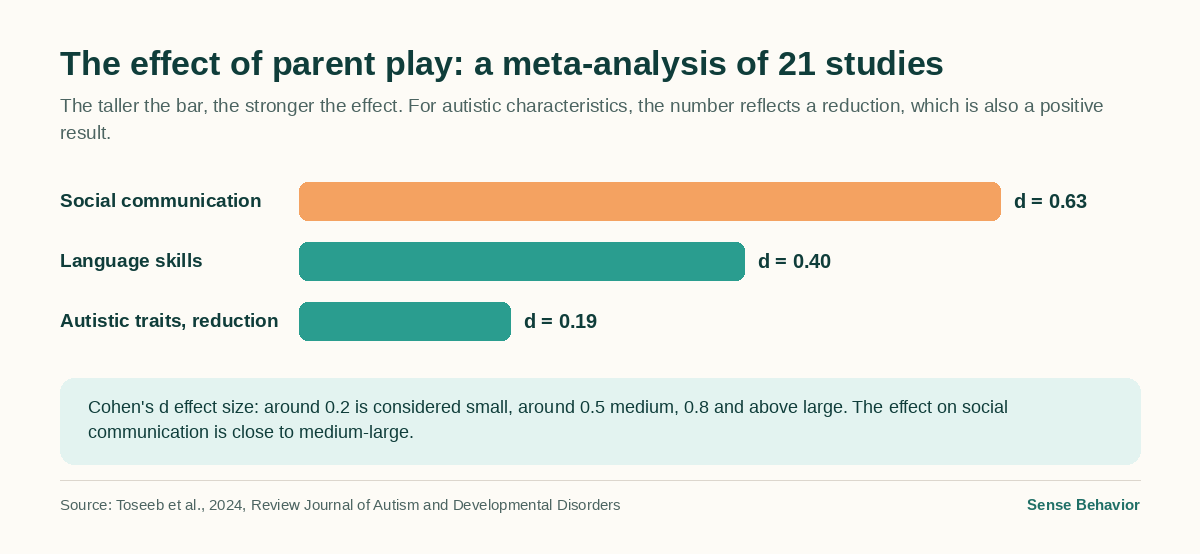
In 2024, a systematic review and meta-analysis of 21 controlled studies of play programs came out, where it was the parent, not a specialist, running the sessions with a preschool-age child with autism (Toseeb et al., 2024). The effect on social communication was medium to large (d = 0.63), the effect on language skills was more modest but still noticeable (d = 0.40), and autistic characteristics showed a small but consistent improvement (d = -0.19). That doesn't mean parent play replaces therapy outright, the review's authors are explicit that they were evaluating play programs as a method of support, not an alternative to specialized help. But it does mean ordinary shared play, built into everyday life, works about as well as many specially organized activities, when it's done deliberately and regularly.
Why one more activity isn't always the better choice
The logic of «more activities, faster progress» feels intuitive, but it has a cost that's easy to miss at first. For a child with autism, moving between places and people already takes more out of them than it does a peer without autism, so a fifth activity in a week doesn't add a fifth of the benefit, it adds the cost of adapting all over again to a new room, a new adult, a new set of rules. If a child regularly comes home from an activity more irritable, sleeps worse, or slips back on skills that were already solid, that's not a sign to swap it for a different activity, it's a signal to reconsider how packed the schedule is overall.
How to fit parent play into an ordinary day
This isn't about adding one more mandatory block to an already packed schedule, it's about a few short moments that are already happening over the course of a day.
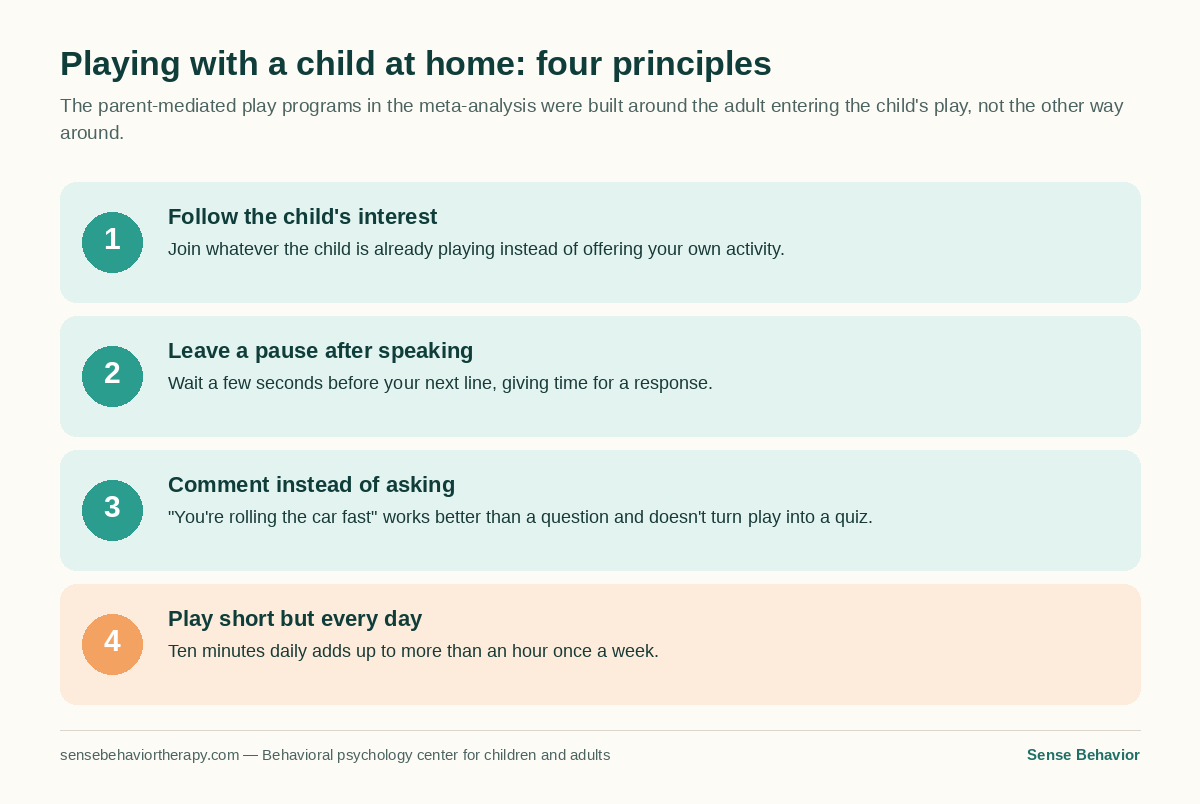
- Follow the child's interest, don't lead it. If a child is lining up toy cars, join that activity rather than offering your own. The programs in the meta-analysis were built around the adult entering the child's play, not the other way around.
- Leave a pause after your own comment. After a comment or question, wait a few seconds before jumping in again. A child often needs more time to respond than it feels like in the moment, and filling the pause with more words takes that chance away.
- Comment on what you see instead of asking questions. «You're rolling the car fast» works better than «why are you rolling the car fast?» because it doesn't require an answer and doesn't turn play into a quiz.
- Keep it short but regular. Ten minutes of play every day adds up to more than an hour once a week, because it's repetition that builds a skill, not the length of a single session.
How this factors into Sense Behavior's programs
In a first consultation, we often go through a child's entire schedule, not just the specific concern a family came in with, because sometimes the core problem isn't a missing activity, it's how packed the day already is. When parent coaching is part of a program, play with the parent is often the first tool a specialist looks at, because it's already built into the family's life and doesn't require an extra trip anywhere. What that looks like in detail is covered here: parent coaching in ABA therapy.
You can start with a free thirty-minute consultation, where we'll look at your child's whole schedule and talk through where there's room in it for simple play instead of one more activity.