Play activities for children with autism: what to play and why
The short answer: play activities for children with autism work not in themselves, but when they are matched to the specific skill that is missing right now and to what genuinely interests the child. Expensive educational sets are not required — most effective play is assembled from what is already at home. Here is which types of play build which skills, and how to work out where to start with your child.
Why «educational play» is not the same as «a useful toy»
The commonest mistake in choosing is to look for an object rather than a task. A parent buys a shape sorter because «it develops thinking», the child shows no interest, the set goes on a shelf, and a bleak conclusion follows: «nothing works for him».
In reality it is not the toy that develops anything, but what happens around it: imitation, turn-taking, requesting, joint attention, seeing an action through. The same box with a lid can be useless plastic or the basis for a dozen repetitions of a skill — the difference is only in how it is played with.
So the question «which toys should I buy» is better replaced by «which skill are we building right now» — and the material follows from that.
What the research says about play and learning through play
Play-based methods have an evidence base, and it is worth understanding it without overstating it.
A meta-analysis of 27 studies of approaches where teaching is embedded in natural play rather than conducted at a table (this family of methods is called NDBI) found positive effects across several areas at once: social engagement, cognitive development, expressive language and play skills themselves (Tiede & Walton, 2019).
What these figures mean in plain terms: the effect is real and confirmed, but modest in size — particularly for play skills themselves. Play is a working tool, not a guaranteed leap forward, and it is worth saying so plainly.
Reviews of play interventions add an important detail: among the commonest formats is training parents, peers or teachers, and most of the sessions studied took place at home rather than in a clinic. In other words, the parent is not a fallback in this work but the main practitioner.
A word on the link between pretend play and language. There is a consistent association between being able to feed a doll or push a block along as if it were a car and functional language. It is important not to overstate it: this is an association, not proven causation. But it explains why symbolic play is worth attending to when speech has not yet emerged. More on that: a child not talking at 3.
Five types of play and the skills they build
It is more useful to sort play not by age or by materials, but by what it actually trains.
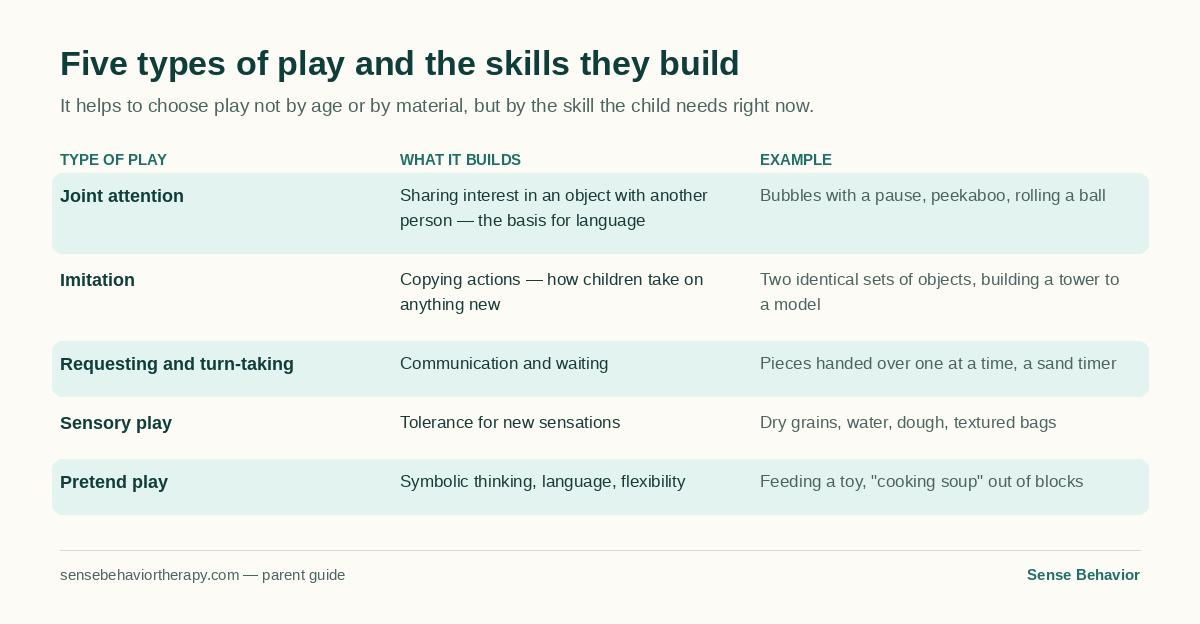
Joint attention play
Builds the ability to share interest in an object with another person — to look where someone points, and to point themselves. This is the foundation language is later built on.
What it looks like: bubbles (adult blows, pause, wait for a glance, blow again), a wind-up toy the child has to ask you to start, peekaboo with a towel, rolling a ball back and forth.
Imitation play
Builds copying of movements and actions — the mechanism by which children take on anything new at all.
What it looks like: repeating simple movements to a rhythm, «do as I do» with two identical sets of objects (one for the adult, one for the child), building a tower to match a model.
The key detail: start with imitating actions on objects rather than body movements — this is usually easier. And it helps to copy the child first: when an adult imitates a child, the child more often starts imitating back.
Requesting and turn-taking play
Builds communication and the ability to wait.
What it looks like: games where the adult holds the needed piece — puzzle pieces, sections of track, construction bricks handed over one at a time; «my turn, your turn» games with a sand timer.
The key detail: keep the desired item in sight but not freely available — this creates a natural reason to make contact. How to build the request itself is covered separately: teaching a child to ask instead of screaming.
Sensory play
Builds tolerance for new sensations, reduces sensory strain and at the same time supports interest in interaction.
What it looks like: dry grains and beans in a tub, water for pouring, dough, shaving foam on a tray, bags with different fillings.
The key detail: this is not desensitisation by force. If the child refuses to touch something, do not insist; you can start through a tool — a spoon, a scoop — rather than bare hands. Sensory intolerance is broader than play: reducing sensory stress around haircuts and toothbrushing.
Pretend and narrative play
Builds symbolic thinking, language and flexibility.
What it looks like: feeding a toy and putting it to bed, «cooking soup» out of blocks, driving cars with a storyline of going to the shop, acting out familiar everyday routines.
The key detail: start with replicas of real objects and familiar scenarios rather than abstraction. First the doll eats with a spoon from a plate; only later does a block become «bread».
How to work out where to start with your child
There is no universal order, but there is a working rule: start half a step above what the child already does on their own, rather than where they «should» be for their age.
- Observe for a week without intervening. What does the child do with objects when nobody is directing them? Line them up, spin them, bang them, take them apart, carry them around? That is the starting point — what is already interesting.
- Join what is already happening. Don't switch them to the «proper» game. If the child is lining cars up, sit down beside them and hand over the next car. That is already interaction, and it comes more easily than an imposed storyline.
- Add one element at a time. To the row of cars, one «wrong» car that drives. To pouring water, a cup that has to be asked for.
- Watch duration and initiative rather than «correctness». The sign that things are going well: episodes get longer, and the child starts or returns to play by themselves.
If after several weeks of observation it is still unclear which skill to work on, this is exactly where a structured assessment helps. It shows, area by area, what is already in place and what is not, and removes the need to guess: VB-MAPP assessment.
Rough guides by age
These are reference points, not norms: development is uneven, and it is the child's current level that matters rather than their date of birth.
- Under 2 — joint attention and simple imitation: bubbles, peekaboo, rolling a ball, wind-up toys, simple actions on objects.
- 2–3 years — imitation with objects, first requests within play, the beginnings of pretend play with realistic objects, sensory play.
- 3–4 years — turn-taking, short storylines from familiar situations, simple rules, building to a model.
- 4–5 years — extended storylines, play with another child, games with rules and waiting for your turn.
On difficulties with playing alongside others, separately: when a child doesn't play with other children.
Common mistakes
- Too much material at once. An excess of choice lowers the quality of play: with fewer toys children play longer and more inventively. Keep a few items available and rotate the rest.
- Turning play into a lesson. Constant questions — «what colour is that?», «how many are there?» — shift play into testing mode, and the child loses interest, quite reasonably.
- Dismissing unusual play. Sorting by colour, spinning wheels, lining things up — these are play too, and an entry point too. Interrupting to «play properly» means losing the one contact that was already working.
- Playing when the child has no reserves. Hunger, poor sleep, over-stimulation after nursery — not the time for learning something new.
- Expecting fast results. The effect of play-based methods, on meta-analytic evidence, is moderate and accumulates over time.
One more thing: not all of a child's time should be shared. Being able to occupy oneself builds self-regulation and relieves the parent — separately on that: how to teach a child to play independently.
How Sense Behavior helps with this
Lists of games from the internet run into one problem: they don't know your child. A child who already imitates and a child who doesn't yet look at an adult need entirely different play, even if their ages match.
- Assessment first, then play. We look at which skills are already there and choose play for the nearest goal, rather than from a list of what is «good for the age». This removes the main source of frustration — activities pitched at the wrong level.
- From what is already at home. The specialist selects materials to fit your flat and your budget. In the vast majority of cases nothing needs to be bought.
- We teach the parent to lead the play. Online sessions cover not abstract methodology but concrete moments: where to pause, how to prompt and when to fade the prompt, what to do when the child leaves the game.
- We review video of your play. A short recording shows what a retelling misses — for instance, that the pause lasts half a second and the child physically cannot respond in time.
- We adjust as we go. If play stops working, that is not a reason to change the whole programme — usually one detail needs correcting, and that is what contact between sessions is for.
You can start with a free thirty-minute consultation: enough to map out two or three first directions in play.