Echolalia in Children: When It Is Normal and When to See a Specialist

Echolalia in children means repeating other people's words or phrases, either right after hearing them or hours and days later. It also shows up in ordinary speech development, so a single "she repeated me" moment settles nothing. It is worth seeing a specialist when repeats crowd out the child's own words, speech is not growing, or skills have been lost. Below we look at how repeating can help and what to do at home.
When a toddler says your question back ten times instead of answering, worry is understandable. Let us look at what is known.
What is echolalia in children, and do all toddlers do it?
There are two kinds. In immediate echolalia a child repeats words at once: asked "Do you want a drink?", the child says "Do you want a drink." In delayed echolalia the words come back later, for example a line from a cartoon or a familiar "Quick, time for bed." The American DSM-5 describes such repetition as senseless, "parrot-like". Yet a narrative review by Pruccoli and colleagues (2021) notes that repeating words helps children with typical development learn language, and work on autism suggests it may help store words and carry them into new situations, although much depends on context.
The authors suggest treating echolalia as an atypical way of communicating and taking that into account in therapy. It is a review of the literature, not a test of a method, so its conclusions are cautious.
Why does a child repeat words? What one study found
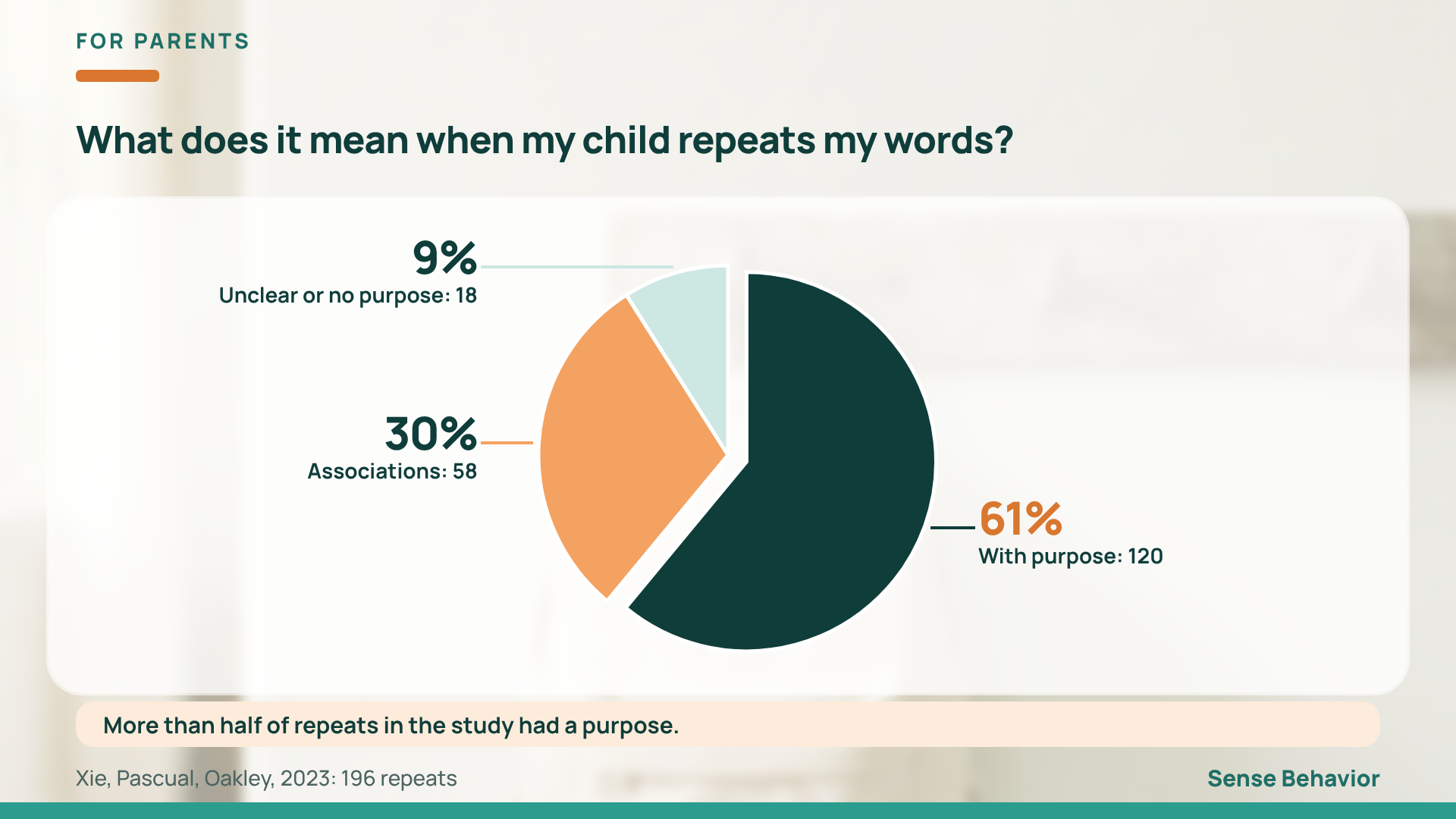
In a study by Xie, Pascual and Oakley (2023) researchers observed eight boys aged 3 to 6 who had an autism diagnosis. The boys were shown 24 pictures and asked questions. In total there were 196 repeats. More than half, 61% (120 cases), had a purpose: the child answered a question, named an object or described a picture. Another 30% (58 cases) were loose associations. The remaining 9% (18 repeats) stayed unclear (7%, 14 cases) or looked meaningless (2%, 4 cases).
Among the repeats with a purpose, the authors found three roles:
- Answering a question. 47% of all repeats (92 cases).
- Thinking aloud. 10% (19 cases).
- Keeping a conversation going. 5% (9 cases).
The sample was small and came from one region of China, and the task was not an everyday one, so the results should be carried over to daily life with care. Still, the takeaway is useful: when you hear a repeat, ask yourself what your child is trying to say.
When repeating words is a reason to book a specialist
The CDC, the US Centers for Disease Control and Prevention, lists milestones by age. By 2 years a child usually says at least two words together, such as "more milk", points to things in a book when asked and uses gestures. If that is missing, skills have been lost or you still have questions, the CDC advises raising it with a doctor and, if concerns remain, asking for a referral to a specialist.
A combination of several signs can be a reason to book a visit:
- Repeats make up most of the speech and there are almost no phrases of the child's own.
- The child rarely points and looks at you little during interaction.
- The child does not turn to their name, see the article on responding to a name.
- Speech that was there has gone. Do not wait in that case, and read about a child who stopped talking.
Echolalia on its own does not count as a diagnosis. Clinicians weigh it as one sign together with the rest. Nobody can name the cause from a description or a video, and an in-person assessment decides that.
What to do at home if your child repeats words
A few simple things are enough for today.
- Do not ban repeats or scold for them. For the child this is a working tool.
- Answer the meaning. If the child echoed "Do you want a drink?", hand over the water and say "Drink." The child then hears a short model of an answer.
- Ask a question and hold a few seconds of silence before you prompt.
- Film two or three examples and note what happened before and after. It helps the doctor, and it will make things clearer for you too.
How repeats sit alongside ordinary speech shows best in recordings from different situations: at home, on a walk, during play.
Who to turn to if repeating words worries you
Start with a pediatrician and a hearing check, then a speech therapist, child psychologist or neurologist may follow. The order of steps is described in where to go if you suspect autism. If your child is around three and has few words, the article child not talking at 3 will help, and when another way of communicating is needed, look at cards and alternative communication.
Sources
- Pruccoli J., Spadoni C., Orsenigo A., Parmeggiani A. (2021). Should Echolalia Be Considered a Phonic Stereotypy? A Narrative Review. Brain Sciences, 11(7), 862.
- Xie F., Pascual E., Oakley T. (2023). Functional echolalia in autism speech: Verbal formulae and repeated prior utterances as communicative and cognitive strategies. Frontiers in Psychology.
- CDC. Milestones at 2 years (Learn the Signs. Act Early).