Child ignores the word no: what to say and do instead

When a child ignores the word no, the usual reason is that the word names a ban but never names an action. A toddler hears a stern tone and has no idea what to do instead. The word starts to work when the adult stands close, the sentence is short and a clear activity follows right away. Below are four typical situations with different fixes, so find yours and start there.
If you have said no five times and a small hand still heads for the socket, many families know that moment. Volume helps little. Three things help more: an exact phrase, a distance of one step and practice at a calm time instead of in a moment of danger.
Child ignores the word no: what to check before choosing a plan
Before changing your phrases, spend a day or two watching three things. They show which of the four situations below fits you.
- Understanding. Does your child follow simple requests such as “give me”, “come here” or “show me” when you are close and nothing is forbidden?
- Attention. Does your child turn to their name and look at you when you speak? If not, start with the article on not responding to their name.
- What happens after the word. Your child carries on as if nothing was said, laughs and runs off, or cries. The plan depends on this.
If simple requests without any ban are also ignored, the question is wider than the word no. Then take a look at the last section of this article.
When your child carries on as if they did not hear
This is the most common picture in toddlers. For them the word is still a sound: it is tied neither to an action nor to a result. Repeating it louder is pointless, because the child does not know what exactly you expect.
What to do in this situation:
- Come within arm’s reach, crouch to eye level and wait for a glance.
- Say one short phrase with an action: “Hands on knees” or “Ball goes in the basket”.
- If your child does not do it, show the movement or help with your hand, then praise at once.
- Offer a fitting activity: another object, another game, another place.
Distance matters a lot. A request thrown across the room from behind rarely works in toddlers, while one made close by at eye level tends to work better. Delivering an instruction well is one of the strategies that the review by Radley and Dart (2016) calls evidence-based, more on that below.
When your child laughs, runs off or tests you
Sometimes the word turns into a game: the adult runs after the child, raises their voice and the child gets a lot of attention. Then every repeat of the word feeds the game.
- Say the phrase once and do not repeat it.
- Walk over calmly and stop the movement: take a hand or remove the object.
- Skip the lecture and the dramatic chase: the duller this minute is, the less game there is in it.
- Prepare an interesting activity in advance and give attention when your child is busy with it.
Adult attention is a strong reward. If it goes to forbidden things and not to quiet play, a child will sooner or later start testing limits on their own. This week catch five moments when your child is busy with something allowed and step in with a short word of praise: “You are building a tower, nice.”
When your child cries or screams after the word
Crying after a ban usually means a favourite thing has suddenly vanished and nothing replaces it. The child is going through a loss, which is a normal reaction at an early age. For tantrums in general see the article on tantrums, and here the focus is on softening the ban itself.
- Name the feeling in one phrase: “You wanted the remote, that is hard.”
- Keep the limit in place: the remote stays with you.
- Offer a choice of two allowed options: “Blocks or ball?”
- Leave explanations for later: in the middle of crying a child cannot take them in.
When the situation is dangerous: road, window, stove
In dangerous situations words are not enough for any toddler. Safety comes from the adult: a hand, distance, a window lock, a socket cover. The signal stop works as a second layer of protection and is practised in advance.
- Near a road hold your child by the hand or the hood instead of just walking alongside.
- Fit window blocks and socket covers and move the stove out of reach.
- Do not count on your child stopping at a word until the signal has been practised.
What to say instead of no: ready phrases for every day
A phrase works when it names an action and fits into one sentence. Below are pairs of “instead of” and “say”, so swap in your own objects.
- Instead of “Don’t touch the socket” say “The socket is not a toy, let’s go to the blocks.”
- Instead of “Don’t run” say “In the hallway we take steps.”
- Instead of “Don’t shout” say “Talk quietly, like a mouse.”
- Instead of “Don’t throw it” say “The ball goes in the basket.”
- Instead of “Don’t climb on the table” say “Feet on the floor, let’s climb on the sofa.”
- Near a road, instead of shouting, say “Stop”, show your palm and take a hand.
The word no stays useful when you need to stop your child right now. Then it is said calmly, once, and backed by the adult’s action. Trouble begins when it sounds dozens of times a day with nothing after it.
What to do if your child will not listen at 1–2 years and at 3–4 years
The word no sounds different depending on age, so the work around it differs too.
- 1–2 years. A toddler explores the world with their hands. The main thing is to move dangerous items out of reach and swap the object: they reach for the phone, you hand over a toy one. Few words are needed: “Give me”, “This one”.
- 3–4 years. A child’s own no appears, along with testing limits. A choice of two options, a warning ahead of time (“One more slide and we go home”) and a sand timer that shows how much is left all help.
If protests at three or four are louder than usual, that is often part of an age crisis, and there is a separate article on it in the list at the end.
How to teach a child to stop on the word stop: a two-week practice
The signal stop is best taught in play, not in a moment of danger. The numbers below are a working guide for a start rather than a scientific norm, and the pace differs for every child.
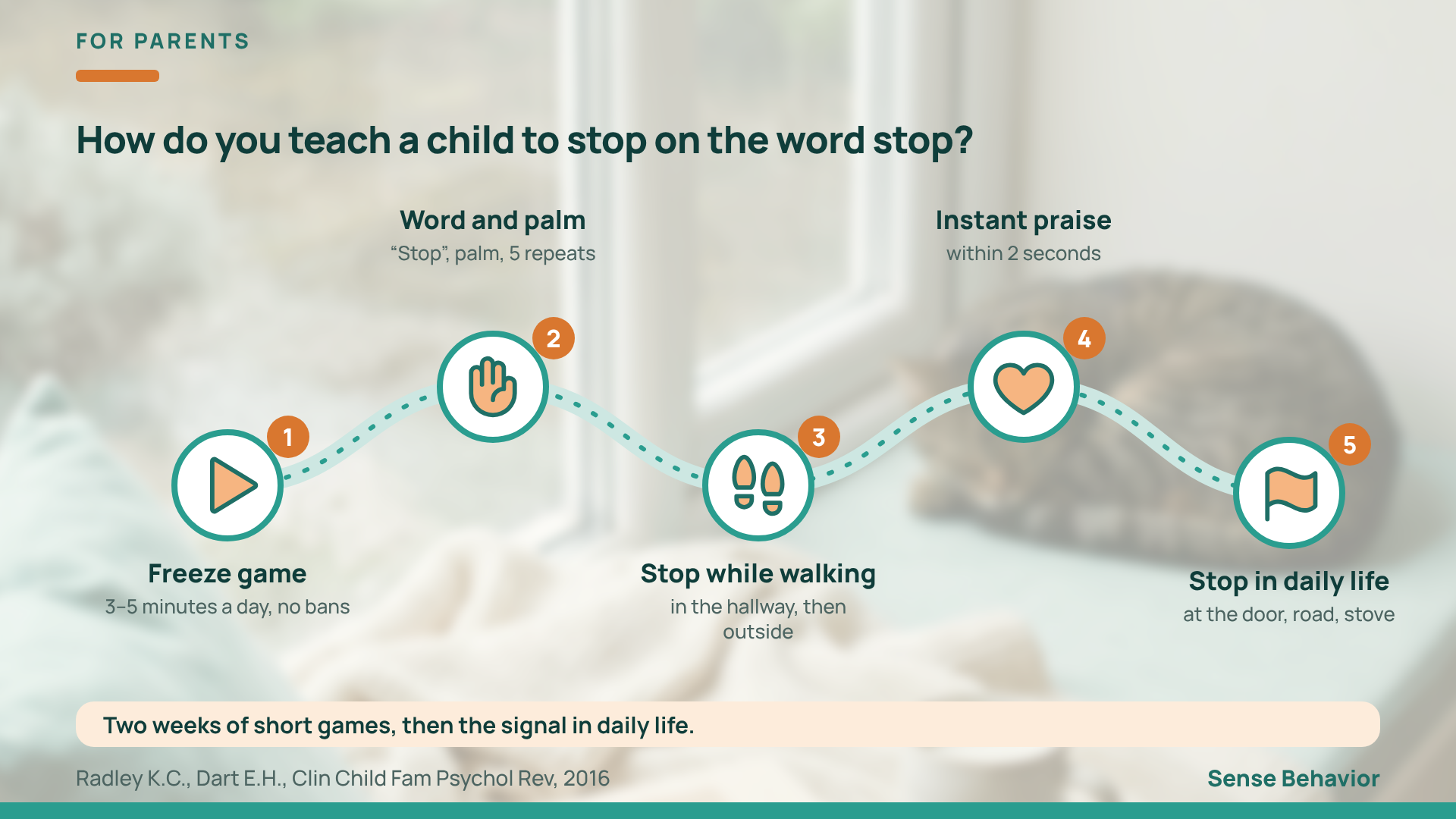
- Days 1–3, the freeze game. 3–5 minutes a day. Play music, let your child move, say “Stop”, show your palm and freeze together. Praise within 2 seconds.
- Days 4–7, word and palm. 5 repeats per session. The word is always the same, and so is the palm.
- Week 2, stop while walking. First in the hallway, then outside, holding hands. You stop, praise at once, then walk on.
- After that, stop in daily life. At the door, by the road, near the stove. The game stays two or three times a week.
Every stop should end with something pleasant: the game goes on, praise follows or you can walk on. If the signal always means the fun is over, a child soon learns to ignore it.
What research says about children following adult requests
The systematic review by Radley and Dart (2016) gathered 42 studies of eight strategies that help children aged 1 to 19 follow adult requests more often. The authors concluded that three strategies can be considered evidence-based: a sequence of easy requests before a hard one, effective delivery of the instruction and errorless teaching.
From the first strategy comes a simple household rule: before a request your child does not want to follow, ask for something easy and familiar. For example “give me five”, “show me your nose”, “clap your hands”, and then “let’s put on your jacket”. People usually take three easy requests in a row, which is a practical guide and not a number from the review.
A similar sequence was described in the study by Rivière and colleagues (2011). Its participants were children who refused doctors’ requests during an examination. After easy requests came before hard ones, they followed the tasks more often, parents could run the procedure and it contained nothing unpleasant for the child. The method does not promise a result in every situation, so a firm timeline for your child cannot be given.
How to agree on the same phrases with grandparents, a nanny and daycare
The word no works when every adult says it the same way. Agreeing is easier than it sounds if you do not try to align everything at once.
- Pick the three rules that matter most: the road, the window, dangerous objects.
- Write one phrase and one gesture for each on a note and send it to every adult.
- Show once in person how you say it and what you do after the phrase.
- Once a week ask what worked and where the phrase failed, and adjust the wording together.
Other rules may differ at home, at Grandma’s and at daycare. A child accepts such differences calmly when the three main rules are the same everywhere.
Common mistakes that make the word no stop working
- The word sounds twenty times a day. It becomes background noise. Keep no for rare moments and name the action in the rest.
- A request from another room. Your child cannot see you and does not realise you are speaking to them. Walk over and stand close.
- A long explanation instead of a phrase. “Don’t touch it, you could get a shock, and it is dangerous anyway” gets lost after the first words. “The socket is not a toy” is enough.
- Different rules from different adults. If Grandma allows and Mum forbids, the child cannot tell what to expect. Agree on three main rules and phrases.
- A ban with no replacement. The child is left with an empty space. Add “but this is fine”.
- Big emotions at the moment of the offence. A vivid reaction becomes a reward by itself. Keep the tone quieter for the offence and brighter for success.
Evening plan when a child ignores the word no
- Pick the two rules that matter most to you, for example the road and the socket.
- Write a phrase with an action for each and stick the note on the fridge.
- Play the freeze game for 3–5 minutes and finish with praise.
- Say no no more than three times today and add an action each time.
- In the evening note which of the four situations above you met most often.
A week later compare your notes. If situations pass more calmly, widen the set of phrases. If nothing has changed, review the distance, the length of phrases and how consistent the adults are. For a general system of rules the behavior plan for a child will help.
When to see a specialist if your child ignores the word no
The word no can be hard for any toddler. A reason to talk to a paediatrician or a developmental specialist appears when other signs sit alongside it:
- simple requests without a ban are ignored and the child does not respond to their name.
- there is no speech, or it disappeared after a period when it was there.
- little interest in play with an adult, little eye contact and few gestures.
- two or three weeks of the steps above bring no change.
This is a reason to get a second opinion. Nobody diagnoses from a description. The order of steps is laid out in the article on where to go if you suspect autism, and it suits questions about speech and development too. If protests grow at three or four, take a look at the article on the crisis of three.
Sources
- Radley K.C., Dart E.H. (2016). Antecedent Strategies to Promote Children's and Adolescents' Compliance with Adult Requests: A Review of the Literature. Clinical Child and Family Psychology Review, 19(1), 39–54.
- Rivière V., Becquet M., Peltret E., Facon B., Darcheville J.C. (2011). Increasing compliance with medical examination requests: effects of a high-probability request procedure. Journal of Applied Behavior Analysis, 44(1), 193–197.