Screen time for a child with autism: how much is okay and how to cut it back without a fight
Screen time for a child with autism has become a topic that makes parents feel guiltier than almost any other part of the daily routine. Parenting communities in 2026 are riding a digital-detox trend, and searches for «screen-free activities» keep breaking records. But for a family where a tablet cartoon is sometimes the only way to eat a meal in peace or answer a work email, a blanket «just take the screen away» sounds like advice from someone who's never been home with a child mid sensory overload. The good news is that the research doesn't point to a total ban, it points to something narrower and much more doable.
What the research actually shows
In 2023, researchers in China surveyed the parents of 358 preschoolers with autism spectrum disorder and looked at how screen time, sleep, and behavior connect (Jia et al., 2023). It wasn't the total hours in a day that mattered, it was specifically screen use before bed: the later and longer a child watched a screen in the evening, the worse and shorter their sleep became, and it was that drop in sleep quality, not the screen itself directly, that predicted more irritability, aggression, and other behavioral difficulties the next day. In other words, the screen doesn't act on its own, it works through sleep, which is already disrupted far more often in children with autism than in their peers without it.
The practical takeaway follows from that: the total number of hours in a day matters less than one specific window before bed. That's where it makes sense to focus effort, rather than trying to police every minute of screen use across the whole day.
How to cut back screen time before bed without a fight
Switching a screen off abruptly while a child is still absorbed in it almost always ends in a meltdown, because the transition happens too fast and without warning. What works is a gradual, predictable shift, not a sudden «turn it off.»
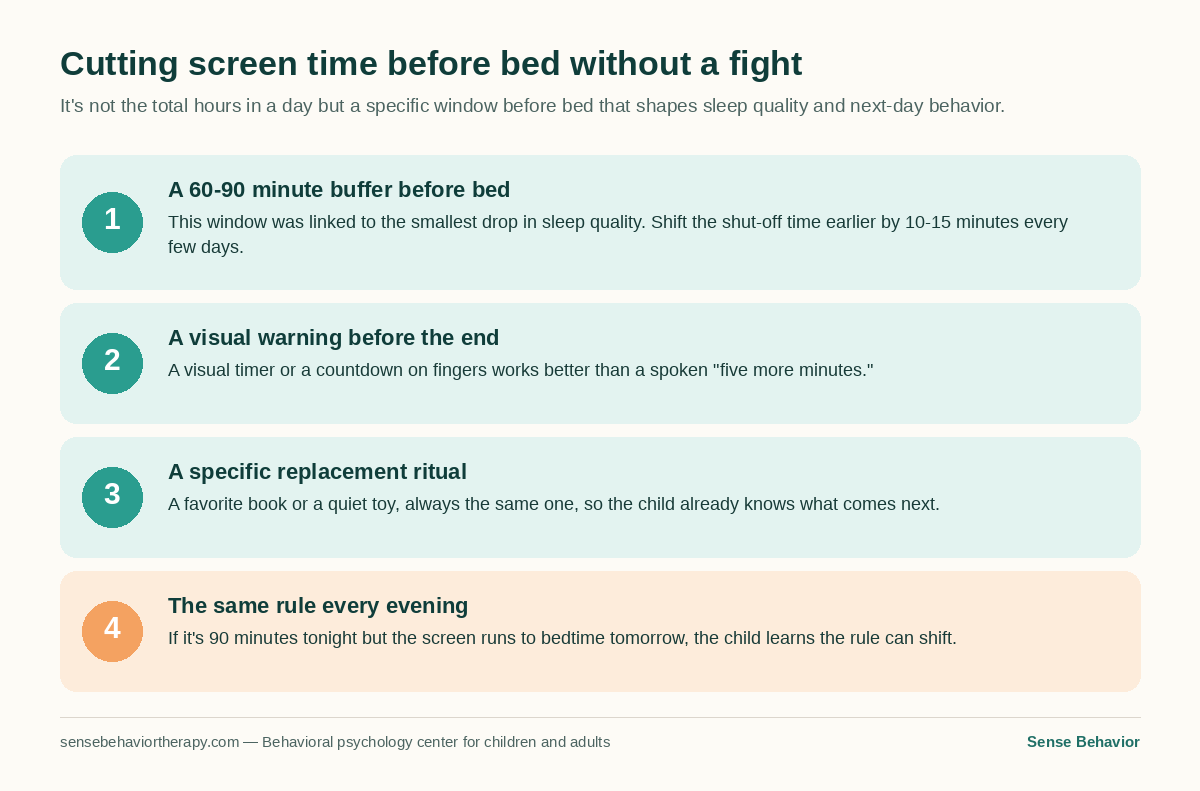
- Set a 60-90 minute buffer before bedtime. That's the window the study linked to the smallest drop in sleep quality. You don't have to cut it abruptly, you can shift the shut-off time earlier by 10-15 minutes every few days until you reach that window.
- Give warning early and visually. A visual timer or a countdown on fingers works better than a spoken «five more minutes,» because the child doesn't have to hold that information in their head, they can see it instead.
- Replace the screen with a specific ritual, not empty time. Just turning off the cartoon and saying «go play» almost never works, because the child has nothing to occupy their hands or attention right when the most interesting thing just disappeared. A short, prepared ritual helps here: a favorite book, a quiet sensory toy, or a simple board game, always the same one, so the child already knows what comes next.
- Keep the rule the same every evening. If the buffer is 90 minutes tonight but the screen runs right up to bedtime tomorrow because an adult is tired, the child quickly learns that the rule can shift if they push back hard enough, and the next transition gets harder, not easier.
What to do with the guilt
According to 2026 parent surveys, close to nine out of ten parents feel guilty about screen time, and that number keeps climbing year over year. For a family raising a child with autism, the guilt usually cuts deeper, because the screen often isn't indulgence, it's the only way to get a breather between therapy, school, and everyday tasks. It's worth honestly separating two different things here. A screen as a way to get through an especially hard day isn't the same as a screen as the only source of calm a child has, full stop. The first is normal and doesn't call for an apology. The second is worth gradually widening with other ways to self-regulate, so the child has more than one thing to lean on, and the family isn't dependent on a single tool that happens to work. A few ready-made quiet games that don't take much energy from a worn-out parent are collected here: games to play when you have no energy left.
How this factors into Sense Behavior's programs
Screen time rarely comes up as its own topic in a first consultation, but it almost always surfaces once we go through the daily routine and evening meltdowns. If sleep is disrupted, a specialist looks at the whole evening ritual, not just whether a screen is involved, and works with the parent to find a specific replacement built around that particular child's interests, not a generic «take away the gadgets» script. What to do if a child barely plays with anything besides a screen during the day is covered separately here: play activities for a child's development.
You can start with a free thirty-minute consultation, where we'll go through your child's evening routine and suggest a specific transition plan that doesn't turn into a fight every night.