How to teach a child to wait: a second-by-second plan for home

How to teach a child to wait: start with a pause of just 5 seconds, put something in the child's hands for that time, and hand over what they asked for the moment the pause ends. Add time in small steps, and only after calm tries. Below you will find ready phrases, common mistakes, what to do when it does not work and a two-week plan.
The cashier is scanning someone else's shopping, the soup is still too hot, you are finishing a phone call, and your child is already tugging your sleeve, shouting or dropping to the floor. Many families know these minutes. Waiting is hard for every small child, and the skill grows gradually, like any other.
Why a child cannot wait: three familiar situations
Waiting is hardest in three places: where you must stand and do nothing, where the thing they want is in plain sight, and where the pause has no known end. A queue, a hot dinner and a «just a minute» without a time limit all work like this.
- A queue or a doctor's waiting room. Nothing to do, no end in sight, noise all around. The child cannot tell how much is left and tries to speed things up by shouting.
- Food or a toy in sight. The wanted thing is close but off limits. The closer it is, the harder it is to hold on.
- Your «in a moment». For an adult it is two minutes, for a child it is forever, because they cannot see when it will end.
The conclusion is simple. Waiting gets easier when the child can see how much is left, has something to do and knows what comes at the end. The plan below is built on exactly these three supports.
How to teach a child to wait: five steps starting at 5 seconds
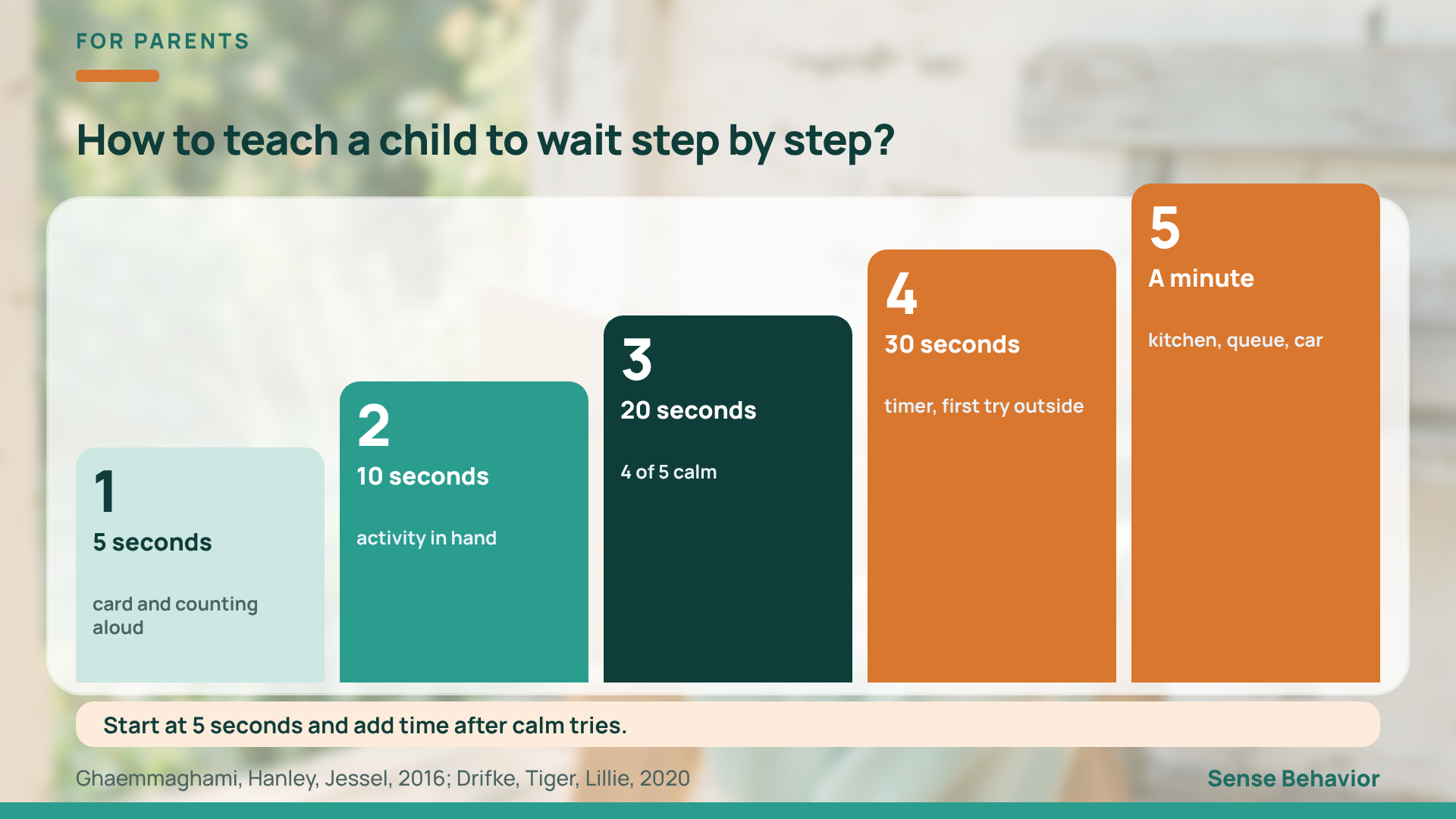
The main rule: lengthen the wait only after a success. If the child waited calmly, the next pause is a little longer. If they could not, you go back one step without blame. Applied behavior analysis research calls this contingency-based: the pause grows right after a good try.
- Step 1. Show «wait». Use a card or a raised palm. Say: «Wait, I will count to five.» Count out loud and give what they asked for straight away.
- Step 2. Add an activity. Put something in their hands for the pause: a block, a card, a soft toy. The activity fills the gap and waiting gets easier.
- Step 3. Add time. When 4 tries out of 5 are calm for three days in a row, move to 10 seconds, then 20, 30 and a minute. This is a rough guide, and every child has their own pace.
- Step 4. Show how much is left. Use a sand timer, a visual timer or a strip you colour in. The end of the wait becomes something the child can see.
- Step 5. Carry it into real life. When a minute works at home, try the queue, the car and the kitchen. Short at first, longer later.
What if cards do not interest your child yet? Start with something they want a lot but that is not critical: a favourite biscuit, bubbles, switching on a cartoon. Begin with 5-second pauses, 5 to 10 repeats a day, no more. A session shorter than you think necessary works better.
What the research says. Ghaemmaghami, Hanley and Jessel (2016) compared two ways of lengthening a delay in four people with problem behaviour who were treated by specialists. When the delay simply stretched with the clock, problem behaviour came back more often; when the delay grew after successful tries, it was lower. Drifke, Tiger and Lillie (2020) worked with three people with developmental disabilities and reached a similar conclusion: waiting works best when the person is busy with an alternative action during the delay. The samples are very small and the settings clinical, so the home plan below borrows the idea, since the studies offer no ready-made protocol.
Waiting at home, in a queue and at the doctor's: three examples
The same technique looks different depending on the place. Three examples show what to bring and what to say.
- At home while dinner cools. Set a timer for 20 seconds and ask the child to put the forks on the table. Say: «While the soup cools, you set the table. When the timer beeps, we eat.» When it beeps, serve the food at once.
- In a shop queue. Prepare stickers, a small book or a figure in advance. Say: «We stand here for two minutes. Stick five stickers and we are at the till.» Break two minutes into small pieces: five stickers, then three more.
- At the doctor's. Show on a phone or on paper that there are three people ahead. Cross out each one who goes in. Give something to hold and name a rough end: «We wait until three people go in. Then it is our turn.»
Decide in advance how the wait ends and tell the child. Do not promise a reward that will not come: if you said biscuits at the end of the queue, the biscuits must appear.
What to say to a child while they wait
Words during the pause do the same job as the card: they give support and say what happens next. Speak briefly, in an even voice, and use the same phrases each time so they become a familiar signal.
- Before the pause: «Wait five seconds. I am counting: one, two, three, four, five. Done, here you go.»
- During the pause: «You are waiting, well done. A little bit left. Take the block while you wait.»
- After the pause: «You waited! Here is the biscuit», and hand over what you promised right away.
- If the noise builds: «Waiting is hard. I am here. Breathe like me», then take a breath together. Do not raise demands at this moment.
Better not to say: «How long will this take», «You are a big kid now», «If you shout you get nothing». The first two judge, the third turns waiting into punishment, and what the child needs is feedback about what went well.
A child screams when they have to wait: what to do
Screaming during a wait usually means the pause was longer than the child can manage right now. It is a signal to shrink the step. A short decision guide follows.
- If they scream already at 5 seconds: cut the pause to 2 or 3 seconds and add an activity. Check whether they understand the word «wait» and know counting aloud.
- If it works at home but falls apart in a shop: go back a step in time and bring an activity: a book, stickers, a figure. A shop has far more triggers.
- If they scream exactly when you are talking: say «I need two minutes» beforehand and start a timer. A warning before the pause works better than an explanation after the first scream.
- If you still hand over the wanted thing right after the scream: the child learns that screaming speeds things up. From now on give it only after a calm pause, even the shortest.
When the screaming is intense, first help with the state and only then return to teaching. For more on what to do in such minutes, see the article on tantrums.
Mistakes that make waiting harder to teach
Most families repeat the same mistakes, and none of them is anyone's fault. Usually it comes down to a step that is too big, an end that is unclear, or a reward that comes at the wrong time.
- Too big a jump. After three good tries at 5 seconds, a full minute is asked. Why it fails: the child has not secured the previous step. Better: add 5 to 10 seconds.
- «In a moment» without a limit. The word «wait» with no count or timer. Why it fails: no end in sight. Better: name the seconds and count out loud.
- A pause with nothing to do. The child stands looking at the biscuit. Why it fails: all attention sits on the wanted thing. Better: put an activity in their hands.
- A late reward. Praise comes in the evening. Why it fails: the link between waiting and the result is lost. Better: within a couple of seconds of the pause ending.
- Practising at the hardest moment. The first try in a queue with a tired child. Better: start at home, when they are rested and fed.
If you already use tokens, waiting fits into a token system: a token for a calm pause. And when the order of events matters to your child, a visual schedule helps, with waiting drawn as its own card.
Teaching waiting to a child who hardly speaks
When speech is limited, a «wait» card becomes the main tool. It replaces words and shows that the request was heard. The child also sees that the request is not lost, because after the card what they asked for always arrives.
- The «wait» card. A large picture of a sand timer. Show it at the moment of the request and start counting at once.
- The «done» card. Show it at the end of the pause together with the wanted thing. The two cards make a pair: «wait, done».
- A visual timer. When the coloured area shrinks, the child can see that little is left. It also suits those who do not yet follow counting.
Teaching requests and teaching waiting go together: first the child learns to say what they want, then to bear a small pause. The first part is covered in the article on how to teach a child to ask instead of screaming.
A two-week plan and when to involve a specialist
Begin with a simple plan. It takes five to ten minutes a day and needs no special materials, only a card and a timer.
- Days 1 to 3: a 5-second pause, 5 repeats a day, with an activity in hand.
- Days 4 to 7: 10 seconds, then 20 if 4 tries out of 5 were calm.
- Days 8 to 10: 30 seconds and a visual timer. The first try outside the home, but a short one.
- Days 11 to 14: a minute. Practice in the kitchen, in a shop queue and in the car.
For today one step is enough: this evening, when your child asks for something, say «Wait five seconds», count out loud and give it straight away. Note how it went, calm or with screaming. Repeat tomorrow.
The method has limits. If screaming or self-injury appear with any pause, if the child does not react to cards and counting, or if waiting breaks down every time for two weeks, it is worth discussing the plan with a behaviour specialist. They can help choose the step and the reward so that you are not practising blind. This is not a verdict on you as a parent: some children need a smaller step and a different kind of support.
Sources
- Ghaemmaghami M., Hanley G.P., Jessel J. (2016). Contingencies promote delay tolerance. Journal of Applied Behavior Analysis. DOI 10.1002/jaba.333.
- Drifke M.A., Tiger J.H., Lillie M.A. (2020). DRA contingencies promote improved tolerance to delayed reinforcement during FCT compared to DRO and fixed-time schedules. Journal of Applied Behavior Analysis. DOI 10.1002/jaba.704.