Child Hitting Other Children at Daycare: What Parents Can Do

A child hitting other children at daycare is almost always trying to get something, avoid something or cope with too much at once. So the first question to ask yourself and the teacher is what happened right before. When parents and teachers look for the reason together and respond the same way every time, hitting usually becomes less frequent. There is no magic button, but there is a clear order of steps.
A familiar picture: half past five, the cloakroom, your little one holding a single mitten. The teacher says quietly that your child pushed another child again today. You nod while everything inside tightens, because you feel awkward in front of other parents, worried about the place in the group and sorry for a tired child. Many families know this moment and it does not make you a bad parent. Below we walk through that day in order, from what happens in the group to what to teach at home.
What happens in the group right before the hit
Hitting rarely flares up from nothing. If you replay the child’s day by the clock, one of four moments usually sits behind it, and one child can have several at once.
- The neighbor has that very toy. Your child wants it, and asking with words does not work yet.
- It is time to tidy up, go to a lesson or sit at the table. A shove pushes the unwelcome demand away.
- Adults are busy with other children. The hit was noticed at once, and the quiet play was missed.
- It is loud, crowded, or time for lunch or a nap. Patience ran out and the tension came out through a hand.
These reasons are called functions of behavior, and the article on the function of child behavior helps you work out which of the four is yours. Sometimes the cause is physical, such as an ear ache or a few bad nights, so show your child to a pediatrician if behavior changes suddenly.
What adults usually do after a hit and where it leads
The reaction almost always comes from tiredness and a wish to stop it fast. It is understandable, yet every familiar step has a price.
- A scolding in the evening. A small child will not link it to the daytime hit, but will feel the tension and learn that talk about daycare is unpleasant.
- The same “no” for every case. If hitting was a way to get a toy and the child cannot ask yet, the reason stays in place.
- Removal from the group or the game. When hitting helps the child escape a task, removal can make it stick.
The response should fit the reason for the hit. In the 2016 review by Fitzpatrick and colleagues on behavioral work with aggression, the authors warn that without a functional assessment it is easy to pick a method that makes the behavior stronger.
Child hitting other children at daycare: what to do tonight
The evening after a complaint is better spent gathering information and having a calm talk.
- Listen to the teacher calmly. Ask what happened right before the hit and right after it.
- Do not punish later. A small child will not link an evening scolding to a daytime hit, but will feel the tension.
- Keep a short log. Time, place, what came before, how it ended. After a week a pattern shows.
- Say one sentence. “No hitting. If you want the toy, say ‘give’ or show the card.”
- Check the basics. Sleep, hunger, tiredness and overly busy days.
What to ask the teacher tomorrow morning
What works best is an agreement that home and daycare respond to hitting in the same way. Then the child learns faster what helps. These questions are a good way to start the talk.
- What happened a minute before the hit, and who was nearby?
- What time of day does it happen most often?
- How do you respond right after, and what does the child do next?
- Can the hard moment be announced in advance, for example by showing that an activity change is coming?
- Does the child have a way to ask for a toy or for help in the group?
What to teach in place of hitting
Hitting fades faster when the child has another way to get the same thing. In the same review, functional communication training combined with a consistent response to hitting is called a well-established approach. Treat it as a pointer for a talk with a specialist, since it is not a ready plan.
- Asking. The word “give”, a gesture or a card to ask for a toy instead of grabbing it.
- Turns. A game of “my turn, your turn” with a sand timer for a couple of minutes.
- Exit. A phrase or card such as “I am tired” or “I want quiet” to leave the noise without hitting.
- Praise for peace. Name the moment the child asked or waited while it is still fresh.
If asking is still hard, start there. The article on teaching a child to ask instead of screaming shows the steps, and they work at daycare too.
When one plan at home and in the group is no longer enough
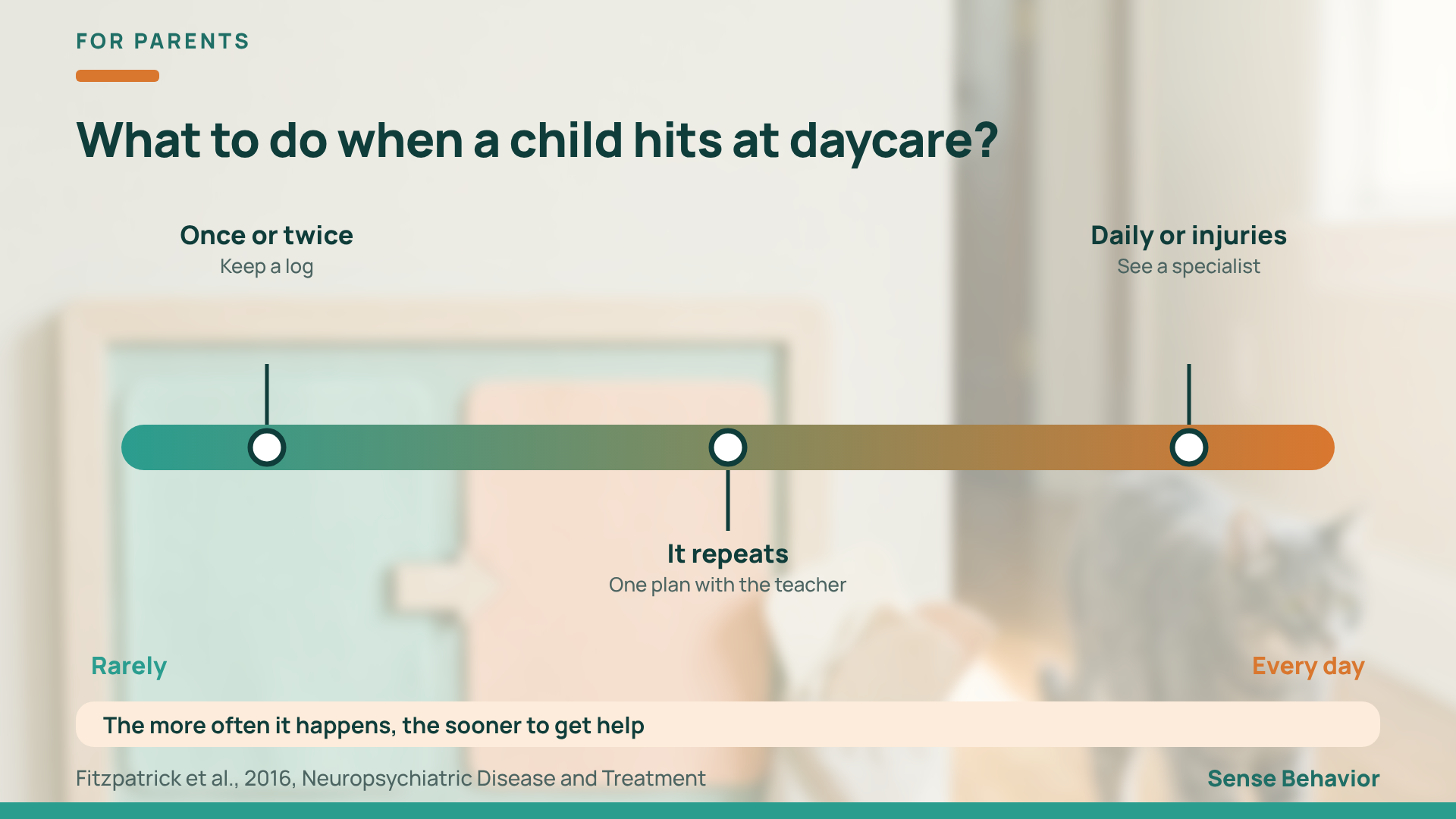
The more often and the harder the hitting, the sooner a specialist is needed. A single incident is enough to log, repeated incidents call for one shared plan with the teacher, and daily incidents or injuries call for help. Book a behavior specialist if you notice any of the following.
- Hitting happens every day or leaves injuries.
- Teachers suggest shorter days or taking the child out.
- There are other difficulties alongside, such as speech, sleep or avoiding contact.
- You and the teacher have kept one plan for two or three weeks and nothing improves.
Your log and the talk with the teacher help a specialist find the reason sooner. If the daycare refuses a place altogether, read not accepted to daycare: what to do and where to turn for your next steps.