PDA in a child with autism: what it is and how it differs from ordinary stubbornness
PDA in a child with autism, or pathological demand avoidance, has become one of the most discussed ideas in English-language parenting communities, and it's coming up more often for parents elsewhere too. PDA isn't officially listed as a separate diagnosis in any diagnostic manual, but more and more families and specialists use the term to describe a specific pattern: a child resists almost any request, even one tied to something they love doing, and the usual ways of working something out just don't land. It's worth saying honestly up front: this profile can't be identified from a description in a message or a post, that's not a substitute for an in-person assessment by a specialist.
How PDA differs from ordinary refusal
A child with autism without signs of PDA usually refuses something for an understandable reason: the task is boring, it interrupts something more interesting, or the environment is too loud and sensory overload has built up. For a child showing signs of PDA, the source of stress is often the fact of being asked at all, regardless of what's actually being asked. Sometimes a child resists just as strongly when invited to play with something they chose themselves minutes earlier, if the invitation came across as a request from someone else rather than their own idea. That doesn't mean the child is manipulating or being difficult on purpose, it points to real anxiety tied to a sense of losing control.
What the research shows
In early 2026, British researchers published a study comparing children and teenagers across three groups: 475 with autism and signs of PDA, 171 with autism but no marked PDA profile, and 94 neurotypical children (Rai et al., 2026). In all three groups, demand avoidance rose along with anxiety and autistic traits, and that pattern turned out to be general rather than specific to PDA. But children with a PDA profile specifically showed one factor that didn't explain demand avoidance in the other two groups: heightened sensory reactivity, meaning both high sensitivity to input and active sensory-seeking at the same time. The authors suggest that this sensory piece may be part of what makes demands especially hard to tolerate for this particular group of children.
What actually helps
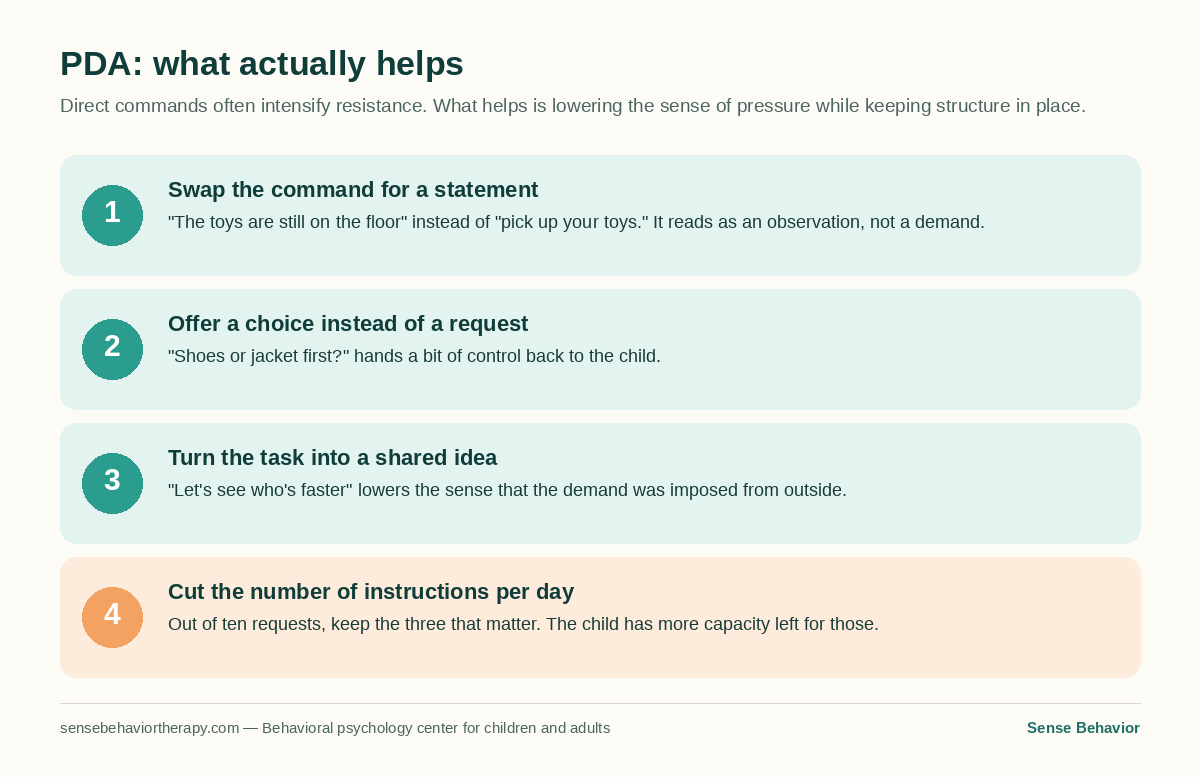
Since the driver is often anxiety tied to a loss of control, not a wish to win a power struggle, direct commands and firm boundaries that work well in other situations often just intensify the resistance here. What helps is lowering the sense of pressure while keeping structure in place.
- Swap the command for a statement. Instead of «pick up your toys,» try «the toys are still on the floor» and leave a pause. It reads as an observation rather than a demand, and the shift in phrasing alone often lowers resistance.
- Offer a choice instead of a direct ask. «Do you want to start with your shoes or your jacket?» hands a bit of control back to the child, while the task itself doesn't go away.
- Turn the task into a shared idea. «Let's see who's faster» or a short bit of role play reduces the sense that the demand came from outside and was imposed.
- Cut the number of direct instructions in a day, not their firmness. If ten requests a day become three that are genuinely necessary, with the rest dropped or reframed, the child has more capacity left to actually meet those three.
When it's worth involving a specialist
If demand avoidance shows up in almost any situation and with almost any adult, not only at home or only at daycare, and if the usual strategies for difficult behavior aren't helping or are making things worse, it's worth working through it with a specialist. The first step here is the same as with any difficult behavior: understanding what's actually maintaining a specific reaction in a specific situation before changing the strategy. How that works is covered in detail here: the function of a child's behavior.
You can start with a free thirty-minute consultation, where we'll go through the specific avoidance situations in your family and match strategies to them, rather than a generic template.