Setting boundaries for a child with autism without yelling
How do you set boundaries for a child with autism without yelling, when asking them to turn off a cartoon or put on a jacket ends in a meltdown on the floor? Parenting forums in 2026 are hitting the same wall from two different directions. Some have spent years practicing gentle parenting without a single firm «no,» and now admit they're exhausted, and their child doesn't register a single limit. Others held strict rules and ended up with a child who freezes at the sound of an adult's voice but never learned to stop on their own. For a family raising a child with autism, this isn't an abstract debate about parenting styles, it's something that plays out every single day. And applied behavior analysis has a specific, testable answer.
Why warmth alone doesn't work, and control alone doesn't either
A 2024 systematic review of research on parenting autistic children found a clear pattern: the more criticism and rigid, unexplained control a parent uses, the more aggression, meltdowns, and other challenging behavior a child shows (Paynter et al., 2024). But the opposite extreme doesn't work either. Without clear, predictable rules, a child with autism loses a form of scaffolding they already struggle to build on their own, given the difficulty reading social cues. A rule works like a handrail on a staircase: without one, a person either clings to the wall or falls. The least challenging behavior shows up in children whose parents combine both pieces at once: a warm, accepting relationship and, at the same time, clear, consistent structure.
In practice that means one simple thing. A boundary and warmth don't contradict each other, and they shouldn't come one after the other, hugs first, then discipline. What works is combining them in a single action: the voice stays calm and kind, while the rule itself doesn't shift an inch.
Four steps that hold the boundary without breaking the connection
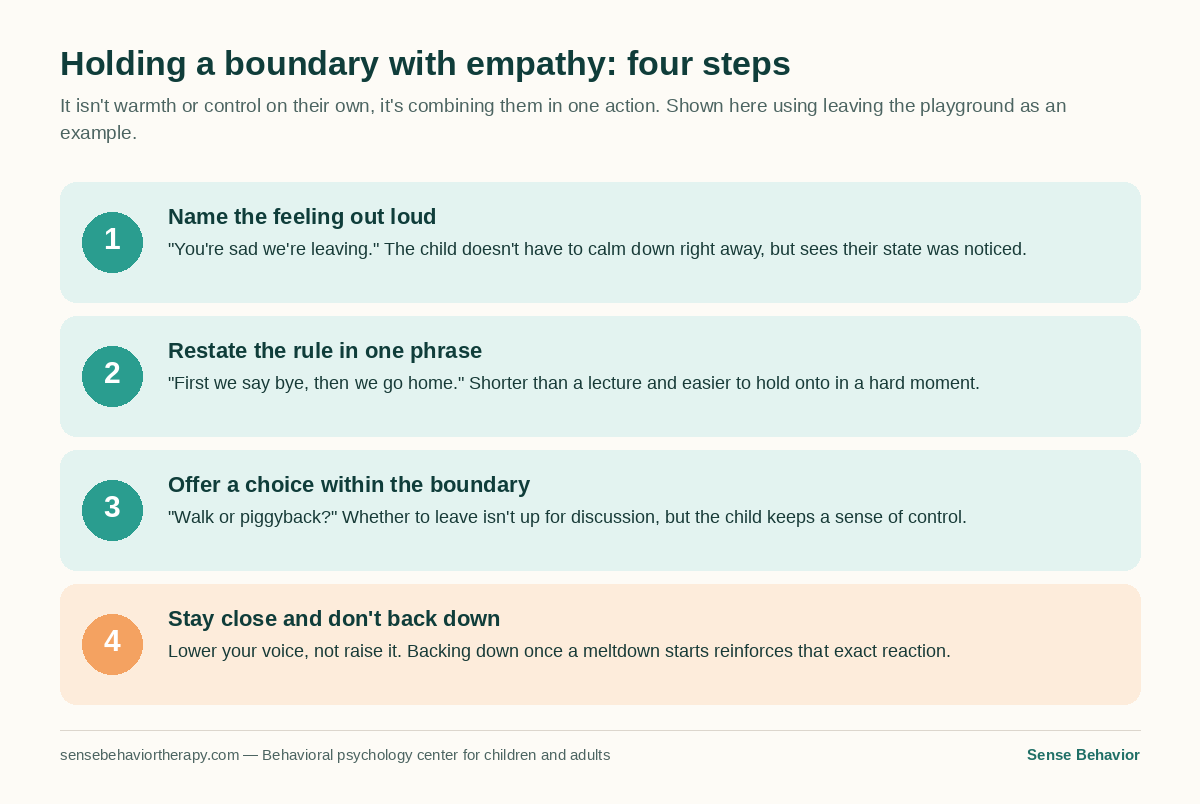
In practice this isn't an abstract principle, it's a concrete sequence you can repeat in any similar situation: time to turn off a tablet, leave the playground, brush teeth. Here's what it looks like using leaving the playground ten minutes before rain as an example.
- Name out loud what you're seeing. Not «stop crying,» but «You're sad because we're leaving and you wanted to swing more.» The child doesn't have to calm down immediately from this phrase, but it shows their state was noticed, not ignored.
- Remind them of the rule in one short phrase. Not a lecture about why routines matter, but «First we say bye to the swings, then we go home.» The «first, then» formula from ABA works better than a long explanation precisely because it's easier to hold onto at the moment things are already getting hard.
- Offer a choice within the boundary, not instead of it. Not «can we stay a bit longer?» (that cancels the rule), but «Do you want to walk or get a piggyback ride?» Whether to leave isn't up for discussion, but the child keeps a sense of control over something, in a situation where they otherwise have very little of it.
- Stay close and don't back down. Get physically down to the child's level, lower your voice rather than raising it if they're screaming, and don't reverse the decision even if the protest gets louder. Backing down once a meltdown has started teaches, in practice, that a stronger protest cancels the rule, which reinforces exactly the reaction a parent is trying to move away from.
What most often breaks this balance
Even with good intentions, the balance shifts easily toward one side, and it's usually exhaustion in the moment rather than not knowing better. The most common mistake is changing the rule in the middle of a meltdown because it's faster and quieter right now. In that moment, the child learns not that the adult is kind, but that crying of a certain volume and length cancels any «no.» Next time, the threshold has to be crossed again, and it sits a little higher.
The second most common mistake runs the other way: punishing the tears or the crying itself, rather than a specific action like hitting or throwing something. If a child gets the same harsh response for crying as for hitting, they quickly stop telling the two apart, and over time they stop showing that they're struggling at all, which doesn't remove the overload, it just hides it from the adult.
A third mistake that rarely gets mentioned: explanations that run too long exactly at the moment of overload. A calm talk about why a rule exists works fine over a relaxed breakfast, but during sensory or emotional overload a child is physically unable to process a long stream of words. That's where the short formula from step two earns its place: the fewer words used in a crisis moment, the better the odds they'll actually land.
If boundaries still don't hold even when you're doing everything right
Sometimes the four steps above don't work, not because they were applied wrong, but because there's a function behind the specific behavior that needs to be understood first. A child might run off not out of stubbornness, but because running off has previously worked to end an unpleasant task, or because every departure from the playground happens to coincide with sensory overload that's been building all day already. In cases like that, holding the boundary well isn't enough on its own, a behavior plan has to be built around whatever is actually maintaining the unwanted response. How to identify that function is covered in detail in a separate article: the function of a child's behavior. At Sense Behavior, a specialist starts by looking at that function first, not just the behavior itself, and works with the parent to put together a specific plan for the situation: what to say, when to hold a pause, and when to change the environment before the behavior even happens.
You can start with a free thirty-minute consultation, where we'll walk through the specific situation in your family and suggest which step makes sense to start with in your case.