Autism in girls: why diagnosis comes later, and what to watch for
Autism in girls has become one of the most talked-about topics among specialists and parents worldwide in 2026, and there's a concrete statistical reason for that. For a long time, autism was thought to be far more common in boys than in girls, but newer data paints a more complicated picture: girls aren't necessarily fewer, they're more often diagnosed later and differently. For the parent of a girl who's long sensed that something wasn't quite adding up, but couldn't get anyone to confirm it with an actual diagnosis, this isn't abstract statistics, it's an explanation for years of lived experience.
Why girls are more often diagnosed later
Classic diagnostic criteria for autism were originally built mostly from samples of boys, so they're better tuned to catch the presentation that's more typical in boys: clear speech difficulties, visible repetitive movements, narrow interests that stand out as unusual to peers. Autism in girls often looks different. Many girls learn from an early age to imitate the behavior of their peers, copying expressions and rehearsed phrases to appear socially successful on the outside, while the interaction underneath stays just as hard and energy-draining as it does for boys with more obvious signs. This is usually called masking or camouflaging, and it's exactly why outward signs in girls often go unnoticed until adolescence.
What the research shows
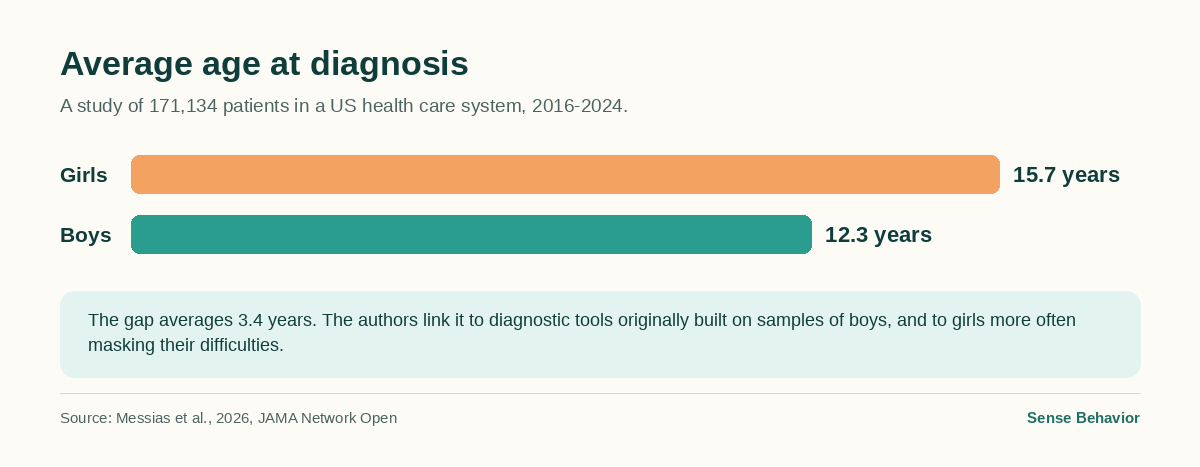
In 2026, a large study of 171,134 patients within a single US health care system covering 2016-2024 was published (Messias et al., 2026). New diagnoses among boys stayed stable or declined over that period, while diagnoses among girls rose sharply starting in 2020. At the same time, the average age at diagnosis was 15.7 years for girls versus 12.3 years for boys, a gap of nearly three and a half years. The authors link this not to autism «appearing» later in girls, but to it going unnoticed for longer.
What to watch for in girls
The signs worth watching for in girls often look softer and more socially acceptable than the classic checklist, and that's exactly why they're easy to write off as shyness or a sensitive temperament.
- Exhaustion after socializing that seems out of proportion to the event. An ordinary school day looks fine from the outside, and then exhaustion, irritability, or a full shutdown from contact follows that evening or the next day.
- Meltdowns almost exclusively at home. A girl holds it together at school or daycare, and all the built-up tension only comes out around the people she's closest to, because home is the one place she doesn't have to keep masking.
- A narrow but socially approved interest. A deep fixation on horses, a particular book series, or a specific singer can look like an ordinary girlhood hobby, while actually taking up just as much time and attention as a more «typical» narrow interest in boys.
- Scripted friendship rather than felt closeness. A girl might be part of a friend group and copy its norms precisely, while describing friendship as a set of rules to follow rather than something that comes naturally.
What to do if this description sounds like your daughter
None of these signs is a diagnosis on its own, and only an in-person assessment by a specialist familiar specifically with the female presentation can tell where a personality trait ends and autism begins. If a specialist you've already seen focused mainly on the classic criteria that stand out more in boys and said there was nothing to worry about, that isn't always the final word, especially if the sense that something doesn't add up hasn't gone away for you as a parent. Not having an official diagnosis doesn't stop you from starting to work out which specific skills and situations are harder for your daughter than others, even before a diagnosis is confirmed or ruled out.
You can start with a free thirty-minute consultation, where we'll walk through how a skills assessment works for girls with suspected autism and what a reasonable first step looks like in your situation.