Autism diagnosis in Bulgaria: where to go and how long the wait really is
Autism diagnosis in Bulgaria works differently than in many countries families are moving from, and the first practical question usually comes down to a simple one: who do you actually see. In Bulgaria, only a child psychiatrist is authorized to give a formal autism spectrum diagnosis, not a neurologist, psychologist, or pediatrician alone, and understanding that from the start saves time.
Who diagnoses and how
A formal evaluation usually involves several specialists at once: a child psychiatrist, a neurologist, and a clinical psychologist, and sometimes other professionals if the picture is unclear. Different families reach a diagnosis through different paths: some parents sign their child up for a diagnostic evaluation themselves, while others receive a referral from a pediatrician who first notices warning signs of atypical development. As standard practice, an autism diagnosis in Bulgaria typically isn't given before age three, even when warning signs are noticeable earlier.
How long the wait actually is
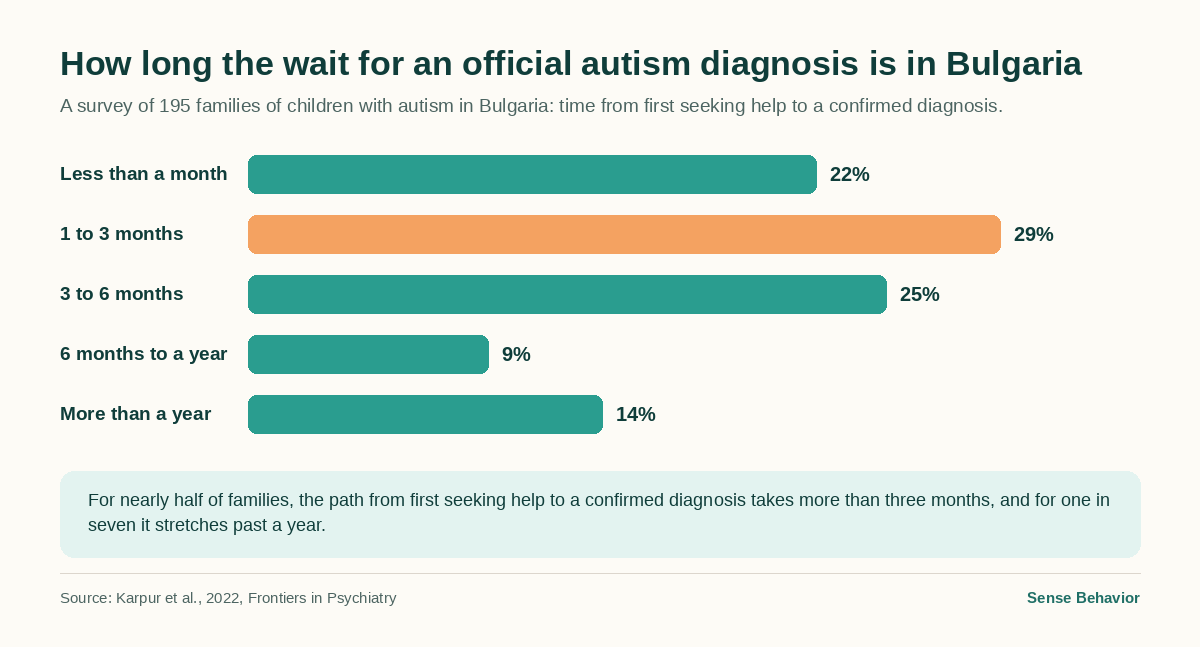
A 2022 study surveying 195 families of children with autism in Bulgaria found that the path from first seeking help to a confirmed diagnosis varies widely: for 22% of families it took under a month, but for nearly half it stretched to three months or more, and for 14% of families it took over a year.
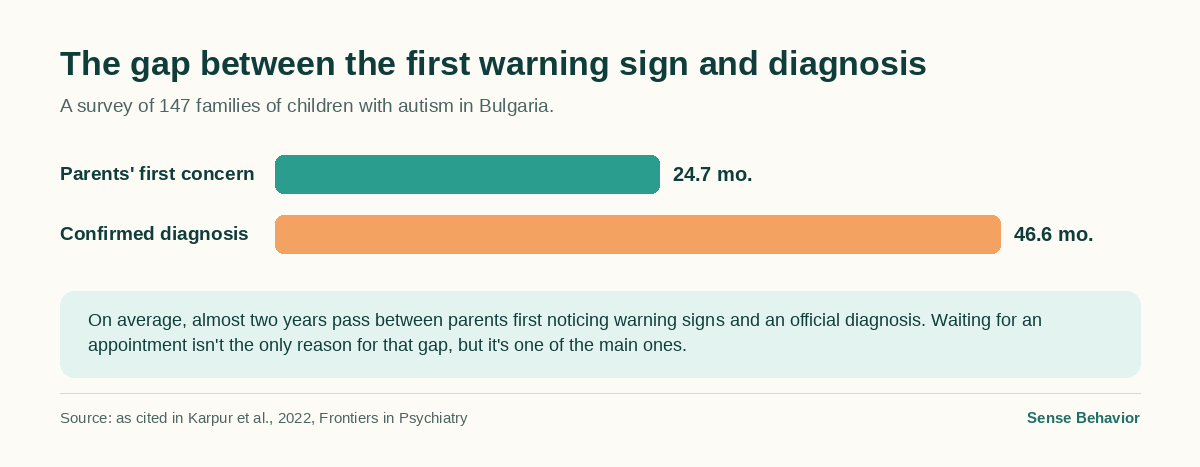
An earlier study the authors of this paper reference gives another useful reference point: on average, parents first become concerned about their child's development at around 24.7 months, while an official diagnosis is only given, on average, by around 46.6 months, a gap of nearly two years between the warning sign and the diagnosis.
There's also good news
According to the same 2022 study, 66.5% of families received their diagnosis right in their own town or village, and another 31.3% did so within the country, without needing to travel abroad. That's a noticeable improvement compared to earlier years, when, according to an older survey, half of families had to travel over 100 km to reach a diagnostic appointment. Access to diagnosis in Bulgaria is gradually improving, even if wait times are still far from ideal.
What you can do while the queue is moving
Waiting for an official diagnosis isn't a reason to delay support. A VB-MAPP or ABLLS-R skills assessment doesn't require a Bulgarian diagnosis in hand and can start right now, in parallel with your psychiatrist appointment, rather than after it. If you haven't come across this kind of testing before and aren't sure what it would even show, the difference becomes clearer in what VB-MAPP testing is.
How this factors into Sense Behavior's programs
We start working with a child based on our own behavioral assessment, not only an official Bulgarian diagnosis, so months spent in the queue don't have to become months of doing nothing. If you've just received a diagnosis or are still in the queue and aren't sure where to start, our article on how to accept your child's diagnosis and our breakdown of the first 30 days after diagnosis may help.
You can start with a free thirty-minute consultation, where we'll talk through what can actually be done for your child right now, regardless of what stage of the Bulgarian diagnostic process you're at.